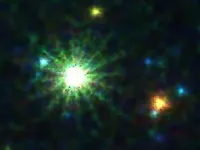
ESA's X-ray observatory XMM-Newton revealed the existence of a magnetic field around the young star AB Aurigae.
Via ESA
At 2.7 times the mass of the Sun, AB Aurigae is one of the most massive stars in the Taurus-Auriga star-forming cloud. It is usually classified as a Herbig star.
As observed with XMM, the star was emitting X-rays. These rays are expected to come from young stars with powerful magnetic fields, but computational calculations repeatedly suggest that Herbig stars do not have the internal conditions to generate an appreciable field. Where could these rays be coming from, then?
Some astronomers suggested they might come from a companion. However, when an international team led by Manuel Güdel and his graduate student Alessandra Telleschi, from the Paul Scherrer Institute in Switzerland, analyzed data from AB Aurigae, they found that the temperature of the gas producing the X-rays was between one and five million degrees Celsius. According to Güdel, this is suspiciously low. Young stars like the Sun possess gaseous atmospheres that are heated to 10 million degrees and more by their magnetic field.
Güdel and his team found another clue that the X-rays should come from the star itself: the rays vary in intensity every 42 hours, and the star's optical and ultraviolet light varies with the same period. This would confirm that the rays come from AB Aurigae and not from a companion. But how does it generate them?
To look for an explanation, Telleschi and her colleagues examined the high-resolution data of AB Aurigae taken with the orbital observatory. There they searched for some spectral fingerprint that could tell them where the X-rays might be coming from.
To their surprise, they found that the rays are emitted from very deep below the star. They expected it to be much closer to the surface. This means that the gas flowing out from the star, called stellar wind, from two different hemispheres, is likely being guided into a collision. And the only thing that can do that is a magnetic field. It wouldn't be a very strong one, but there should be one after all.
Fortunately, a group of astronomers who developed a magnetic field model for this class of stars also worked on the team, so they contributed their knowledge.
Together, the team proposes that the enormous collapsed gas pocket that ended up being AB Aurigae dragged with it part of the magnetic field, now trapped inside the star and pushing the stellar winds together, which must collide to create the X-rays.
Whether this explanation is applicable to other Herbig stars is a good question that still has no answer.