The mass of frozen water found on the red planet would be enough to cover the entire Martian surface with a liquid layer 11 meters deep.
The Cassini probe has discovered immense seas, probably of methane or ethane, in the northern regions of Saturn's moon Titan.
Via El País and Universe Today
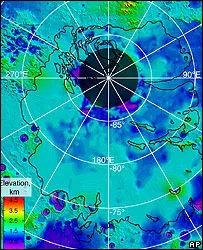
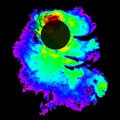
The Mars Express probe has discovered an enormous mass of frozen water beneath the Martian south pole, as revealed today by NASA's Jet Propulsion Laboratory (JPL). In a statement, JPL indicates that this polar region contains enough frozen water to cover the entire surface of the planet with a liquid layer 11 meters deep. "The deposits of the south pole of Mars cover a region larger than the surface of the state of Texas. The amount of water they contain had been calculated before, but never with such precision," according to Jeffrey Plaut, a scientist at JPL.
The Mars Express mission is a joint operation of NASA and the European Space Agency, and the ice mass was detected by the Mars Advanced Radar for Subsurface and Ionosphere Sounding (MARSIS). That instrument, developed jointly by NASA and the Italian Space Agency, is also investigating the thickness of similar deposits at the Martian north pole, according to JPL.
The JPL statement quotes remarks by Giovanni Picardi, of the University of Rome La Sapienza and principal investigator in charge of the instrument, who states that "MARSIS is proving to be a very powerful instrument for investigating beneath the surface of Mars."
The polar ice caps contain most of the existing water on Mars, even though there are other areas that appear to have been wet in the past. "Understanding the history and fate of water on Mars is key to understanding whether the planet had life, since all life depends on liquid water," stated NASA's Jet Propulsion Laboratory.

And on a moon of Saturn too
The Cassini probe has discovered immense seas, probably of methane or ethane, in the northern regions of Saturn's moon Titan, NASA announced. Those seas are represented by black shadows in the probe's radar and some are larger than many terrestrial seas, the space agency said in a statement.
Titan is the second natural satellite of Saturn and is a bit larger than the Moon. "We have long hypothesized about oceans on Titan and now with multiple instruments we have indications of seas that dwarf the lakes we had seen before," says Jonathan Lunine, a mission scientist at the University of Arizona.
NASA indicated that so far there is no conclusive indication that there is any kind of liquid in those seas. However, due to the prevailing conditions on Titan, they are likely a combination of methane and ethane, gases that are abundant in that moon's atmosphere.
The probe has also revealed the presence of plumes of water and vapor at the south pole of Saturn's moon Enceladus, which originate from a hot source of radioactive material in its interior.
According to a study presented at the Lunar and Planetary Science Conference in Houston, Texas, that moon brings together the crucial ingredients for the formation of life as known on Earth. The geysers were detected by Cassini in 2005 at 200 degrees Celsius below zero.