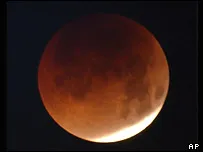
Unfortunately, in metropolitan areas the eclipse could not be seen due to the amount of clouds. In other parts of the country, such as Bariloche, it could be seen and recorded. Other parts of the world were more fortunate.
The eclipse began at 20:18 GMT and the Moon was completely immersed in Earth's shadow between 22:44 and 23:58 GMT.
During the total eclipse, the Moon turned red due to the light filtering from Earth's atmosphere onto the lunar surface.
The eclipse was visible throughout Europe, Africa, South America and the eastern United States and Canada.
The United Kingdom was one of the fortunate ones that could enjoy the eclipse due to a clear sky, a privilege not had by other states where the weather did not help them.
Lunar eclipses occur when the Sun, Earth and Moon are in an almost perfect line in space, and Earth comes between the Sun and the Moon.
The Moon travels through the long cone-shaped shadow that Earth casts into space and the only sunlight it receives is through that which filters from Earth's atmosphere.
The appearance of the lunar surface varies according to the amount of dust in Earth's upper atmosphere.
For example, after large volcanic eruptions, the Moon appears a deep red and almost invisible.
Considering that there have been no large eruptions recently, astronomers predicted that the Moon would be bathed in a strong orange light.
The red Moon could be observed over Lake Nahuel Huapi, from the city of Bariloche
In Argentina, the phenomenon, accessible from all provinces, could not be seen in a large part of the country, due to the clouds and rains that affected the metropolitan area and the central and northeastern regions. Even so, the phenomenon could be observed by thousands of people from cities such as Bariloche (see photo) or Mendoza.
Shortly after 19:15 the expectation grew at the Galileo Galilei Planetarium to see Earth's natural satellite redden under its shadow, but the high clouds deprived those interested of the celestial spectacle.
The expectation lasted well into the night, during the span when the viewing of the natural phenomenon was expected, to hope that the closed group of clouds, at some point, would allow the shadowed moon to be seen.
For this purpose, a vigil was kept at the Planetarium, but the efforts were fruitless. The forecasts that already indicated worsening weather, with a drop in temperature, had already discouraged the public from showing up both at the Planetarium and the Parque Centenario observatory.
The phenomenon was going to be visible from all of South America between 19:45 and 21:00, a span during which the Moon crossed the cone of shadow that Earth projects into space.
The last lunar eclipse was 28 months ago, so the one last night Saturday was eagerly awaited by astronomy enthusiasts and nature lovers.
The coordinator of the Astronomy area of the Buenos Aires Planetarium, Mariano Ribas, explained that the eclipse, "the full Moon, but shaded and with a very particular orange color".
After this Saturday's eclipse, the next one that will be seen in western Europe will occur on February 21, 2008.
In La Nación: Yesterday, the red Moon dazzled millions across almost the entire planet
In Infobae: Bad weather left Porteños without a lunar eclipse
In Clarín: Rain left Porteños without seeing the awaited lunar eclipse
In Río Negro: The lunar eclipse fascinated the region
In Bolivia: Diario La patria: Total lunar eclipse was seen clearly in Oruro
ElCaribeCDN: Dominicans observe total lunar eclipse