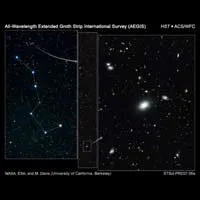
Hundreds of images taken by NASA's Hubble Space Telescope have been woven into a rich tapestry of at least 50,000 galaxies.
The orbital observatory's vision is providing new clues about the youth of the universe.
Via HubbleSite
Among the discoveries of this galactic tapestry are a giant red galaxy with two black holes in its nucleus, several gravitational lenses, and a gallery of rare galaxies that will keep astronomers busy for a good while trying to explain them.
The panoramic view, achieved by weaving together many separate exposures, is of only a small part of the sky. The total width of the image, in angular size, is no greater in the sky than the apparent width of a finger with the arm extended. However, for astronomers it is a large celestial fragment.
To cover this field, the Advanced Camera for Surveys took more than 500 separate exposures at 63 different points, over a year. The final mosaic is 21 images long by 3 high. (The dimensions in degrees are about 1.1 by 0.15 degrees. For comparison, the Moon is about 0.5 degrees in angular size)
The Hubble observations are part of the All-wavelength Extended Groth Strip International Survey (AEGIS), which involves the use of several telescopes and more than 50 researchers around the world, observing the same small portion of the sky at different wavelengths.
The goal, according to one of the project leaders, Marc Davis of the University of California at Berkeley, is to study the universe as it was when it was half its present age, or about 8 billion years ago.
In a paper, now online in Astrophysical Journal Letters, Davis and his colleagues noted that AEGIS is providing a unique combination of deep, intense observations, contrasting their work with that of the Sloan Digital Sky Survey, which observed the local universe in great detail, but focusing on the last 2 billion years of cosmic evolution.
A total of 19 papers based on the Groth Strip Survey will appear in a special edition of ApJ Letters and in its online version at http://www.journals.uchicago.edu/ApJ/.