The more massive the galaxy, the faster its gas and stars will move. This relationship holds whether the galaxy is elliptical, spiral, or of some strange shape, according to a new study.
Via UsaToday
This rule would even apply to the remnant of galactic collision and merger.
The new discovery, to be detailed in the next edition of Astrophysical Journal Letters, shows that the relationship between the mass of galaxies and the orbital speed of their stars and gases is remarkably consistent across a wide range of galaxy shapes and over billions of years of galactic evolution.
The researchers analyzed 544 distant galaxies of different shapes and from different epochs in the history of the universe. The analysis team used a new method for measuring the internal motions of galaxies proposed by Benjamin Weiner, a postdoctoral researcher at the University of Arizona.
This relationship was already known for spiral galaxies under the name of the Tully-Fisher relation. Another general rule, called Faber-Jackson, says the same regarding ellipticals.
The latest research goes a step further and extends the relationship between mass and orbital speed to galaxies of all shapes and up to 8 billion years old, when galaxies tended to be more distorted.
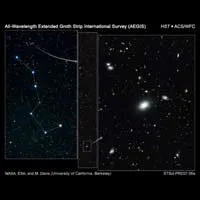
The galaxies were studied as part of the Groth Strip survey (AEGIS), an international collaborative effort of scientists and instruments which we discussed earlier in "A tapestry of 50,000 galaxies"