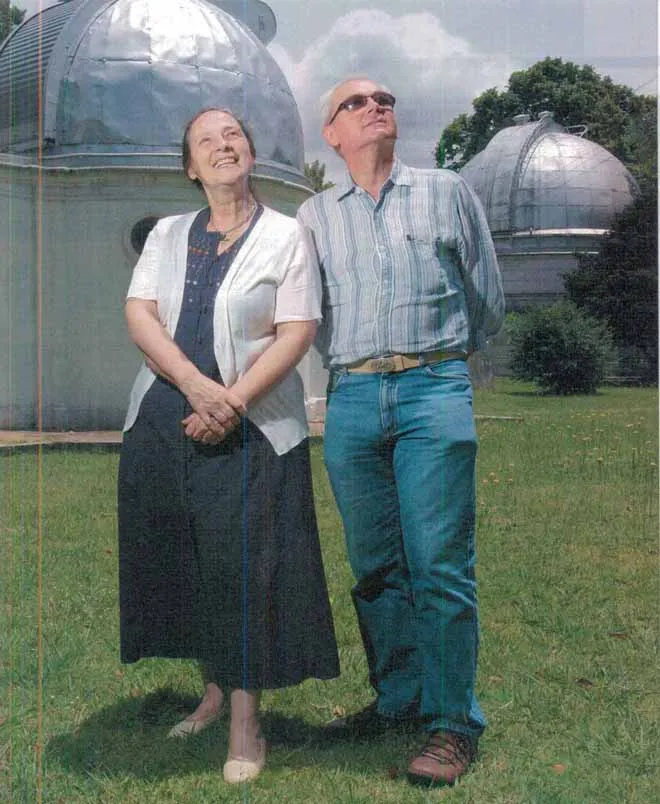
A married couple of Argentine astrophysicists who worked at the La Plata Astronomical Observatory will observe with a complex telescope located in Mexico the first heartbeats of the Universe after the big explosion.
Via Revista Viva
Revista Viva No. 1613 04-01-2007
Text Marina Aizen ([email protected])
Photos Hernán Rojas
Let's think of a totally dark sky, without any stars. What would become of poets or lovers? This landscape may seem desolate, but when Elena and Roberto Terlevich describe it, their eyes literally fill with light. We are talking about when the Universe was barely a gestating embryo. To the married astrophysicists from La Plata, this phase of the cosmos obsesses them like detectives after a serial killer. And their research tool will be the Large Millimeter Telescope (LMT), a new, very new instrument, capable of uniquely recording the relics of the primordial explosion: the Big Bang. The LMT is located on a mountain in the state of Puebla, Mexico, near Cholula, a place that was a ceremonial center and that Hernán Cortés destroyed with malice during the conquest. Now, the LMT site, the Sierra Negra Volcano, is the pedestal to reconquer the most remote of pasts. That which not even Cortés could conceive.
Elena and Roberto seem just as in love as when they met in a physics class at the University of La Plata. The story of how they ended up at the LMT, an instrument that promises to open authentic highways in man's knowledge of the Universe, has a scientific side and a rather earthly one. It began in 1976, when she, who was doing a doctorate at the University of La Plata, was fired overnight and even had the lock on her office changed so she couldn't enter. Then, in November of that year, he also lost his job at the Institute of Astronomy and Space Physics. Both acts were decoded as political vendettas of the military regime. Vendettas against people who had demanded elementary things like Conicet fellows being able to have retirement contributions (a right which even today, after so many years, they cannot enjoy).
One day, Roberto and Elena woke up frightened, when they heard men talking on walkie-talkies. They saw an orange light over a car through the curtains. They thought a commando was coming for them. It was natural: there were shootings in La Plata every day. They went to get the kids. They were terrified.
But in the end they discovered it was all an Automóvil Club roadside assistance. It was clear; it was time to leave. They didn't want to live in fear.
The destination was Cambridge, England. There they were received by Martin Rees, an eminence, who today is president of the Royal Society, Astronomer Royal and Master of Trinity College, among other things. 'How can we manage to stay here to do a doctorate?', they asked. For the English code, that was such a direct request that it could have been interpreted as politically incorrect. But they had come there to stay. And, through hard work, they ended up earning their doctorates at that, Newton's University.
Later, he ended up at the Royal Greenwich Observatory until it was closed by Margaret Thatcher herself. And she held positions at the University of Sussex, the Royal Greenwich Observatory and the University of Cambridge until she was called to set up, together with Mexican colleagues, a group for cosmology and extragalactic astrophysics, fundamental for the LMT. Now they live half the year in Cambridge and the other half in Puebla, working on this, which is the largest scientific project in Mexico, done in cooperation with the University of Massachusetts, in the United States.
The smell of eucalyptus from the forest comes in through the window of the old office, refreshing the hot morning. The La Plata Astronomical Observatory not only continues to produce science, but is also a little architectural gem that translates the enthusiasm that Argentines had at the end of the 19th century to know the Universe. Roberto, who lived on this very grounds, recognizes with an air of respect the instruments with which he once worked looking at the sky, although today he has at his disposal instruments that are the latest in science.
Once someone told them: 'What you do is not a job, it's a passion.' And it shows when both, with infinite patience, explain what they will do with the LMT.
THE GREAT OVEN
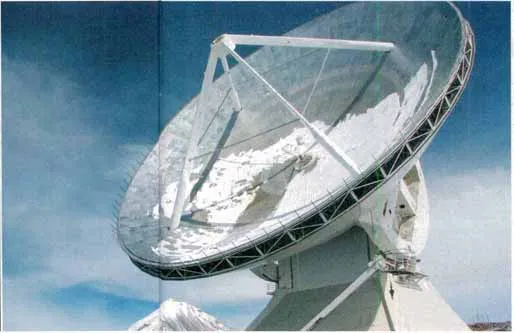
Seen from afar, the LMT does not look anything like a traditional telescope but rather like a huge satellite antenna or a giant cone spitting upwards. The reason it is on that Mexican mountain is that to make millimeter observations you need a pristine atmosphere, with very low humidity. This is achieved above 4,000 meters in altitude. It sounds very pompous to say millimeter waves, but in reality these are nothing more than the same waves produced by a microwave oven, like the one we have in the kitchen to heat up yesterday's food.
This telescope, however, serves to observe very cold objects, which are the ones that emit millimeter waves. In that category falls, for example, the entire Universe. It's that as it expanded after the first seconds of the Big Bang it also cooled down. The first nuclei formed and after about 100,000 years, all the electrons that were floating around joined those nuclei to form the first atoms or chemical elements - hydrogen and helium. At that moment the cosmos became transparent.
The Universe does not stop expanding. What's more: it does so faster and faster and becomes colder. 'To see the more and more distant past, detectors are needed that see colder things. The farthest we can see is precisely when the Universe became transparent,' says Roberto.
'That happened 15,000 million years ago and we can see it with a millimeter telescope,' he adds.
'You can see the Universe as it was before the first stars or oxygen and carbon existed, elements that formed in stars,' Elena completes. 'With the LMT we will be able to see from new extrasolar planets to the formation of stars and galaxies, the relics of the Big Bang,' she says.
And what happened before the Big Bang? Like so many other questions in this life, there is no certain answer. It is territory for speculation or religion, not for science, she states. "For before the Big Bang there are no physical laws, nor a model that allows us to predict observations. There was neither space nor time. And for now, there is no way to verify it," adds Elena. We'll have to stick with the big bang. Still, it's no small thing.
The GTM in all its splendor (above).
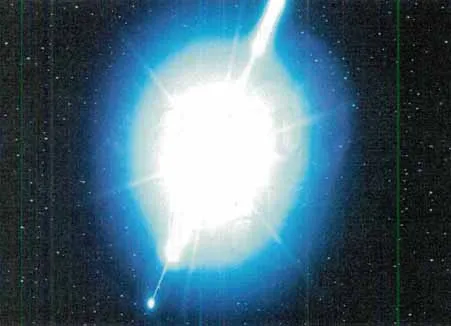
NASA illustration of gamma rays that could be seen with the GTM (below).
http://es.wikipedia.org/wiki/Gran_Telescopio_Milim%C3%A9trico