In July 2005, the Deep Impact spacecraft launched a probe that impacted comet Tempel 1 to discover its composition. The aggression was justified because comets are remnant objects from the formation of the solar system, so learning more about them is understanding better the formation of our stellar neighborhood.
Via Physorg
Since then, the spacecraft has been sailing silently through space, in good condition and capable of performing another mission, if necessary. The Deep Impact team realized that with the spacecraft it was possible to make extra discoveries at low cost, a bonus from a mission that was already successful.
The team proposed using the spacecraft's telescope to observe the atmospheres of exoplanets and to visit another comet. The mission extension proposal is called EPOXI (Extrasolar Planet Observation and Deep Impact Extended Investigation, that is, Extrasolar Planet Observation and Deep Impact Extended Investigation).
The proposal has already received $500 thousand from NASA for the initial study to determine the requirements and costs of the extension.
If approved, while the spacecraft passes Earth on December 31 of this year, it will use the planet's gravity to head towards comet Boethin. While traveling towards the comet, the first part of the extension - the investigation of other worlds - would begin in January 2008. More than 200 exoplanets have been discovered to date. Most of these are detected indirectly, by the gravitational pull they exert on their star. Direct observation is very difficult due to the brightness of the star compared to that of the planets.
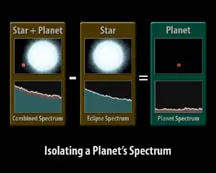
The diagram illustrates how astronomers capture the elusive spectrum of extrasolar planets.
However, sometimes, due to a change in an exoplanet's orbit, they become aligned so as to eclipse their star. In these rare cases, it is possible to observe these planets directly. "When the planet appears near its star, your telescope captures their combined light. When the planet passes behind, your telescope only sees light from the star. By subtracting the star's light from the combined light, you are left with the planet's light. We can analyze this light to discover what the atmospheres of these planets are like," said Drake Deming of NASA's Goddard Space Flight Center, Principal Investigator for EPOXI.
Around May 2008, the extended mission will begin its second phase as the spacecraft approaches comet Boethin. By mid-December of that year, Deep Impact is 700 kilometers from the comet traveling at 10 kilometers per second, so it will only have about a dozen hours to perform detailed observations.
"The comet that was impacted by the spacecraft, Tempel 1, was unusual compared to others," said Michael A'Hearn of the University of Maryland, Investigator for EPOXI. "For example, it seems as if several pieces had come together to create the comet's nucleus. Second, comets vent gases as they approach the sun and heat up. Tempel 1 did that too, but in an unusual way. Water vapor appeared all over the nucleus, as expected, but carbon dioxide only in certain parts. Third, there are certain smooth areas on the nucleus, as if something had flowed there. Finally there are circular areas as if they were craters. However, craters have not been seen on any other comet visited so far. We want to see Boethin up close to see if the surprises of Tempel 1 are more common than we think or if that comet is truly unusual"