An American scientist said he detected water in the atmosphere of a planet outside our Solar System.
Via BBC and NASA
If the conclusions of astronomer Travis Barman, from the Lowell Observatory in Flagstaff, Arizona, are correct, it would be the first time water has been discovered on a planet of another star.
The planet, known as HD 209458b, is a gas giant similar to Jupiter, located 150 light-years from Earth, in the constellation Pegasus.
In a study released in February, other researchers had said they could not find indications of the existence of water in the atmosphere of this planet or in that of another similar one.
However, in an article published in the specialized journal Astrophysical Journal, Barman said he found evidence that there is water absorption in the atmosphere of HD 209458b.
His conclusions were based on an analysis of measurements made with the help of the Hubble Space Telescope by an astronomer from Harvard University, United States, Heather Knutson, and on new theoretical models that he himself developed.
Is there life?
Barman noted that the result of his research allows us to infer that other planets outside the Solar System also have water vapor in their atmospheres.
"I feel very confident," he said, "it is undoubtedly good news because the existence of water in the atmosphere of this planet and in those of many others had been predicted for a long time."
The astronomer added that it is very unlikely that there is life on gas planets like this one.
"Understanding the distribution of water in other solar systems is important for understanding whether or not life is possible," he said.
Great proximity
The main difficulty in detecting water and other components on planets like this one is the great proximity with which they orbit around their stars.
The heat generated by the star is so great that the planet's outer atmosphere expands and tries to escape its gravitational force.
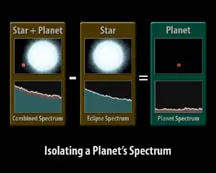
Barman's research is based on the fact that HD 209458b, seen from Earth's perspective, passes directly in front of its star every three and a half days.
When a planet passes in front of its star, its atmosphere blocks a different amount of light from it, at different wavelengths.
In particular, the absorption of water in the atmosphere of a giant planet makes it appear larger in a specific fragment of the infrared spectrum, compared to the wavelengths of the visible spectrum.