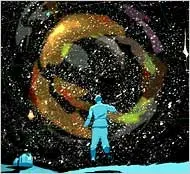
Physicists are predicting the death of cosmology, the study of the universe, as we know it. However, cosmologists are not out of work for a few billion years.
The universe is rapidly expanding so that distant galaxies will eventually move faster than light.
A few billion years from now, how will future intelligences inhabiting the universe study it if the human race were long extinct? Will they be able to rediscover relativity or if the Big Bang occurred?
Via Dave Mosher, Space.com
According to Lawrence Krauss, a theoretical physicist at Case Western Reserve University in Ohio, and co-author of a paper in the upcoming issue of The Journal of Relativity and Gravitation, future observers will not be so lucky.
"They will be stuck in an endless black void. In 100 billion years, everything -except the galaxies in our local group- will have disappeared for them. They will feel very special after that, because our small group of galaxies will be the entire observable universe then."
Without a cosmological frame of reference, explains Krauss, future observers will have no clues that their universe would still be expanding. "It would be a kind of strange situation, where thought would go back to where it was in the 20th century."
In other words, observers will think that the universe is just a static -or non-expanding- cluster of galaxies, as scientists thought until the '20s. "The static universe will return for revenge."
Another issue for those hypothetical future observers would be the disappearance of the cosmic microwave background radiation, the footprint of the Big Bang, in about 250 billion years. Without that footprint, commented Krauss, observers will have no certainty of how the universe was created, not to mention when.
The problem relates to the Doppler effect: when a fast train approaches, the sound wave of its whistle narrows and the pitch rises. As it passes, the waves lengthen and become lower until they are lost. Similarly, as the universe expands, the "pitch" of the light's wavelength will lengthen until it is lost. "The light wave will be so long that eventually it will be the size of our universe, it will be absorbed."
Krauss, however, is optimistic that some form (presumably human) would be the next Einstein and would rediscover general relativity. He also hopes that future observers would be able to explain the creation of the solar system by studying the stars of the galaxy.
And, concludes Krauss, there is a positive side to not knowing the true history of the universe: "There will be no static on their televisions," explaining that if there are no distant galaxies around emitting cosmic rays, the air is much freer of interference.
The article in question is titled "The Return of the Static Universe and the End of Cosmology" will be published in October in the Journal of Relativity and Gravitation and was awarded by the Gravity Research Foundation.