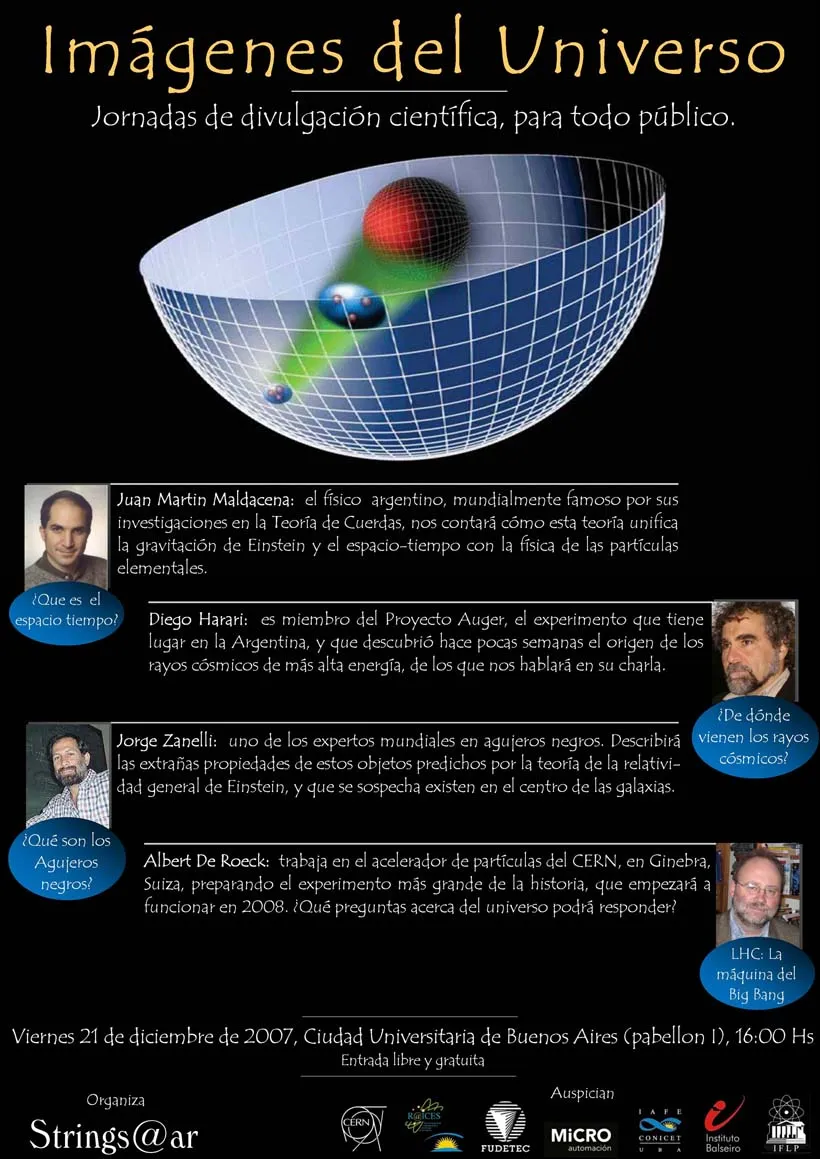
The young Argentine physicist Matías Zaldarriaga, a cosmologist who researches at Harvard University, gave a captivating talk at the Faculty of Exact and Natural Sciences of the UBA, where he graduated.
Via Agencia CyTA-Instituto Leloir. By Florencia Mangiapane
The young Argentine physicist Matías Zaldarriaga, who researches topics in cosmology at Harvard University and was distinguished at the end of 2006 by the MacArthur Foundation with a "genius" grant of half a million dollars, passed through the Faculty of Exact Sciences of the UBA, where he graduated as a licentiate, to give a talk before hundreds of students who listened with interest to what cosmologists do and what results they have obtained in recent times.
"We were not surprised that he earned his doctorate at the Massachusetts Institute of Technology (MIT) in three years, with a prize for the best thesis in Astrophysics. Nor were we surprised that he developed a tool for generating observations that made him famous in the world. We are not surprised that he is a professor at Harvard, nor that the MacArthur Foundation distinguished him for his contributions to cosmology. We knew Matías as a student and graduate of this house, and we know he is a very special guy."
This is how Juan Pablo Paz, professor of the Department of Physics of the Faculty of Exact and Natural Sciences of the UBA, introduced Matías Zaldarriaga (36) last May 10 before he began the talk "Other universes outside and inside ours" in the Aula Magna of the house of studies where he took his first steps in cosmology, until he left for the United States, in May 1995.
The Argentine researcher received his physics degree at Exactas and completed his doctorate at MIT under the direction of Professor Uros Seljak. In the 12 years he has been out of the country, he has been especially interested in the properties of the cosmic background radiation, those remnants of light left over from the dawn of the universe, discovered experimentally by Arno Penzias and Robert Wilson in 1965.
The traces of the past
"Cosmology is a branch of physics that deals with understanding the universe, but it is quite similar to archaeology, because it aims to understand history from fragments that reach our days," explained Zaldarriaga to the audience, composed mostly of high school students and those recently entered the university.
The activity, organized by the Department of Physics and the Area of Popularization of Knowledge and Articulation with High School of the Secretariat of Extension of Exactas, aimed to bring knowledge about the universe and galaxies to the general public, and especially to high school students.
"I try to make people realize that what we do, which may seem complicated, is the same thing they would do if they could do it. How would they do it? Using the scientific method, doing experiments to solve questions that seem very sophisticated, but are almost common sense," commented Zaldarriaga to Agencia CyTA with a good dose of modesty.
Throughout the talk, the scientist highlighted that in the last century and a half cosmology has made great advances. The first measurements, based on counting stars in different directions, detected a small cosmic piece around the Sun. "Today it is known that that piece observed back then is just a part of our galaxy, and that many other galaxies exist," said Zaldarriaga, pointing to a recent full-color map taken by the WMAP probe.
"The most important discovery in cosmology is the expansion of the universe. This finding implies that the universe was changing. For example, galaxies did not always exist. In the past the universe was denser and hotter," said the young scientist, recalling that light coming from distant points takes time to reach us, so by observing what is farther away astronomers can see how the universe was back in time.
"The oldest photo," continued Zaldarriaga, "is the one that portrays the intensity of the cosmic background radiation, when the universe was about 400,000 years old. Today the age of the universe is 13,800 million years."
Universes from here and there
Why can it be said that there are many universes within ours? Because although the universe is expanding, in the past its objects were farther apart from each other. "By looking at different little pieces of the young universe, we observe that they were actually many separate universes," indicated the researcher.
"Objects that are not visible today probably will not be able to be seen in the future either," he added, "because this is the era when the greatest expansion of the universe is visible. It is speculated that the non-visible part is a 'multiverse,' governed by other laws of physics."
When it came time for questions, the audience's curiosity did not wait. At what speed is the universe expanding? What shape does it have? What are black holes like? Does time exist outside the universe? Those were some of the questions posed by adults and kids. Zaldarriaga broke down the issues one by one and even allowed himself to introduce a dose of humor: "No one has jumped into a black hole and lived to tell the tale," he said, stealing laughter from the audience.
After the talk, Florencia, a 16-year-old high school student who arrived accompanied by her dad, commented: "I found it very interesting. I liked the way he explains things and also knowing that there are still several unknowns, for example, about the dark matter and dark energy that make up the universe."
Professor Juan Pablo Paz ended the activity with thanks to Zaldarriaga for his visit and encouraged the students to concern themselves with unraveling the keys to the cosmos. "Hopefully one day we will have Matías as a professor in this house and that in the future you can help us understand, among other things, what the universe is made of."
Matías Zaldarriaga's page
Canal Encuentro
(Suggested activities for High School and Polimodal)
Cosmology: The origin of the universe