A lustful string theorist is found by his wife with another woman. 'But darling,' he pleads, 'I can explain everything!'
I didn't invent the joke; it appeared in the satirical magazine The Onion. The incredible thing is that people understand it! Apparently the person on the street is familiar with current high-energy physics thinking to know that string theory—the idea that the ultimate building blocks of nature are quantized loops of strings, not point-like elementary particles—is our leading candidate for a theory that would, in effect, 'explain everything.'
Via Sean Carroll, Cosmic Variance Blog
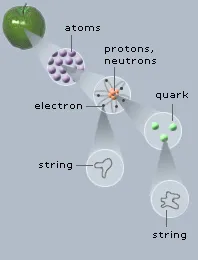
What is an apple? (or anything else)
Well, if you dig deep enough, string theorists say, you will find small, vibrating strings.
But, despite capturing the popular imagination, string theory has fallen on hard times lately, at least in public relations. We read articles like 'Hanging on by a Thread' (USA Today), 'Theorists snap over string pieces' (Nature) and 'The Unraveling of String Theory' (Time). Much of the attention given to skepticism about strings can be traced to books by Lee Smolin and Peter Woit that appeared last year. But those are not the only sources; increasingly, professional physicists are willing to pronounce the failure of the ambitious project of string theory to unite all the forces of nature.
So, is that it? Is string theory on its last breath? No, not at all. At least, not if we measure the health of the field by more academic criteria. String theorists are still being hired by universities in substantial numbers; new graduates are flocking to string theory to do their doctoral theses; and, more importantly, the theory continues to be our most promising idea for bridging the gap between quantum mechanics and gravity.
String theory is unique; never has so much effort been dedicated to exploring an idea in physics without the benefit of direct experimental proof. A major reason for this has been the absence of experimental surprises in high-energy physics; for thirty years, the standard model of particle physics has withstood all challenges. But even that has not been enough to persuade theorists to think about the famously difficult problem of quantum gravity if string theory had not come along to present a surprisingly promising approach.
In the '70s it became apparent that string theory was a theory of quantum gravity, whether we liked it or not—certain vibrating strings have the right properties to represent gravitons, carriers of the gravitational force. Thus, this feature distinguished string theory from other approaches; while analyses in quantum gravity tended to run into dead ends, here was a quantum theory that insisted on gravity!
In the '80s the triumph of the Standard Model became complete, and the work of Michael Green and John Schwarz demonstrated that string theory was a consistent framework. Physicists who had never thought of dedicating themselves to quantum gravity quickly became immersed in string theory. True, there were five different versions of string theory, and they all lived in ten dimensions. The trick would be to find the right way to compactify those extra dimensions into the four we all know and love, and the connection to observation would be established.
That didn't happen, but the '90s were nevertheless a boom. It became apparent that those five versions of the theory were different manifestations of a single underlying structure, M-theory. Tools were developed, in certain special circumstances, to tackle the famous problem introduced by Stephen Hawking in the '70s—calculating the entropy of black holes. Incredibly, string theory gave precisely the right answer. More and more people became convinced that there was something true about this theory, even if we don't understand it very well, and even though the connection to experiments remained elusive.
Since 2000, progress has been slower. In the mid-'90s it seemed there was a revolution every month, and—perhaps not so surprisingly—that is no longer the case. Instead of finding a single way to go from ten dimensions to four, current ideas suggest we might be facing 10^500 or more possibilities, not exactly unique. It is possible—perhaps—that only a small number of those possibilities are close to the world we observe, so there are still concrete predictions to make. We don't know, and it could be an illusion.
The truth remains—the miracle that gets people excited about string theory in the first place has not gone away. The biggest obstacle to progress is that we don't understand string theory very well; it is a collection of bits and pieces that show suggestive promise, but they don't yet fit into a coherent whole. But it is a theory of quantum gravity, it is compatible with everything we know about particle physics, and it continues to provide new ways to start thinking about time and space.
Meanwhile, positive effects of string theory continue to proliferate. Ideas about higher-dimensional branes have reinvigorated model building in more conventional particle physics. It has provided numerous deep physical insights into pure mathematics. Cosmologists thinking about the early universe are increasingly paying attention to ideas from string theory. And a promising new approach has connected string theory with the dynamics of quark-gluon plasma observed in particle accelerators.
Ultimately, of course, string theory must make contact with data in order to remain relevant and interesting. But deep ideas don't come with an expiration date; that contact may come next year, within ten years, or in a century. Meanwhile, the relative importance of string theory within the high-energy physics community is poised to give a boost, as a result of the promise of the Large Hadron Collider to take us beyond the Standard Model with new experimental puzzles to solve. A resurgent interest in more phenomenological particle physics is already easy to discern in hiring patterns and the interests of graduate students.
But string theory is not going to disappear. Gravity exists, and quantum mechanics exists, and the two must be reconciled. Ambitious theoretical physicists will continue to pursue string theory, at least until an even better idea comes along - and even then, the chances are good that something of strings will be part of the final story.
Related links
Sean Carroll is a Senior Research Associate in the Department of Physics at the California Institute of Technology. He is the author of the blog Cosmic Variance where he reproduced the article he wrote for NewScientist, titled: "String theory: it's not dead yet" on May 19.
His website is http://preposterousuniverse.com/
The Official String Theory Web Site
Nova: The Elegant Universe, by Brian Greene.
strings@ar, a homepage that brings together a network of Argentine researchers working on String Theory, High Energy Theoretical Physics, Cosmology and Gravitation. The aim of this page is to create a means of interaction and meeting between those working on these topics in the country and Argentine researchers who are abroad.
The Strings That Hold Up the World
DIALOGUE WITH CARMEN NUÑEZ, ASTRONOMER
Página/12
My Youtube video Playlist on The Elegant Universe, series by Brian Greene.