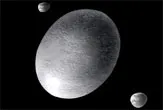
The asteroid belt between Mars and Jupiter is like the old, messy attic of the solar system.
The dusty, forgotten objects are relics of cosmic prehistory, each asteroid with its own story to tell about the origins of the system we inhabit.To answer these questions, NASA plans to launch a robotic probe called Dawn. Its mission: to fly to the asteroids Ceres and Vesta, and explore them up close for the first time. The launch is scheduled for next month.
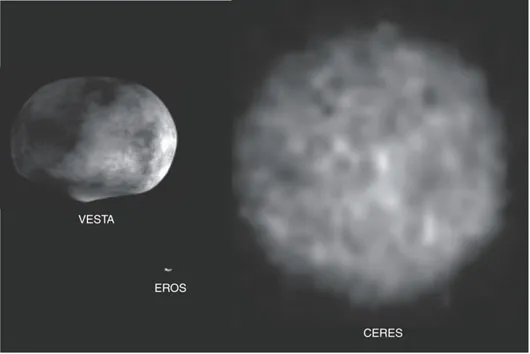
Ceres and Vesta seen by Hubble and Eros seen by the NEAR mission. (c) NASA.
These are stories that planetary scientists want to know. Much is still unknown about the distant past of the solar system. We learned the basic story in school: a vast disk of gas and dust around the Sun slowly gathered into larger and larger clumps, eventually forming the planets we know today. But how exactly did this happen and why did it produce those and not other types of worlds, including a certain blue planet, well equipped for life?
To answer these questions, NASA plans to launch a robotic probe called Dawn. Its mission: to fly to the asteroids Ceres and Vesta, and explore them up close for the first time. The launch is scheduled for next month.
Dawn's first stop will be Vesta. Telescopic observations of Vesta and studies of meteorites believed to have come from that asteroid suggest that it was partially melted early in its history, allowing heavy elements like iron to form a dense core with a lighter crust on top.
"It's interesting, and a bit difficult to resolve," comments Chris Russell, Principal Investigator for Dawn at the University of California, Los Angeles. Melting requires a heat source like the gravitational energy released when material came together to make the asteroid. But Vesta is a small world -"too small, says the researcher- only about 530 km. "There wouldn't have been enough gravitational energy to melt the asteroid when it formed".
A supernova (or two) might provide the explanation:
Some scientists believe that when Vesta formed, it was "seasoned" with aluminum-26 and iron-60 created in possibly two supernovas that exploded near the time of the solar system's birth. These forms of iron and aluminum are radioactive isotopes that could have provided the extra heat needed to melt Vesta. Once these radioactive isotopes decayed, the asteroid would have cooled and solidified to its present state.
This idea would explain why Vesta's surface appears to bear the marks of ancient basaltic lava flows and magma oceans, similar to what happened on our Moon. The supernovas would also have changed the sequence of events of planetary formation:
"When I went to school, the thinking was that Earth formed, heated up, and the iron went to the center and the silicate floated to the top, producing a core formation event," says Russell. This view assumes that the small asteroids that collided and merged to form Earth were amorphous masses that had not yet formed their own iron cores. But if chunks of rock the size of Vesta could melt and form dense cores, "it would have affected the way planets and their cores grew and evolved".
If all goes as planned, Dawn would reach Vesta and enter its orbit in October 2011. Detailed images of Vesta's surface will reveal traces of its molten past, while spectrometers will catalog the minerals and elements that formed its surface. The asteroid's gravitational field will be mapped by Dawn and that should establish once and for all if Vesta does indeed have an iron core.
Toward Ceres
The Dawn probe will not use conventional rocket fuel, as one of the largest rockets would have to be used to carry all the fuel. Instead, it will use ion propulsion, which requires only a tenth of the fuel. These efficient ion engines will take the spacecraft from Vesta to Ceres, in February 2015.
About 950 km in diameter, Ceres is the largest object in the asteroid belt. It is not a rocky world like Vesta, but one covered in water ice. "Ceres will be a true surprise for us," comments Russell. Since Ceres appears to possess an ice layer 60 to 120 km thick, the surface has probably changed over time much more than Vesta's, obscuring much of its history. But if Ceres does not offer a window to peek into planetary formation, it could teach scientists about the role water has played in planetary evolution since then. For example, why do certain rocky worlds like Ceres and Earth possess large amounts of water, while others, like Vesta, are dry?
"Vesta will tell us about the early epoch and Ceres will tell us what happened later," explains Russell. Together, they offer two unique stories of our solar system's past and who knows how many lessons about how planets formed.
Sources and related links
- Science@NASA:Voyage to the Giant Asteroids
- Maps of Vesta by Hubble
- Ceres seen by Hubble
- Dawn mission page