Astronomers from the University of Minnesota have found a huge hole in the Universe, nearly a billion light-years across, devoid of normal matter such as stars, galaxies, and gas, as well as the mysterious dark matter. While previous studies have shown other holes or voids in the large-scale structure of the Universe, this new discovery dwarfs them all.
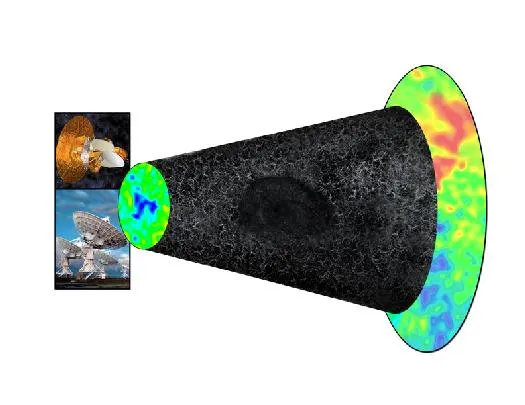
The hole in the Universe. Credit: Bill Saxton, NRAO/AUI/NSF, NASA
"Not only has no one ever found a void this big, but we never expected to find one this size," says Lawrence Rudnick, a professor at the University of Minnesota, who together with his graduate student Shea Brown and professor Liliya Williams reported their findings in a paper accepted for publication in Astrophysical Journal.
Astronomers have known that on large scales, the Universe has voids. However, most of these holes are much smaller than the one recently discovered.
The astronomers reached their conclusions by studying sky data from the NRAO Very Large Array Sky Survey (NVSS), a project that observes the entire sky visible to the VLA, and a map of the cosmic microwave background (CMB) made with the WMAP satellite. The cosmic microwave background is the remnant radiation from the Big Bang. The irregularities in this microwave background show structures that existed only a few hundred thousand years after the "Big Bang".
The WMAP satellite measured temperature differences in the cosmic background that are only millionths of a degree. The cold region in Eridanus was discovered in 2004.
Astronomers wondered if the cold region was intrinsic to the cosmic background and if it indicated some structure in the early Universe or if it was caused by something closer. Finding the scarcity of galaxies in that region by studying NVSS data resolved the question.
"Although our surprising results need independent confirmation, the very low temperature of the cosmic background in this region appears to be caused by a huge hole devoid of all matter located between 6 and 10 billion light-years from Earth," said Rudnick.
How does a lack of matter cause a low temperature in the background radiation seen from Earth?
The answer lies in dark energy, which became dominant in the Universe recently, when the cosmos was already about three-quarters of its current size. Dark energy works in opposition to gravity and is accelerating the expansion of the universe. Thanks to dark energy, photons from the cosmic background that pass through a large void before reaching Earth have less energy than those that pass through an area with a normal distribution of matter.
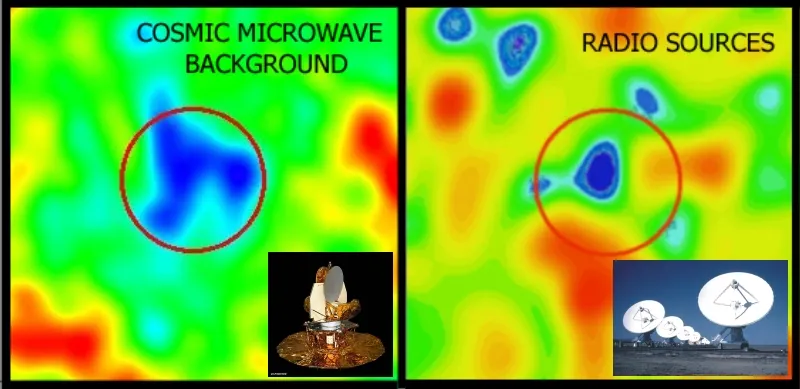
Left: a 25-degree region of the Cosmic Microwave Background emission around the WMAP cold spot region (circled). Colors represent small variations (parts in 100,000) around the average temperature of 2.7 degrees above absolute zero, with blue colors for the coldest. Data from WMAP.
Right: A portion of the NVSS showing radio galaxy emission. Blue colors represent a brightness approximately 20% below average.
Credit: Rudnick et al., NRAO/AUI/NSF, NASA
In a simple expansion, without dark energy, photons approaching a large mass—such as a supercluster of galaxies—gain energy from its gravity. As they move away, gravity takes that energy away, and they end up with the same amount of energy as at the beginning.
But photons passing through a matter-rich region when dark energy is dominant do not return to their previous state. Dark energy counteracts the influence of gravity, so large masses do not take much energy away from the photons. Thus, they arrive on Earth with higher energy or temperature.
Conversely, photons passing through an empty region lose energy. The acceleration of the Universe's expansion and dark energy were discovered less than a decade ago. The physical properties of dark energy are not known, although it is by far the most abundant form of energy in the current Universe. Learning its nature is one of the most important problems in modern astrophysics.
Sources and related links
- Note on EurekAlert
- Note on NRAO
- Paper data:
http://www.journals.uchicago.edu/ApJ/future.html
Extragalactic Radio Sources and the WMAP Cold Spot
Lawrence Rudnick, Shea Brown, and Liliya R. Williams
Received: 05 Apr 2007
Accepted: 02 Aug 2007
Dr. Lawrence Rudnick, Department of Astronomy, University of Minnesota, 116 Church Street, SE, Minneapolis, MN 55455, USA ([email protected])