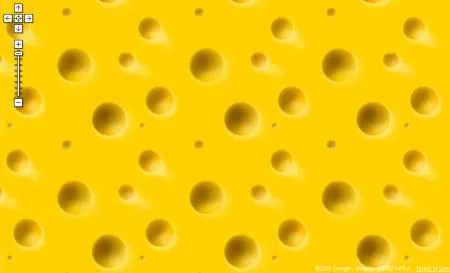
The dark energy might not be necessary to explain why the expansion of space seems to be accelerating. If our Universe were like Swiss cheese on large scales—with dense regions of matter and holes with little or no matter—it could, at least partially, mimic the effects of dark energy, according to a controversial new cosmological model.
In 1998, astronomers found that distant supernovae were fainter, and thus farther away than expected. This suggests that the expansion of the universe is accelerating as a result of a mysterious entity called dark energy, which seems to be 73% of the Universe.
But trying to identify the nature of such energy has proven extremely difficult. Particle physics theories suggest that space has an inherent energy, but this energy is about 10 to the 120 times greater than what is currently observed.
This has caused some cosmologists to seek alternative explanations. "I have nothing against dark energy, but we must make every possible effort to see if we can avoid this exotic component in the universe," says Sabino Matarrese of the University of Padova in Italy.
So he and his colleagues, including Edward Kolb from Fermi, decided to think of a universe model that had large-scale variations in density.
That contradicts the standard cosmological model, which assumes that the universe is homogeneous on a large scale. In the homogeneous model, known as the Friedmann-Robertson-Walker (FRW) universe, the effect of dark energy is to stretch space and thus increase the wavelength of the photons from supernovae.
A similar effect was seen when the researchers added large-scale spherical holes to the FRW universe. They allowed the matter density in each hole to vary with the radius and found that in certain cases, photons traveling through voids of lower density stretched their wavelength, mimicking the effects of dark energy.
The extent of the effect depends on the exact location of the supernova and how many low-density regions the photons must cross before reaching our planet. And Matarrese warns that the deviations are not enough to explain all the observed dark energy effects. The scientist says his model is still preliminary.
Sean Carroll, a cosmologist at Caltech, says a "Swiss cheese" universe model is interesting and useful as a test of more predominant theories. "The vast majority of cosmologists think that complete smoothness is a very good approximation. But if you want to have confidence you're on the right track, it's better not to make assumptions and cross your fingers, the best is to test it."
Astrophysicist Niayesh Afshordi of Harvard is less impressed. Astronomical observations suggest that the matter density in the universe is relatively smooth and not like "Swiss cheese" on scales of 100 million light-years or larger, he says. The new model, however, suggests that space has holes on scales of 500 million light-years.
"The model is very non-homogeneous on the scales we observe as homogeneous."
In contrast, team member Antonio Riotto, from the University of Geneva, says that "We know the universe has voids, we can debate about their size." Indeed, recent research suggests that voids can extend across nearly a billion light-years.
Sources and related links
- Note in NewScientist
- Paper:On cosmological observables in a swiss-cheese universe, by: Valerio Marra, Edward W. Kolb, Sabino Matarrese, Antonio Riotto
- They find a huge hole in the universe