The Province declared the project of interest and committed all necessary support together with UNSa. Recent studies confirmed the optimal environmental conditions offered by Tolar Grande.
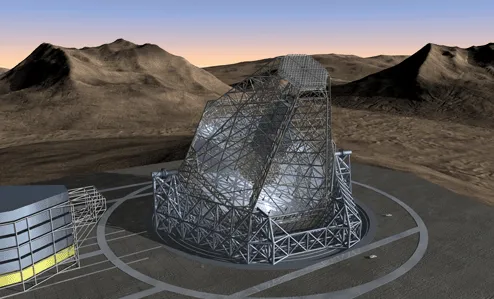
The ELT could revolutionize astronomical research as much as the introduction of the first telescope by Galileo. Illustration: ESO.
The possibilities of Tolar Grande becoming the site for the world's largest optical telescope are strengthening every day, as new studies confirmed the optimal conditions that area of the Puna offers for stellar observations and a good dialogue has been established between the Province and the National University of Salta (UNSa) with the European Organisation for Astronomical Research in the Southern Hemisphere (ESO).
As this newspaper anticipated in its edition of last March 26, ESO began defining in the Salta Puna and in the Atacama Desert the possible sites for the placement of a colossal observatory that promises to revolutionize astronomical research as much as the first telescope created by Galileo did.
It is the ELT project (acronym for Extremely Large Telescope), in which the European organization plans to invest 1,000 million euros over the next ten years. The final design studies alone will take three years and its construction will demand another seven years, so the megatelescope will begin to delve into the confines of the universe only in 2017.
Nevertheless, the titanic project is already going through moments of crucial decisions and the most important of all is to determine the placement site before the end of the year, as the partner countries in ESO await the official announcement of the chosen site for the beginning of 2008.
In this context, it emerged from sources close to the project that recent studies increased the chances of Tolar Grande compared to other places evaluated in the Chilean region of Antofagasta.
The candidate site is located in the Cordillera del Macón, at 4,600 meters above sea level, within the municipal jurisdiction of Tolar Grande, in the Los Andes department, 380 kilometers from the city of Salta.
There, at the request of ESO, experts from the Argentine Institute of Radio Astronomy (IAR) began in April 2004 studies aimed at determining the levels of humidity, visibility, seismic stability and other environmental conditions required for the placement of the ELT observatory, which will have unprecedented resolution and sensitivity thousands of times greater than that of space telescopes.
Provincial interest
Following the news from Europe, the Chamber of Deputies approved a project presented by Leopoldo Salva, legislator for the Los Andes department, and the probable installation of the ELT in the Salta Puna was declared of provincial interest through decree 1517 of last May 28.
In line with this declaration, the Government of Salta sent an extensive letter to the authorities of ESO, in Germany, in which it made available the public lands of the candidate site, detailed the infrastructure conditions and explicitly stated guarantees of legal security. In that letter, moreover, commitments of support from the Province and UNSa with all the support that ESO considers necessary to facilitate the development of this project of international interest were reaffirmed, in case it is decided to locate it in Salta territory.
After reading the letter, the Director General of ESO, Catherine Cesarsky, sent copies to the committee in charge of developing the ELT project and a source close to the aforementioned scientific body, in response to an email sent from this newspaper, emphasized that the commitments expressed from Salta "could not have arrived at a more opportune moment" in the hands of the leaders of the European organization.
Legal security
The chances of Tolar Grande as a possible site for the placement of the ELT telescope appear strengthened not only by the optimal environmental conditions that the area offers for astronomical observations, but also by an unexpected title conflict that arose a few months ago in northern Chile.
One of the megaprojects funded by European countries in Atacama, it was learned, was one step away from failing when landowners of lands that were supposedly legally assigned for one of ESO's observatories presented themselves to the scientific organization and demanded payment of a veritable fortune.
After this incident, it is logical to assume that in the choice of the ELT placement site, the guarantees of legal security offered at the candidate sites will weigh as much as the natural conditions. And in this last aspect, both the declaration of provincial interest of the project and the letter sent from Salta to ESO left no room for doubt.
A gaze that will reach distant extrasolar planets
The concepts on which the ELT telescope will begin to take shape within a couple of years were carefully evaluated by more than a hundred European scientists and presented, in December 2006, to 250 experts gathered in Marseille.
ESO's flagship telescope will have unprecedented resolution and sensitivity thousands of times greater than that of space telescopes. The scientists working on the project assure that the ELT will revolutionize astronomy, as it will enable detailed studies of extrasolar planets, the first objects formed in the universe and supermassive black holes.
It will also allow deepening knowledge about the nature and distribution of the dark matter and energy that dominate the universe.
The ELT's primary mirror - 42 meters in diameter - will be composed of 906 hexagonal segments, each 1.45 meters, while the secondary mirror will have a diameter of 6 meters.
To compensate for the distortion introduced by atmospheric turbulence in images of celestial objects, the telescope will need to incorporate adaptive optics elements.
The tertiary mirror - 4.2 meters in diameter - will direct light to the adaptive optics system, composed of two other mirrors - one 2.5 and the other 2.7 meters in diameter - which will allow the final image corrections.
Experts expect these five mirrors to provide exceptional image quality, without significant aberrations in the field of view.
ESO has in Chile four large astronomical complexes that helped position it at the forefront of world astronomy.
Its observatories in the neighboring country are those of La Silla, Paranal, APEX and Alma. All are in the II Trans-Andean Region, which offers in the Chilean Atacama Desert special conditions for astronomical research.
Sources and related links
Article in El tribuno de Salta by Antonio Oieni