Breaking news
Scientists from the Pierre Auger Observatory announced today, November 8, that Galaxies with active nuclei are the most likely candidates to be the sources of the highest-energy cosmic rays that reach Earth.
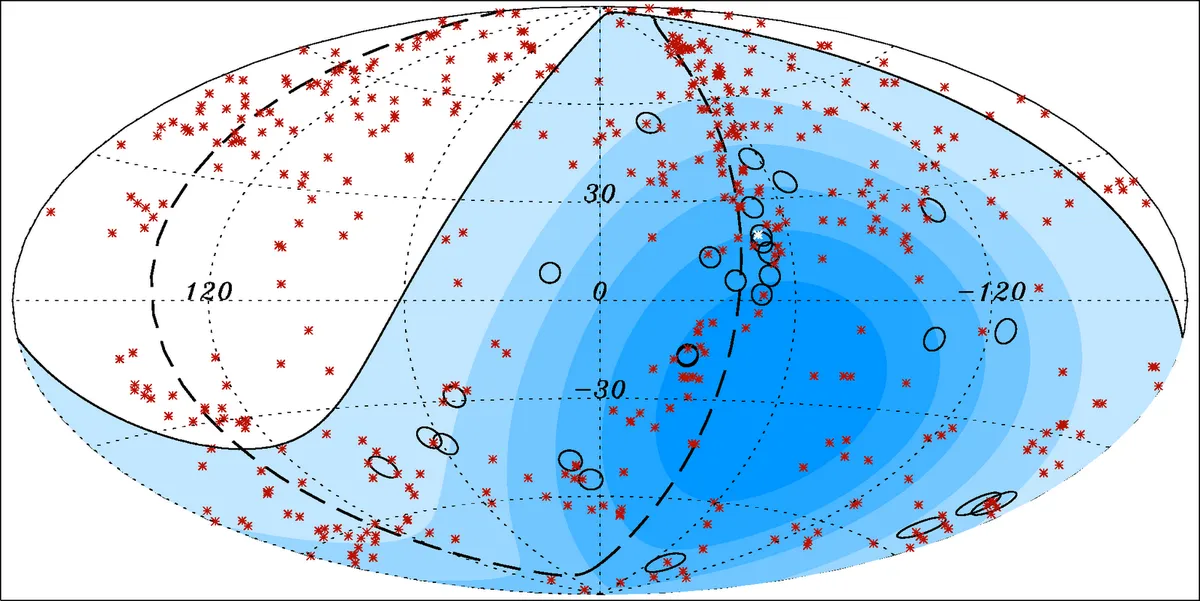
Celestial map showing the arrival directions of the 27 most energetic cosmic rays detected by the Pierre Auger Observatory (black circles) and the positions of known nearby AGNs (red crosses). In light blue, the region of the sky visible to the Auger Observatory.
Using the Pierre Auger Observatory, the world's largest cosmic ray observatory, located in Malargüe in the province of Mendoza, a team of scientists from 17 countries found that the sources of high-energy particles are not distributed uniformly across the sky. Instead, the Auger Observatory results link the origin of these mysterious particles to nearby galaxies that possess active nuclei. The results will be published in the November 9 issue of the prestigious journal Science.
Active galactic nuclei (AGN, according to their English designation) are believed to be powered by extremely massive black holes that absorb large amounts of matter. These galaxies with active nuclei attract and devour gas, dust and other types of matter and launch a prodigious amount of particles and energy into the cosmos. Most galaxies have black holes at their center, with masses ranging from one million to several billion times the mass of our Sun. The black hole at the center of our galaxy, the Milky Way, possesses about 3 million solar masses, but it is not an AGN. Only a small fraction of galaxies have active nuclei. The Auger Observatory result indicates that AGNs could also produce the highest-energy particles in the Universe. The detailed mechanism of how these active galactic nuclei can accelerate particles to energies 100 million times greater than the most powerful particle accelerator on Earth is still a mystery.
"We have taken a big step forward in solving the mystery of the origin of the highest-energy cosmic rays," said Nobel Prize winner James Cronin of the University of Chicago in the United States, who conceived the Pierre Auger Observatory together with Alan Watson of the University of Leeds in Great Britain.
"We discovered that the highest-energy cosmic rays do not arrive equally from all directions. There are preferential arrival directions. This discovery opens a new era for observing the universe: cosmic ray astronomy has been born," said Alberto Etchegoyen, one of the main promoters of the Auger project being realized in our country, and who, from the National Atomic Energy Commission, leads the project in Argentina.
Cosmic rays are protons and atomic nuclei that travel through the universe at speeds close to the speed of light. As soon as these particles enter our planet's atmosphere they collide with air molecules and create a cascade of secondary particles, which can spread over 40 or more square kilometers when it reaches the Earth's surface.
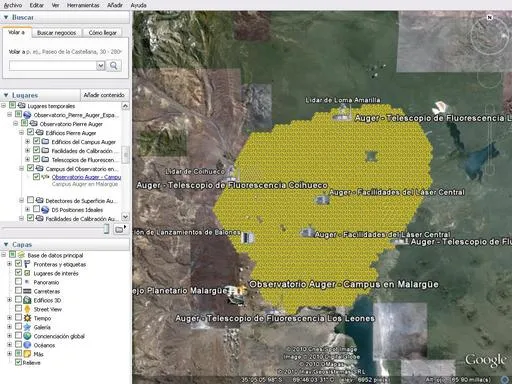
The Pierre Auger Cosmic Ray Observatory records the cascades of secondary particles using an array of 1,600 detectors, spaced 1.5 kilometers apart and distributed over 3,000 square kilometers. It also has twenty-four fluorescence detectors, telescopes specially designed to record the faint light emitted by the cascade of secondary particles as they pass through the atmosphere. The combination of particle detectors and fluorescence telescopes provides an exceptionally powerful and precise instrument.
The Observatory has already recorded nearly one million cosmic ray cascades. Only the least frequent of them, those with the highest energy, reach Earth without being appreciably deflected by the magnetic fields they traverse in interstellar and intergalactic space, which makes it possible to identify their potential sources. Auger Observatory scientists have recorded to date 81 cosmic rays with energies above 4 x 10^19 electron volts (eV), more than any other observatory in the world. In these ultra-high energy events, the arrival direction of the cosmic rays can be determined with an accuracy of just one degree, and the deflection caused by magnetic fields is a few degrees. This allowed scientists to find the location of the sources of these cosmic particles.
"We know that the highest-energy cosmic rays cannot come from very great distances, more than hundreds of millions of light-years, because they lose energy in collisions with the cosmic microwave background, the remnant radiation from the Big Bang that fills all space," described Diego Harari, a researcher at the Bariloche Atomic Center and CONICET. "We compared the directions with which the cosmic rays arrive on Earth with the positions in the sky of nearby extragalactic objects that are sufficiently violent to be able to produce these cosmic rays. Applying statistical methods we concluded that the arrival directions of the 27 highest-energy cosmic rays are not randomly distributed." Most of these events come from directions close to the positions of nearby AGNs, such as the galaxy Centaurus A.
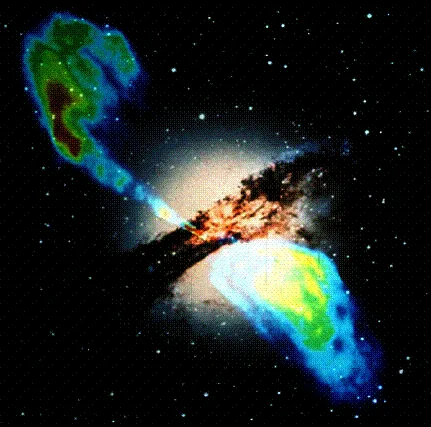
The active galaxy Centaurus A. The two jets from the central nucleus (VLA, 21cm) and the galactic plane in the optical (Hubble, 0.36 - 0.78 µm) are clearly observed. Credit: VLA, Hubble
Unfortunately, very few ultra-high energy cosmic rays reach Earth: only one falls per square kilometer per century, which requires a large observatory. Due to its large size, the Auger Observatory can detect approximately 30 ultra-high energy events per year. Auger Observatory scientists are developing plans for a second observatory in Colorado, United States, to cover the entire sky and, at the same time, substantially increase the number of high-energy events recorded.
The Pierre Auger Observatory is being built by a team of more than 370 scientists and engineers from 17 countries. In Argentina, scientists, engineers, and technicians from the Comisión Nacional de Energía Atómica, CONICET, the Universidad Tecnológica Nacional, the Universidad Nacional de La Plata, the Universidad Nacional de Cuyo, the Universidad Nacional de Buenos Aires, the Instituto de Astronomía y Física del Espacio, and the Centro de Investigaciones en Láseres y Aplicaciones are participating. The institutions responsible for the construction of the Auger Observatory are the Comisión Nacional de Energía Atómica and the Government of the Province of Mendoza. The participating researchers have received support from their respective institutions and from CONICET, ANPCyT, and the Fundación Antorchas. The Municipality of Malargüe has also provided support for the realization of this project.
Construction of the Observatory began in 1999 and, although it has not yet been completed, data has been taken steadily since January 2004. Currently, the 24 fluorescence telescopes and more than 1400 of the 1600 particle detectors have already been installed. The Auger Project has already committed to expanding the capabilities originally planned for the Observatory, and new developments, with new technologies, will be installed on the Malargüe plain in the coming years.
The collaboration is a true international partnership in which no country has contributed more than 25% of the total construction cost, which amounts to US$ 54 million. The names of the funding agencies contributing to the Pierre Auger Observatory, as well as the names of the participating institutions, are listed below this document.
The observatory is named after the French scientist Pierre Auger (1899-1993), who in 1938 was the first to observe the extensive cascades of particles produced by the interaction of high-energy cosmic rays with the Earth's atmosphere.
Science cover
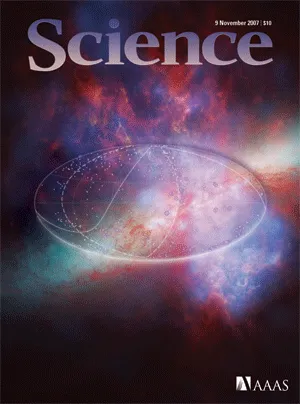
Projection of the high-energy cosmic rays detected by the Pierre Auger Observatory (circles) that are related to the positions of nearby quasars (crosses), a measure of the local galaxy distribution. The galactic and Milky Way planes are marked. The background shows a composite of the nearby galaxy M82 observed by Spitzer, Hubble, and Chandra.
Kelly Krause/Science (figure: Auger Collaboration; photo: NASA/JPL-Caltech/STScI/Chandra X-ray Center/Univ. of Arizona/ESA/AURA/Johns Hopkins Univ.)
Full information (from tomorrow) on page 938.
The information to be presented in the southern part of the province is so valuable that it will be published on Friday by the prestigious worldwide journal Science, from the American Association for the Advancement of Science.
So much so that the official announcement will be known today and tomorrow the journal Science, which this year was awarded the Prince of Asturias Award for Communication and Humanities, will publish the full report for the entire planet.
Until then, the journal Science has embargoed the information. "They will publish it on Friday, November 9, and the cover of the journal will talk about the advances at Pierre Auger," detailed the astronomer and head of the group from the Universidad Tecnológica Nacional (UTN) that is part of the Observatory.
Sources and related links
- Note on Pierre Auger Observatory
- Note on Eurekalert, NewScientist, Physorg.