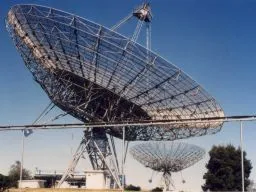
The future of the Arecibo radio telescope is not very promising after a 25% cut to its budget plus another 50% cut expected for 2011.

If you've seen the movie Contact -one of my favorites, by the way- starring Jodie Foster based on a novel by Carl Sagan; or if you saw GoldenEye, the first Pierce Brosnan movie in the James Bond suit -which is also one of my favorites- then you have seen the Arecibo Radio Telescope.
The instrument has been listening to radio waves arriving from the cosmos since 1963 and even today remains the largest and most sensitive radio telescope in the world.
In times when it seems necessary to adjust budgets, a review panel recommended a 25% cut to the budget (from 10.5 to 8 million dollars) and another 50% cut in 2011.
The panel also said that Arecibo should seek other institutions and agencies for funding, otherwise, the foundation should consider closing the instrument.
Robert L. Brown, director of the National Astronomy Center at Cornell University, which manages Arecibo, remains optimistic that the observatory will stay open.
Cornell has spoken with the government of Puerto Rico (where the instrument is installed) and the University of Puerto Rico. The atmospheric sciences division of the National Science Foundation could end up contributing to the budget. Arecibo's radar is used to study the dynamics of the upper atmosphere.
Discoveries
The Arecibo telescope has made several significant scientific discoveries. On April 7, 1964, shortly after its inauguration, Gordon H. Pettengill and his team used it to determine that the rotation period of Mercury was not 88 days, as believed, but only 59 days. In August 1989, the observatory took a picture of an asteroid for the first time in history: asteroid 4769 Castalia. The following year, Polish astronomer Aleksander Wolszczan discovered the pulsar PSR B1257+12, which later led him to discover its two orbiting planets. These were the first extra-solar planets discovered.
Arecibo is the data source for the SETI@home project proposed by the University of Berkeley's space sciences laboratory.
In 1974, an attempt was made to send a message to other worlds (a 1,679-bit message was transmitted from the radio telescope towards the globular cluster M13, which is 25,000 light-years away. The pattern of 1s and 0s defines a 23-pixel by 73 bitmap image that includes numbers, drawn people, chemical formulas, and an image of the telescope (see Arecibo message).