Argentina will participate in the Meta III project, which will attempt to find signs of extraterrestrial life in the Cosmos. With funding from the NGO founded by Carl Sagan, The Planetary Society, the Argentine Institute of Radioastronomy in Berazategui will join the search through a spectrometer with 254 million audio channels.
This is the third time this plan has been launched, which began in the '50s with few or scarce results. In the '90s it started operating again and they managed to detect 25,000,000,000,000 different signals, of which about 30 had the appearance of being artificial and their origin still cannot be known for certain, but nothing seems to indicate they were produced by other intelligent beings. In this third option, the most sophisticated technical equipment has revived hopes in Argentine scientists.
From the town of Berazategui, a spectrometer, with 254 million audio channels, will attempt to receive intelligent signals from space. The experiment is part of the "Project Meta III", which is funded by the "Planetary Society" (The Planetary Society), an NGO founded by the famous American astronomer Carl Sagan.
This initiative began to take shape in the late '50s and soon, due to negative results, expectations and followers were lost. That was the first international attempt to search for extraterrestrial signals and it was known as SETI, Search for Extra Terrestrial Intelligence.
A second opportunity in Argentina came in 1989. That year, The Planetary Society chose this country as the destination for the installation of the "Meta II" spectrometer, a receiver that analyzed 8.4 million audio channels.
In these years, technology changed drastically and today there is the possibility of building a new spectral analyzer with 254 million channels with the ability to make observations 600 times more precise in the same time and much more technical versatility, which considerably increases the sensitivity of the radioastronomical equipment.
The cost of this new device would be one-tenth of the previous one and the funds for its construction would be provided by The Planetary Society.
THE PROJECT
In an interview with La Prensa, the director of the Argentine Institute of Radioastronomy, Marcelo Arnal, explained why Project Meta II failed, spoke about the obstacles in verifying signals emitted by extraterrestrials, and explained the scope of Project Meta III.
The above text is only an excerpt from the article published on February 6, 2008 by the newspaper La Prensa, edition 48075, year 139, front page and pages 20-21 under the title "De otro planeta".
New director of the IAR
At the end of December 2007, the National Council for Scientific and Technical Research (CONICET) appointed, by competition, Dr. Edmundo Marcelo Arnal as Director of this Institute.
Dr. Arnal was born in the city of Comodoro Rivadavia and completed his Astronomy studies in the city of La Plata. He obtained his Bachelor's degree in 1971 and his doctorate in November 1977.
He was Director of the IAR from November 1997 to December 1999 and Deputy Director from 2004 to 2007.
Since 1985 he has been Director of various Research and Development Projects (PID), as well as Director of Bachelor's and Doctoral Theses and Director of Fellows.
He is a Full Professor of the subjects "Astrophysics of continuum emission" and "Radioastronomical Observational Techniques" at the Faculty of Astronomical and Geophysical Sciences of La Plata (FCAGLP).
He has a total of 160 published articles of various kinds, 54 oral presentations at national congresses, and 30 at international congresses.
Sources and related links
- *La Prensa: De otro planeta
- *IAR: Argentina en el proyecto SETI
- *Planetary Society: Putting an Ear to the Center of the Galaxy
- *SETI Institute
- *Latinquasar: SETI: Buscando inteligencia extraterrestre
About the images
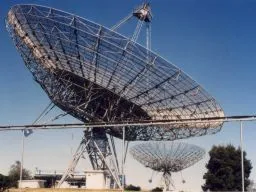
The two 30-meter antennas at the Argentine Institute of Radioastronomy (IAR).
Credit: IAR/Guillermo Lemarchand