The Hubble Space Telescope found strange objects, nicknamed "blobs" that are bright blue clusters of stars born in the swirls of a galactic collision 200 million years ago.
The discoveries are being reported by Duilia de Mello of the Catholic University of America, Washington and the Goddard Space Flight Center and her colleagues at the 211th Meeting of the American Astronomical Society in Austin, Texas.
These "blue blobs," which weigh tens of thousands of solar masses, had never been seen in detail. They are more massive than most open clusters inside galaxies but a fraction of the massive globular clusters that orbit galaxies.
Since these orphaned stars do not belong to a particular galaxy, the heavy elements produced in their stellar furnaces will be easily expelled into interstellar space. This may offer clues about how the early Universe was "contaminated" by heavy elements, the researchers say.
The mystery is that these "blue blobs" are found across a bridge of gas tied between three colliding galaxies, M81, M82 and NGC 3077, which reside approximately 12 million light-years from Earth. This is not the place where astronomers expect to find star clusters. "We couldn't believe it, the stars were in the middle of nowhere," says de Mello.
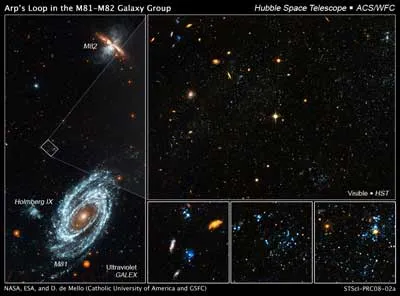
These "blue blobs" are grouped in a structure called Arp's Loop, along the faint gas bridge. The gas filaments were considered too thin to accumulate enough material to build these stars, says de Mello. However, Hubble revealed that these "blobs" contain the equivalent of five Orion Nebulas.
After discovering that these "blobs" were stars, the team used the Hubble image to measure an age for the cluster of less than 200 million years with many stars younger than 10 million years. It is no coincidence that 200 million years is the estimated age of the galactic collision that created the gas streams.
De Mello and her team proposed that the star clusters in this diffuse structure could have formed from the gas of the collisions and the subsequent turbulence that locally enhanced the density of the gas streams. Galactic collisions were much more frequent in the early Universe, so this type of "blue blob" could have been common. After the stars exploded, the heavy elements forged in their cores would have been ejected to thus enrich interstellar space.
Radio observations with the VLA gave a detailed map of the intergalactic bridge that reveals knots of dense gas. Studies with the WIYN telescope at Kitt Peak mapped the optical brightness of hydrogen along this bridge. Observations with GALEX revealed an ultraviolet glow in those knots and earned them the nickname "blue blobs."
Sources and related links
- *HubbleSite:Hubble Finds that "Blue Blobs" in Space Are Orphaned Clusters of Stars
- *SpaceTelescope:heic0801: Hubble finds that “blue blobs” in space are orphaned clusters of stars
About the images
Left: A GALEX ultraviolet image of the interacting galaxies M81 and M82 in the Constellation Ursa Major. The gravity of each galaxy dramatically affected the other during the last encounter 200 million years ago. Gas waves around M81 give it the spiral design. M82 is forming large numbers of stars in its core.
Right: A Hubble visible-light image of the bright blue clusters found along the gas bridge between the two galaxies and a third companion not seen in the image.
Credit:NASA, ESA, and D. de Mello (Catholic University of America/GSFC)