A group of astronomers used the Hubble Space Telescope to dissect one of the largest structures in the Universe to understand the violent life of galaxies. Hubble provides indirect evidence of dark matter in a massive supercluster of hundreds of galaxies.
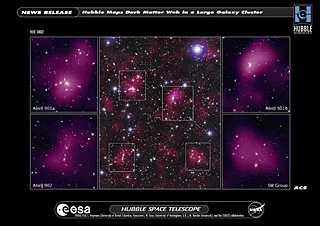
Hubble's Advanced Camera for Surveys mapped the dark matter in the supercluster Abell 901/902 as well as the detailed structure of individual galaxies within it.
The images are part of the STAGES study (Space Telescope Abell 901/902 Galaxy Evolution Survey).
The area studied is so wide that it takes 80 Hubble images to cover the entire field. The new work is led by Meghan Gray of the University of Nottingham and Catherine Heymans of the University of British Columbia along with an international team of scientists.
The study determined four main areas in the supercluster, where dark matter gathered into dense clumps, totaling 100 trillion (one trillion is a one followed by 12 zeros) solar masses.
These areas coincide with the location of hundreds of old galaxies that have had a violent history in their passage from the outskirts of the supercluster into these dense regions.
"Thanks to Hubble's Advanced Camera for Surveys we are detecting for the first time the irregular clumps of dark matter in this supercluster. We can even see an extension of dark matter toward a very hot group of galaxies that are emitting X-rays as they fall into the cluster's core," says Heymans.
The dark matter map was built by measuring the distorted shapes of 60,000 distant galaxies. To reach Earth, the light from the galaxies traveled through the dark matter surrounding the supercluster's galaxies and was bent by the massive gravitational field. Heymans used the observed distortion of the galaxies' shapes to reconstruct the distribution of dark matter using a method called weak gravitational lensing. The map is 2.5 times sharper than in previous studies with ground-based telescopes.
On Earth, the quiet life of the countryside is very different from the urban hustle. In the same way, isolated galaxies look very different from those found in the more crowded regions, like a supercluster. "We have long known that galaxies in crowded environments tend to be older, redder, and rounder" adds Gray.
In those environments galaxies are subject to a violent life: collisions with other galaxies, the formation of new stars, distortion due to the powerful gravitational pull of dark matter.
The study focused simultaneously on the big picture and the details. "We are examining large-scale structures, like making road maps, counting skyscrapers, monitoring traffic. And at the same time studying the residents to know how the lifestyle differs from those who live in the suburbs. In our case, the city is the supercluster, the streets are the dark matter and the people are the galaxies," explained Gray.
"We see more collisions between galaxies in the regions toward which galaxies are flowing than in the centers of the clusters. By the time they reach the center, they are moving too fast to merge, but on the outskirts their passage is calmer and they still have time to interact."
The team found that in the outer parts of the clusters is where star formation is slowly shutting down and where the supermassive black holes in the centers of galaxies are more active.
"The galaxies in the centers of the clusters have been there a long time and have probably finished their transformation. Now they are old, round, red and dead," says Heiderman.
Abell 901/902 resides 2.6 billion light-years from Earth and measures over 16 million light-years across.
Gray and Heymans will present their discoveries at the meeting of the American Astronomical Society in Texas. A scientific paper has been accepted by Monthly Notices of the Royal Astronomical Society.
Sources and related links
- *Space Telescope:The violent lives of galaxies: caught in the cosmic matter web
To enlarge the image in this post and access other images and materials, visit the Space Telescope site. - *EurekAlert:The secret life of galaxies
- *Galaxy morphologies and environment in the Abell 901/902 supercluster from COMBO-17,
K. P. Lane, M. E. Gray, A. Aragón-Salamanca, C. Wolf and K. Meisenheimer,
Monthly Notices of the Royal Astronomical Society, Volume 378, Issue 2, Page 716-722, Jun 2007, doi: 10.1111/j.1365-2966.2007.11809.x
About the images
Credit for Hubble images: NASA, ESA, C. Heymans (University of British Columbia, Vancouver), M. Gray (University of Nottingham, U.K.), M. Barden (Innsbruck), and the STAGES collaboration.
Credit for ground-based images: ESO, C. Wolf (Oxford University, U.K.), K. Meisenheimer (Max-Planck Institute for Astronomy, Heidelberg), and the COMBO-17 collaboration.