Preparation for the International Year of Astronomy
You don't need to undertake a long journey, wait many years, or have high-precision instruments to enjoy the wonderful sight of the Moon entering the Earth's shadow cone. On the night of next February 20, the Moon will make contact with the penumbra that the Earth casts into space and we can have the experience of observing a total lunar eclipse. This is a good opportunity to get closer to this science, astronomy, which gives us so much satisfaction just by looking up during a starry night.
SOME GENERALITIES ABOUT ECLIPSES
The effects of the combined movements of the Earth and the Moon result in eclipses. The term eclipse in astronomy is reserved for solar and lunar eclipses.
For a solar eclipse to occur, the Moon must be in its New phase, in the necessary position for the Moon's shadow to cover the Earth, that is, between the Sun and our planet. This type of Sun-Moon-Earth alignment is called a conjunction.

For a lunar eclipse to occur, the Moon must be in its full moon phase, it then passes behind the Earth and is eclipsed. This type of alignment is called an opposition.

WHAT IS A LUNAR ECLIPSE?
As we already said, this occurs when the Moon, Earth and Sun align so that Earth is between the Moon and the Sun. Sunlight cannot reach the Moon due to Earth's interference. Basically, the Moon is in Earth's shadow cone. This only happens during the full moon.
One might think the Moon will become invisible during an eclipse; however, some light reaches it due to a certain amount of sunlight that is deflected by Earth's atmosphere.
We do not witness a lunar eclipse every time it enters the full moon phase because the Moon's orbit is inclined by about 5° relative to the plane of Earth's orbit (the ecliptic). The moon is generally not in that plane but constantly enters and leaves it. The point where the Moon crosses the Ecliptic is called a node. In each orbit there are two nodes. It is at these points that lunar and solar eclipses occur.
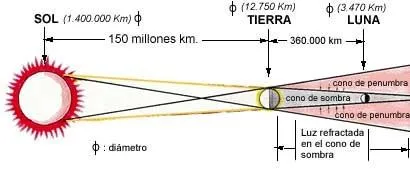
The approximate mean length of the shadow cone is 1,379,200 km; at a distance of 384,600 km, the mean distance between the Moon and Earth, it has a diameter of approximately 9,170 km.
Lunar eclipses can be partial or total, depending on the degree of shadow the Moon passes through.
A total lunar eclipse occurs when the Moon fully enters the cone of shadow. If it enters directly through the center, it will darken for about 2 hours; if it does not enter through the center, the period of totality is shorter, and if the Moon moves only along the edge of the shadow cone, its darkness may last only an instant.
A partial lunar eclipse occurs when only a part of the Moon enters the shadow cone and darkens. The extent of the partial eclipse can range from an almost total phase, when most of the Moon darkens, to a minor eclipse when only a small area of Earth's shadow is seen passing over the Moon. Historically, the first hint of Earth's profile was seeing its circular shadow passing across the face of the Moon.
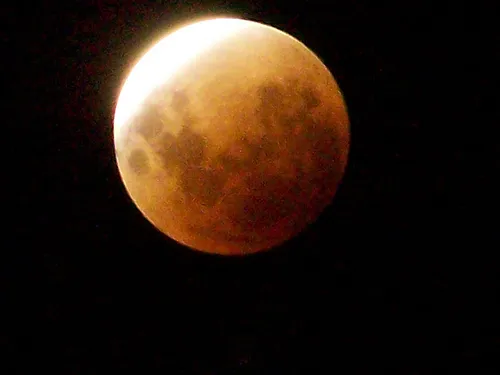
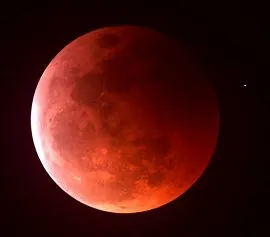
Before the Moon enters the umbral cone, both in a total and a partial eclipse, it is within the penumbral zone and its surface becomes visibly darker. The part that enters the umbral cone appears almost black, but during the total eclipse the lunar disk is not completely dark; instead, it remains slightly illuminated with a reddish light: the solar rays are refracted by the Earth's atmosphere and penetrate the umbral cone. If a lunar eclipse occurs when the Earth is covered by a dense layer of clouds, these clouds prevent the refraction of light; in that situation the Moon's surface becomes invisible during the total phase.
One of the qualities of lunar eclipses is their duration, as they can last for hours, contrary to what happens with solar eclipses.
Lunar eclipses are massive; all terrestrial observers who see the full Moon can see the eclipse (approximately one third of the Earth).
COLORS IN THE ECLIPSE
When we observe a total lunar eclipse, the Moon never disappears completely thanks to a luminosity that spreads across the entire lunar disk. This luminosity is almost always colored, with reds and blues dominating.
This is because the atmosphere surrounding the Earth acts as a lens or prism and deflects some of the sunlight, introducing it into the shadow and giving it an intense reddish coloration.
Essentially what illuminates the Moon during lunar eclipses is the light from all the sunsets and sunrises of Earth.
As a reciprocal phenomenon, the eclipse of the Moon for Earth will be an eclipse of the Sun for the Moon, and around our planet as seen from the Moon, a luminous halo of several colors will appear. That halo is precisely the origin of the Moon's luminosity during the eclipse that we see.
In some eclipses the Moon appears light amber in color. But especially in the years following large volcanic eruptions, the shadow becomes so dark that the Moon practically disappears, even when viewed through a telescope.
DIFFERENCES BETWEEN SOLAR AND LUNAR ECLIPSES
Solar eclipses are only visible in a narrow strip of Earth, and in a different form depending on where the observer is located. This is because these eclipses are effects of perspective and consequently depend on the observer's position relative to the Moon and the Sun. A given region of Earth only has a total solar eclipse every 360 years.
Lunar eclipses, in contrast, do not depend on the observer's position, but on the more or less considerable portion of the satellite enveloped in the cone of shadow that Earth projects.
Since that portion of shadow can cover the entire Moon in cases of total eclipse, our satellite will appear darkened for all observers who have the Moon above the horizon at those hours. Considering the long duration of lunar eclipses, the phenomenon is visible from more than one hemisphere.
Although lunar eclipses are in themselves less frequent than solar ones, it is more likely to witness a lunar eclipse than a solar one.
The number of solar and lunar eclipses within a year varies between two and seven. If there are only two, both are solar and there is no lunar eclipse. If there are seven, five are solar and two are lunar.
PHASES OF THE MOON
To understand the different phases of the Moon, one must consider:
1. That the Moon moves around the Earth and therefore the Sun illuminates it differently throughout the month (to understand this, we can set aside for a moment the movements of the Earth and the Sun, and think of them as if they were still).
2. That the Sun always illuminates the half of the Moon that faces it. That is, the Moon has a day and a night, like Earth.
Now then, the phases:
Full Moon:
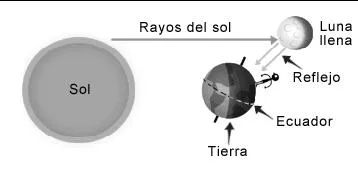
In this phase, the face of the Moon that faces the Earth is also facing the Sun.
As seen in the figure, an observer on Earth sees the entire half of the Moon illuminated (that's why it looks round).
Last quarter and first quarter:
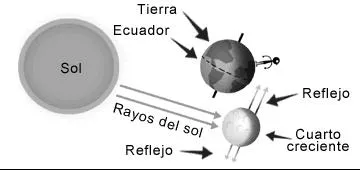
We see the Moon in first quarter or last quarter when the Sun, the Moon and the observer form a right angle. In this case, what we see from Earth is half of the face of the Moon illuminated by the Sun (that is, a quarter of the Moon).
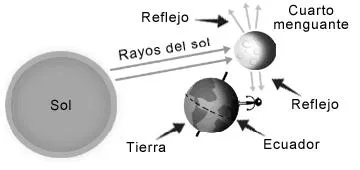
After the last quarter comes the new moon. The first quarter, on the other hand, precedes the full moon.
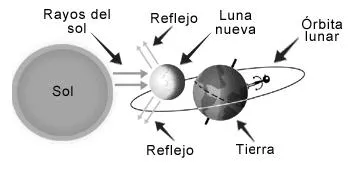
New moon:
The new moon occurs when the Moon is between the Sun and the Earth, so none of the rays that the Sun gives on the Moon are reflected towards us, and we don't see it at all!
MOON DATA
• Distance to Earth: Maximum: 406,700 km. (Apogee)
Mean: 384,403 km.
Minimum: 356,400 km. (Perigee)
• Distance from the Earth-Moon barycenter to the center of the Earth: 4,670 km.
• Orbit / sidereal lunar month (by star): 27 days 7h 43 min. (Mean solar days)
• Orbit / synodic month (New Moon to New Moon): 29 days 12 h 44 min. (Mean solar time)
• Inclination of orbital plane relative to the ecliptic plane: 5° 9'
• Mean orbital velocity: 1 km/s (3,600 km/h)
• Orbital eccentricity: 0.0549
• Axial inclination: 1° 32' 32"
• Diameter: 3,476 km (27% of Earth's)
• Apparent size from Earth, max. and min.: 33' 302 and 29' 22"
• Albedo: 0.12 (7%)
• Mean density: 3.34 g/cm3
• Rotation: 29 days 31 h 50' 7.2"
• Gravity: 1.62 m/s2
• Escape velocity: 2.37 km/s (8,532 km/h)
• Mass (Earth = 1): 7.3483 x 1025 g (0.012 T)
• Volume: 2.199 x10¹⁹ m3 (0.0203 T) (0.204 T) 16
• Surface temperature, day-night: 101° C/-157° (Equator)
• Full Moon light received on Earth: 0.25 lux (candela per meter)
GLOSSARY
Apogee: point at which an object is at its maximum distance from Earth
Perigee: point of the orbit around Earth closest to it.
Orbit: path of one object around another, both objects are bound by the action of the Gravitational Attraction Force. The orbits of a planet around the sun or of a satellite around its planet are elliptical.
Ellipse: a closed conic geometric figure (resulting from cutting a cone with a plane), which has two foci. The other conics are: circle, parabola, hyperbola (these last two are open figures). The orbits of planets around the sun and satellites around planets are ellipses (Kepler's first law); comets can have open orbits.
Eccentricity: degree of flattening of a closed conic. The eccentricity of a circle is zero.
Albedo: ratio between the light reflected by an object (planet, satellite) and the incident light (coming from the Sun). In the case of planet Earth, its albedo is 0.37, that is, it reflects 37% of the light it receives.
Density: quotient between mass and volume of a substance.
Escape Velocity: velocity needed to overcome the gravitational attraction force of a body. For Earth, that velocity is approximately 11 km/sec
GRAPHS, EPHEMERIDES, OBSERVATION
ON FEBRUARY 21, 2008, IT IS WEDNESDAY, THE MOON WILL BE IN ITS FULL MOON PHASE, BUT ALSO, IT WILL BE THE MOMENT OF A TOTAL LUNAR ECLIPSE.
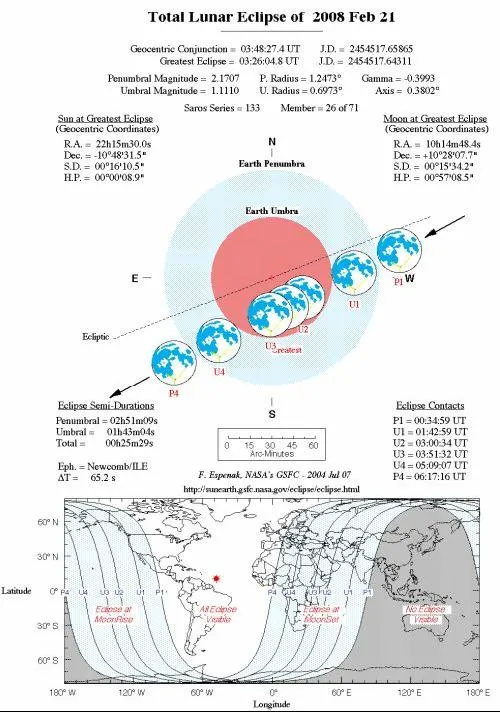
Note: The figure, taken from the NASA page, is valid for observers in the Northern Hemisphere. In the south, the image of the Moon and its entry into the shadow cone are inverted.
OBSERVATION AND EPHEMERIDES FOR THE LUNAR ECLIPSE OF FEBRUARY 20-21, 2008 (TIME ZONE -2)
It is interesting during eclipses to organize the observation for the entire event. For this, one should look for a sky, if possible, clear and remember that the apparent path of the moon from rise to set is toward the north.
Because the eclipse from its initial phase to its end lasts several hours, it is good to provide oneself with a comfortable chair.
The lunar eclipse is visible without the aid of telescopes and poses no risk.
Because the Moon enters the Earth's shadow cone, it does not reflect sunlight directly. This allows us to better distinguish features on its surface. For the observation of the Moon's surface to be truly impressive, the best instrument for observation (beyond the eyes!) is binoculars. A telescope will also allow seeing surface features in greater detail, but it is not absolutely necessary to have one.
Below, the times of the eclipse and the characteristics of each phase are detailed:
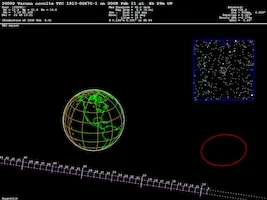
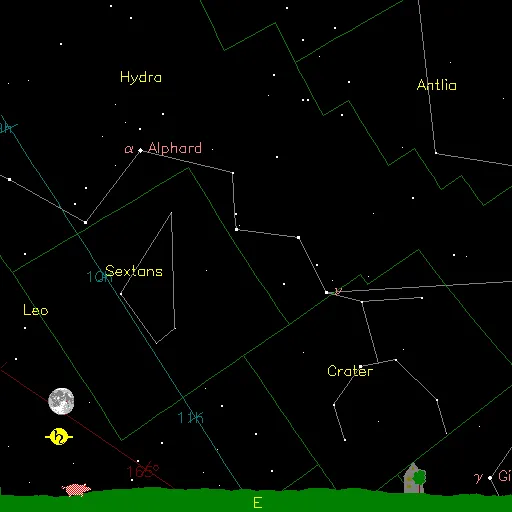
at 22:34 on February 20, the "first contact" of the Moon with Earth's penumbra will occur (there will be an occultation of Regulus (or the star alpha leonis, in the constellation Leo)
at 23:43 on Wednesday, February 20, 2008, the Moon will be completely inside the penumbra. At that moment, the first contact of the Moon with Earth's umbra will occur
at 01:00 on February 21, the Moon will acquire a fairly dark reddish coloration (it will be passing or entering completely through the Earth's umbra zone)
at 01:51 on Thursday, February 21, 2008, the Moon will be beginning to exit the Earth's umbra
at 03:09 am on Thursday, February 21, 2008, the final phase of the eclipse would already be beginning (the Moon is beginning to exit the Earth's penumbra). Approximately at 04:17 am on February 21, the Moon will have already completely passed the Earth's penumbra zone.
A little below the Moon and further west, Saturn can be seen and a little above the Moon, the star Regulus (alpha of the constellation Leo or alpha leonis) will be visible.
The planet Mars will also be visible in the constellation Gemini, to the west.
The second lunar eclipse of the year will occur on August 16 and will only be partial for the inhabitants of Argentina.
More information about this and other eclipses at:
http://sunearth.gsfc.nasa.gov/eclipse/OH/OH2008.html
The eclipse in Don Torcuato
According to the IAFE mailing list sent by Liliana Opradolce, the Grupo Astrónomico Don Torcuato invites neighbors to come to Plaza Alvear – Estrada and Camacuá- Don Torcuato- starting at 22:00 h to share this experience with the naked eye and with telescopes. Completely free activity
Sponsored by Delegación Don Torcuato, Municipalidad de Tigre
CANCELLED IN CASE OF CLOUDY SKY
GRUPO ASTRONOMICO DON TORCUATO. More information: 4748-6803
Other observation sites in Sur Astronómico
"Watch the lunar eclipse on the Internet"
The Asociación Argentina Amigos de la Astronomía has the page ¡La noche de la Luna Roja! from which the astronomical event can be followed online.
The Asoc. Arg. "Amigos de la Astronomía" will have several telescopes at its headquarters in Parque Centenario, a digital system for projecting images on a giant screen, and specialists to satisfy the curiosity of those who come to the place.
Sources and related links
- Information sent by the IAFE mailing list by Liliana Opradolce. Material prepared by Viviana Bianchi and Beatriz García
[email protected], [email protected]
(Activity based on an idea from the IAC, Instituto de Astrofísica de Canarias) - Cielo Sur: TOTAL LUNAR ECLIPSE OF FEBRUARY 20/21, 2008: OBSERVATION GUIDE
- International Year of Astronomy 2009 (Argentina Node): Total Lunar Eclipse February 20-21, 2008