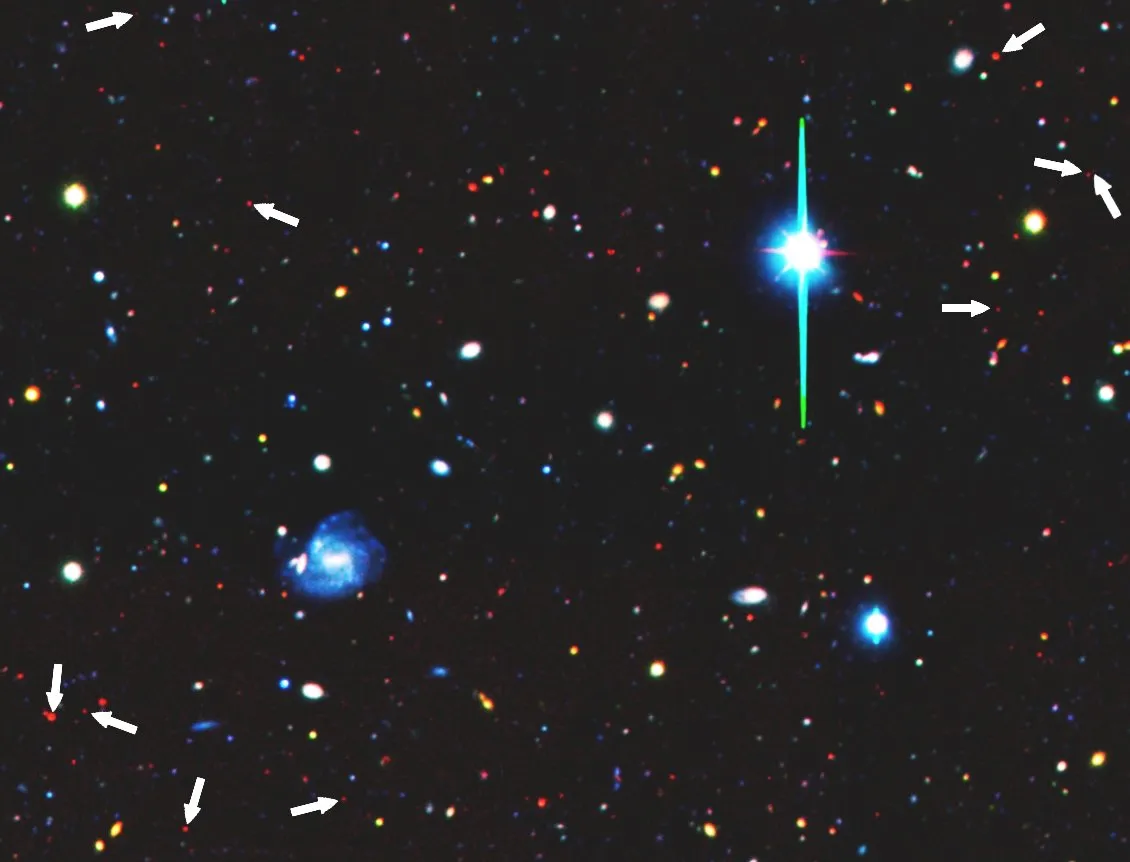
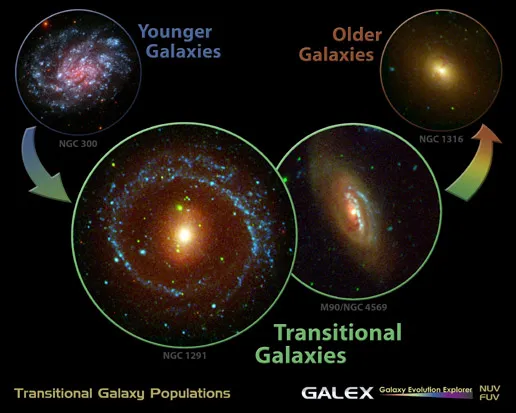
Astronomers using the Hubble Space Telescope have compiled a large catalog of gravitational lenses in the distant Universe. It contains 67 amazing new images of gravitational lenses found around massive elliptical and lenticular galaxies. If this sample is representative, there would be nearly half a million similar gravitational lenses across the entire sky.
The lenses come from a set of recently completed observations as part of a project to survey a portion of the sky (1.6 square degrees of the sky, nine times the area of the full Moon), with ground-based and space telescopes. The COSMOS project, led by Nick Scoville of the California Institute of Technology, used observations from several observatories: Hubble, Spitzer, XMM-Newton, Chandra, the VLT, Subaru and CFHT.
A European team of astronomers led by Jean-Paul Kneib and Cécile Faure analyzed the results from the Hubble's Advanced Camera for Surveys (ACS). From there, complemented by extensive ground-based observations, the astronomers identified 67 powerful gravitational lenses. They were found near very massive galaxies that are usually elliptical or lenticular.
The massive objects that create the lenses are usually enormous clusters of massive galaxies. "We often see gravitational lenses creating a series of bright arcs or spots around a galaxy cluster. But what we are observing here is a similar effect but on a much smaller scale, happening only around a single but very massive galaxy," notes Kneib.
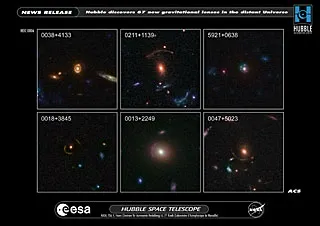
At least four of the lenses result in Einstein rings, a circular image of a background galaxy that forms when a background galaxy, a massive foreground galaxy, and the space telescope align.
Identifying these natural lenses was quite a process. First, possible galaxies were identified from a catalog of over two million galaxies. Then, as Cécile Faure relates, "we had to look at each individual COSMOS image by eye and identify any potential gravitational lens." Finally, it had to be checked whether the foreground galaxy and the magnified galaxies were really different or just a single galaxy with a strange shape.
"With this sample of gravitational systems identified by the human eye, we now plan to use the lens sample to train robotic software to find more of these lenses throughout the entire Hubble archive and perhaps we will find even more powerful systems in the COSMOS field," added Kneib.
The study of these lenses will give astronomers an opportunity to investigate the distribution of dark matter around galactic lenses. Once astronomers find a larger number of these smaller and more powerful lenses they can use them to create a census of galactic masses in the Universe to test the predictions of cosmological models.
Sources and related links
- SpaceTelescope:Hubble discovers 67 gravitationally lensed galaxies in the distant Universe
- HubbleSite:Hubble Discovers 67 New Gravitationally Lensed Galaxies in the Distant Universe
- First catalog of strong lens candidates in the COSMOS field;
Authors: Cecile Faure, Jean-Paul Kneib et al.
About the images
In the image, six examples of the rich diversity of the 67 powerful gravitational lenses found in the COSMOS survey.
Credit:NASA, ESA, C. Faure (Zentrum für Astronomie, University of Heidelberg) and J.P. Kneib (Laboratoire d’Astrophysique de Marseille)