Two astronomers from the Space Telescope Science Institute (STScI), Dr. Marc Postman and Dr. Ken Sembach, have been selected among 19 science teams to lead studies of new concepts for NASA's next generation of large observatories. The studies will help the agency make decisions on how to explore the cosmos in the future, in accordance with the Astronomy and Astrophysics Decadal Survey.
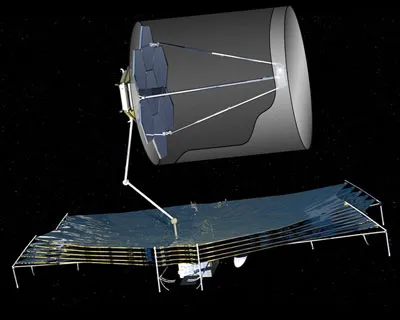
Postman's group will study the feasibility of building the Advanced Technology Large-Aperture Space Telescope (ATLAS Telescope), which will have more than 40 times the sensitivity of the Hubble Space Telescope. It would have a primary mirror that could be up to 16 meters in diameter and that could be carried aboard an Ares V launch vehicle. It would be located 1 million miles away at a Lagrange point L2, where the James Webb Telescope will be placed after its launch in 2013.
"The ATLAS telescope will revolutionize astronomy. It will allow us to definitively answer the question: 'Is there life on an Earth-like planet in our galaxy?'. It will allow us to map dark matter around galaxies with unprecedented detail, giving us fundamental insights into how structures in the Universe develop over time. And it will enable us to detect stars like the sun in galaxies up to 30 million light-years away. (...) The primary goal of our study is to identify a development path for the key technologies we need to be at the forefront and that, ten years from now, will allow us to create a telescope much more powerful than Hubble but at a similar cost," said Postman.
Ken Sembach and his team will study the feasibility of adding ultraviolet spectrographs to large space telescopes. This novel instrumentation will strengthen observational cosmology by examining the "cosmic web" in much greater detail than is possible with Hubble or FUSE (Far Ultraviolet Spectroscopic Explorer). This "web" is formed of large filaments of dark matter that interacts with the evolution of stars and galaxies. Observations of the cosmic web will provide fundamental tests of cosmological theory.
"Our goal is to reduce the cost of future NASA missions by producing new instrument designs and investments to enable ultraviolet wavelength technologies. We hope the investments will revolutionize studies of the filamentous cosmic web of tenuous gas that surrounds and connects galaxies," the scientist stated.
Every 10 years, astronomers and physicists in the U.S. work with the National Academies of Sciences to define the direction of future research for astronomy and astrophysics. The science teams are part of an effort to ensure that the technical and cost contribution is appropriate for the upcoming Astronomy and Astrophysics Decadal Survey (Astronomy and Astrophysics Decadal Survey). The survey produces directions that guide federal agencies like NASA and the NSF in planning their programs for the next decade.
"Astrophysics is in a true golden age, revolutionizing our knowledge on topics as diverse and fascinating as the origin and evolution of the Universe, the physics of black holes and the distribution and habitability of planetary systems in our galaxy," says Alan Stern, administrator of NASA's Science Mission Directorate.
Results are expected by March 2009. The top-ranked concepts could result in missions that would launch after the missions currently in development, such as GLAST, the Kepler mission and James Webb.
Sources and related links
HubbleSite:STScI Astronomers to Head Two Studies of Next Generation Astronomy Missions
About the images
Illustration of one of the possible designs for the ATLAS telescope.
Credit NASA, J. Frassanito & Associates, Inc., and the Future In-Space Operations Working Group, and STScI