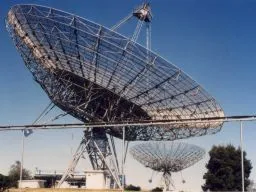
In relation to the facts recently made known, it is worth asking to what extent the computerization of astronomical instruments may be in danger.
Given the increasing computerization of astronomy and the new paradigm of the "Digital Data Deluge" obtained by instruments and the recent news of a large-scale cyberattack, I revisit an idea that circulated on the internet a few years ago.
First of all, two clarifications: Firstly, never in this blog (and this will not be the exception) has alarmism been practiced, but rather the opposite.
And, secondly, in case anyone had doubts, I am not a neo-Luddite, I am not against technological development.
To try to answer the question at hand, it is necessary to define the term "hack." According to the New Hackers Dictionary 1 the term hacker etymologically comes from "a person who creates something using an axe," with the double valence of creating and destroying which, in other words, is nothing other than creating something new from what already exists. In this sense, the verb to hack (which does not exist in Spanish according to the DRAE) would be synonymous with to invent, which among its meanings includes giving a new use to something known.
Thus, the natural sciences "hack" nature in that they first try to understand how it works and then use that knowledge for the benefit of some social sector, thereby achieving something that was not possible before. And, in many cases, nature is modified in the process. Therein lies another nuance as well: solving a problem.
So much so that at least in English it is possible to find several examples of the positive use of the term hack. For example, in a quick web search I find advice on how to "hack" a red light, that is, how to make a flashlight with red light from elements we already have 2. The article in question suggests something we observers know: using cellophane to cover the bulb of a common flashlight, or a soda bottle cap.
According to the same dictionary cited earlier and also according to Wikipedia, the use of the verb "crack" (also does not exist in Spanish) is preferred to account for computer procedures that seek to cause damage, although in the mass media it is rarely used, preferring the more well-known verb.
Hacking, therefore, is neither good nor bad. The category will depend on the social use made of it.
Anyone who in their youth took apart a clock to see what was inside, even if they couldn't put it back together afterwards, can already think of themselves as a beginner hacker.
For the curious: it's not very difficult to make a common clock (not a wristwatch) run backwards, with the hands going in the opposite direction. Whoever achieves this can well call themselves an initiated hacker. I give this example because in its broadest sense, the term is not necessarily limited to computing, although that is the most common use.
In relation to computing, I don't think it's far-fetched to say that in general, doing something relatively simple is not considered "hacking." To give a case: downloading an mp3 file embedded in a web page. On the other hand, intruding into a password-protected server and downloading files that are supposedly forbidden to those not authorized can already be thought of as a "hack," even if it's not done with bad intentions.
In many cases, an attempt is made to breach a system with the goal of better protecting it. For example, in recent years, with the implementation of electronic voting in Argentina, a skilled citizen managed to breach the system, but not to harm anyone, but to show that it was not secure.
In general terms, it is a popular saying that everything that is computerized is "hackable" and therefore vulnerable.
Although this is ultimately true, downloading an embedded mp3 is not the same as entering a highly protected site, for which greater knowledge is necessary.
If we then discard several meanings given to the word and concentrate on uses restricted by bad intentions and difficulty, what are we left with?
CRACKING ASTRONOMY
If we associate those meanings with cracking, a couple of very different examples come to mind.
First case: the real (though old) computer risk
As recounted by Eric Chaisson, an astrophysicist who worked on the Hubble Space Telescope, several years ago there was a hacking case that put scientific data at risk. I translate an excerpt from his book "The Hubble Wars" 3:
Scientists using Hubble have exclusive rights to their data for one year. No one else (not NASA, ESA or the Space Telescope Science Institute) knows the passwords necessary to gain access to the data without the principal investigator's permission. After that "proprietary period," the observational data (including images) enter the public domain in the Space Telescope archive at the Science Institute where they are available for research. Any astronomer can write a proposal to investigate the archive (...)
With all that data downloading, the project must protect itself from hackers and software viruses trying to penetrate the system - and thus potentially damage the multi-million dollar spacecraft. The Science Institute, to take part in the intricate command and control network needed to operate the telescope, installed years ago an invisible private NSA-type (U.S. National Security Agency) structure that effectively allows its large array of computers to "disconnect from the world" whenever it senses an intrusion trying to hack Hubble's central nervous system. This security mechanism, which is much more than a simple set of codes and passwords, also protects against electronic viruses, for example, on the internet, as demonstrated in 1988 when the Institute isolated its computers from a virus released by a Cornell University graduate.
The New York Times site refers to the event that occurred in November 1988 4.
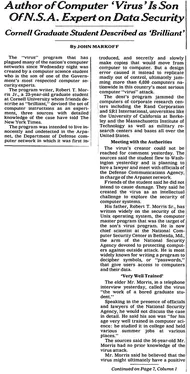
In this regard, two considerations occur to me:
The possibility of someone infiltrating the computer network of an institute-observatory and manipulating stored data should not go unnoticed and should not imply great damage since, I presume, important institutions make backup copies stored on different servers.
The second question is more disturbing: if it is possible to manipulate a telescope through commands from the computers that control it, could an intruder manipulate the instrument and cause a breakdown or at least prevent researchers and technicians from using the instrument for a certain amount of time?
Second case (unlikely): As some may remember, in 2010, NASA reported that it was receiving unreadable data from the Voyager 2 probe 5. As was later learned, it was a small change (a bit flip in a register) probably caused by cosmic rays that altered a computer register on the spacecraft. However, sensationalist press speculated about the possibility of it being a ..."alien hack"!
Beyond the absurdity of the suggestion, one could ask something similar: Could a terrestrial hacker interfere with a radio telescope to give the appearance of receiving ET data?
Or, could a very advanced ET civilization send data to terrestrial radio telescopes to plant a virus in all the world's computers?
These are two quite imaginative questions, more a product of science fiction than reality. However, I believe the first option is rather impossible, while the second is completely far-fetched. Yet, I am not the one with this lush imagination; rather, the question was posed in 2012 on the website io9 6. Although the article does not mention it, there are references in the comments to the movie "Independence Day" - more than science fiction, it's "sovereign fantasy". Even in the ridiculous case that an ET civilization knows terrestrial computer systems, radio telescopes do not receive "executable" data. It would be like putting a virus in an executable .exe file on an mp3 player that does not read that type of file and therefore does not execute it. I would prefer a better technical explanation given by some radio astronomer, but in general, scientists do not like to publicly refer to issues that border on the absurd.
It would be different if a message with instructions were received and we humans decided to follow them with full confidence. It would be like opening an email from an unknown person without prior inspection with an antivirus or other precautions.
With a dose of humor, since most users use a certain operating system, perhaps it is time for consumers to finally decide to give the penguin operating system a chance, which is not invulnerable, but is more secure, efficient, and free...
CONCLUSION
Potential computer risks must be taken seriously as we increasingly depend on that type of information. Precisely because of the level of dependency, it would be easier to breach terrestrial systems with an electromagnetic pulse that sends us back to the pre-electricity era.
Aside from precautions, ETs are certainly not a problem, but people are. Tools are neither the solution nor the origin of our troubles. Conflicts are human, social. Man is a wolf to man. Whether with the internet, office software, binary data, or with stones and sticks.
The recent attack on Telefónica and Movistar with ransomware (software that "kidnaps" data by encrypting it) is, perhaps, a reaction to the kidnapping we users of oligopolistic companies suffer, forcing us to pay a much higher rate than the quality of service.
If companies were to pay those extortions, they would cover it by later extorting users with higher rates, while insurance companies would make a killing with new policies against ransomware. Because, ultimately, since someone saw how to make a business at the expense of others, we have done nothing but replicate that virus through civilizations. The danger is not out there.
Sources and related links
- 1 The New Hacker's Dictionary, Third Edition
https://mitpress.mit.edu/books/new-hackers-dictionary - 2 Astronomy: Hacking a Redlight
http://www.instructables.com/id/Astronomy-Hacking-a-Redlight/
3 The Hubble Wars: Astrophysics Meets Astropolitics in the Two-billion-dollar Struggle Over the Hubble Space Telescope
Eric Chaisson
Harvard University Press, 1998, pag. 82.
4 1988: ‘The Internet’ Comes Down With a Virus https://www.nytimes.com/times-insider/2014/08/06/1988-the-internet-comes-down-with-a-virus/
'Virus' in Military Computers Disrupts Systems Nationwide http://www.nytimes.com/1988/11/04/us/virus-in-military-computers-disrupts-systems-nationwide.html
5 NASA cannot understand the information sent by Voyager 2 https://www.fayerwayer.com/2010/05/la-nasa-no-logra-entender-la-informacion-enviada-por-la-voyager-2/
6 Is SETI at risk of downloading a malicious virus from outer space?
http://io9.gizmodo.com/5921814/is-seti-at-risk-of-downloading-a-malicious-virus-from-outer-space
About the images
Image created with a drawing from OpenClipArt and image Bidding Hubble Farewell (2009). Credit: Nasa.