It is truly sad. Science fiction is in mourning. Space will never be the same.
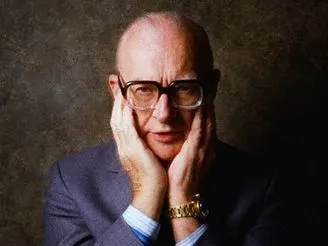
Immensely famous for his novel and film "2001: A Space Odyssey", he is also the one who conceived a geostationary orbit in which satellites orbit the Earth once every 24 hours, always seeing the same face of the planet. That is where most communication satellites are placed today.
Other science fiction works by Clarke that I have read are Childhood's End, Rendezvous with Rama, The Hammer of God, and The Light of Other Days.
His novels are what we could call hard science fiction, meaning they have a certain scientific rigor and, in my opinion, are usually the best because they present situations well worth considering regarding technological advancement and human reactions.
A couple of days ago, talking with friends about time travel (we were talking about the series Lost) I remembered a novel in which one could only see the past with some video camera-like devices. By entering the time and place coordinates, one could see what had happened there at that moment. This ended up generating the "end of privacy", but also of crime, since thieves were easily identified. But I couldn't remember the name of the novel. It was, of course, The Light of Other Days.
Clarke was born on December 16, 1917.
His laws
From Wikipedia, the free encyclopedia:Clarke's laws
1. When a distinguished but elderly scientist states that something is possible, he is almost certainly right. When he states that something is impossible, he is very probably wrong.
2. The only way of discovering the limits of the possible is to venture a little way past them into the impossible.
3. Any sufficiently advanced technology is indistinguishable from magic.
Sources and related links
- Bad Astronomy Blog:Arthur C. Clarke, 1917 - 2008
- SpaceRef:National Space Society Statement on Arthur C. Clarke's Legacy
- Arthur C. Clarke on Wikipedia
About the images
Photo: Profimedia.cz