Although it was not widely publicized, February 23 was a special day in space exploration. For the first time in history, a team of scientists and engineers -all women- guided a major NASA mission, the Mars Exploration Rovers.
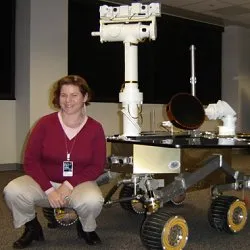
"We had control of Spirit's activities that day," explains Barbara Cohen of the Marshall Space Flight Center, who headed the team. "It was a milestone."
The occasion was Women's History Month, celebrated in March (By meeting in February "we got an early start," says Cohen). According to a resolution of the U.S. Congress, March is a time to recognize and celebrate the achievements of American women.
The meeting was virtual, as Cohen and her colleagues made their plans for Spirit via videoconference. From all over the United States, more than two dozen female scientists and engineers called in to help.
"Hey, any ladies in the house?" asked Cohen at the start
"Any man who comes today must wear a tutu," was heard in response
"Does the webcam make me look fat?" joked another.
The jokes were quickly set aside to start programming Spirit's day. Given the winter, Spirit is "hunkered down," covered in dust. But that doesn't mean the rover can't be busy. With a bit of female ingenuity, Spirit was able to gather data that day by observing the landscape and studying the surroundings.
"During the winter, we study how the Martian landscape changes over time. That gives us valuable information about the Martian seasons. We also study rocks right in front of the rover."
Cohen said she didn't notice any difference with the "women-only" call. "We have been working in our roles for some time and all team members, male and female, are very good at what they do. So we just do our job. It's a great, friendly group."
Although February 23 is a good sign of progress, it is not the end of the road. "Women in science are still undervalued. However, I think it would now be nearly impossible to have a spacecraft team without a woman on it. The work that women have done, now and before, shows that we bring as much talent, knowledge, and teamwork to the table as men."
And, please, no jokes about "women drivers on Mars!"
The Team
Science Operations Team, distributed across the country (United States):
Science Operations Working Group Chair – Barbara Cohen, NASA Marshall Space Flight
Center Science Operations Working Group Documentarian - Wendy Calvin, University of Nevada, Reno
Long-Term Planning Lead - Joannah Metz, California Institute of Technology
Keeper of the Plan - Emily Dean, Cornell University
Mineralogy & Geochemistry Science Theme Group lead - Alian Wang, Washington University, St. Louis
Geology Science Theme Group lead - Nathalie Cabrol, NASA Ames Research Center
Atmospheres Science Theme Group lead - Nicole Spanovich, Jet Propulsion Laboratory
Physical Properties Science Theme Group lead - Kim Lichtenberg, Washington University, St. Louis
Pancam Payload Uplink Lead - Elaina McCartney, Cornell University
Mini-TES Payload Uplink Lead - Amy Knudson, Arizona State University
Microscopic Imager Payload Uplink Lead - Aileen Yingst, University of Wisconsin, Green Bay
Engineering Cameras Payload Uplink Lead - Brenda Franklin, Jet Propulsion Laboratory
APXS/Mössbauer Spectrometer Payload Uplink Lead - Mariek Schmidt, Smithsonian Institution
Deputy Project Scientist - Diana Blaney, Jet Propulsion Laboratory
Spacecraft Engineering Team, Jet Propulsion Laboratory:
Engineering Team Lead - Sharon Laubach
Mission Manager - Cindy Oda
Rover Planners - Ashley Stroupe, Tara Estlin, and Julie Townsend
Tactical Downlink Lead - Dina ElDeeb
Tactical Activity Planner / Sequence Integration Engineers - Caroline Chouinard and Alicia Vaughan
Tactical Uplink Leads - Colette Lohr and Pauline Hwang
Telecom Subsystem - Manju Kapoor
Power Subsystem - Jennifer Herman
Mission Data Operations - Zsarina Bulchand
MIPL Image Processing - Amy Chen
Security - Cindy Alarcon-Rivera
Sources and related links
Science@NASA:Women Drivers on Mars
About the images
Image:Barbara Cohen poses with a full-scale model of Spirit.
Credit:NASA