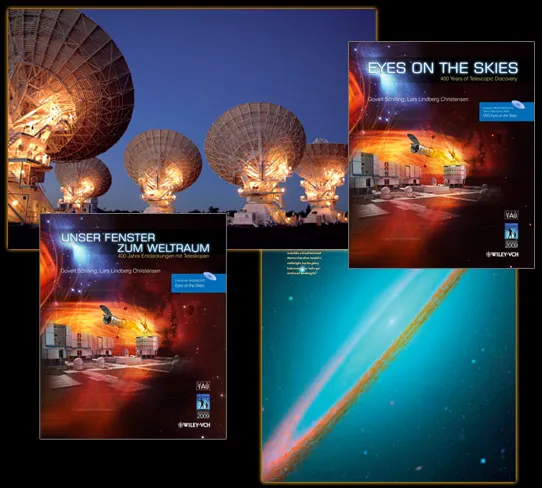
What is the invention that has most changed the way we think about the universe? We would undoubtedly answer this question by naming the telescope. Its history, from the invention to the great current observatories and those projected for construction, is told through incredible photographs and images in a book and a DVD from the International Astronomical Union.
Today, this instrument is familiar to us, but 400 years ago, when Galileo, looking through a device like this, noticed that the Earth and its place in space were not what was thought at the time, it revolutionized the scientific world and changed our way of understanding the universe, forever. Let's imagine what Galileo would think now if he could observe through modern telescopes and access the vision of the cosmos that astronomers have thanks to the descendants of that instrument.
With the goal of bringing astronomy to people's homes around the world, the International Astronomical Union (IAU), in collaboration with the scientific publisher Wiley-VCH, the European Southern Observatory and the European Space Agency/Hubble, produced "Eyes on the sky", a production in book and DVD format. The film is presented by Dr. J (also known as Dr. Joe Liske) of ESO, presenter of the Hubble and ESO podcasts. The book and the film were written by science journalist Govert Schilling and astronomer Lars Lindberg Christensen.
Through words, but also through extraordinary photographs, computer animations and illustrations, they tell the fascinating story of the telescope, from its invention to modern high-tech instruments.
The book and the film can be purchased separately, both on the publisher's site and on the ESA Hubble Space Telescope site. Both are offered in English and in German. Cost? The book is around €20 and the DVD between 3 and 10, depending on the type of cover. In addition, the production has a website for "Eyes on the sky" from which the material can be accessed.
Sources and related links
- IAU releases milestone book and movie celebrating the telescope
About the images
Credit: IAU