Mars, our red neighbor planet, has always captivated us, generating fantasies of life on that planet or the possibility of conquering and terraforming it. In this era of rapid communication, interest in Mars is being socialized, using various Web 2.0 resources, whether to keep us updated on scientific missions, to debunk false versions, or simply to have fun with funny videos.

After five years of exploration on the Red Planet, the communication engineers at NASA's Jet Propulsion Laboratory know very well what they receive when a downlink (a downlink for data transmission) arrives. They know that in a typical transmission come 10 megabits of engineering data, 4 megabits of science data, and about 26 megabits of images. And they noticed that, after the information is accumulated and analyzed by the science teams, the data is released through articles, press releases, scientific reports, etc.
To date, thousands of images from the rovers have been analyzed in detail. But the rovers sent about a quarter of a million images. NASA decided that this incongruity could be corrected by making every image from the Mars rovers available to all interested parties with internet access.
In this way, the excitement of exploration is brought to the whole world in a way never imagined before sending the rovers to our neighboring planet. Now, the Mars rovers have a new life in "Second Life," "YouTube," and "Facebook."
Keri Bean, like most current students, knows Facebook very well. This 20-year-old student at Texas A&M University started a Mars Rovers page on Facebook to keep her friends updated with information. To her surprise, the friend list began to grow. Until she had a friend who changed everything.
"Steve Squyres, the scientist in charge of both rovers, sent me an email and told me he liked my site," said Bean.
Now she has more than 1,700 online friends from all over the world. The page includes links to interesting articles, images, and other resources.
In addition, Keri Bean writes on the Phoenix mission blogs to Mars.
If Bean's Facebook page is for those who pay a little attention to Mars, Doug Ellison created a website for those with an insatiable appetite.
Doug Ellison from England has been interested in the Red Planet since Pathfinder rolled across the planet's surface in 1997.
In those days, Ellison read everything he could about Pathfinder's journey. Then, in February 2004, when Spirit and Opportunity were under construction, Ellison used software to create a panorama from a collection of images on the JPL website.
Ellison's site is now very visited, but he has no ambitions or expectations other than to impress some friends. Online discussions are also part of unmannedspaceflight.com, as are the incredible images that arrive each day. But also, the site allows debunking the fiascos that can appear in the news. An example is the famous "Bigfoot" apparently found in a Spirit image.
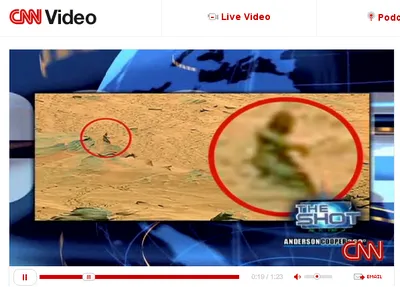
"We take the story and destroy it using only the facts," said Ellison. Some members worked on the distance the "object" was from the rover and calculated that its size was that of a pack of cigarettes. One of our members did brilliant work taking the mosaic from which the image came and demonstrating how many rocks could look like something else, added Ellison.
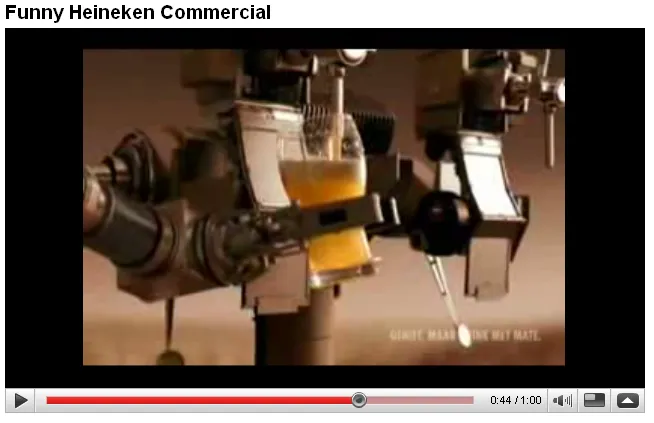
Of course, not all rover images are taken seriously. YouTube is a sample of how images can be used comically. An example is a beer commercial, in which a rover "Thinks Green" (http://www.youtube.com/watch?v=neoUi4poCXI).
And also other videos, like one of a printer (http://www.youtube.com/watch?v=0IcfCfWKF1A) or the very comical: "Mars: 2020: Springtime" in which many rovers arrive on Mars, but at the same place, with a degrading fate, to the dismay of the local residents.
And when it comes to communicating, microblogging is not exempt from Mars news, through Twitter.
Of course, NASA has its own site: http://marsrovers.nasa.gov/home/ and http://www.nasa.gov/mission_pages/mer/index.html but it is clear that interest in Mars is being socialized and expanding around the world thanks to Web 2.0.
Sources and related links
About the images
Credit:JPL, YouTube, CNN