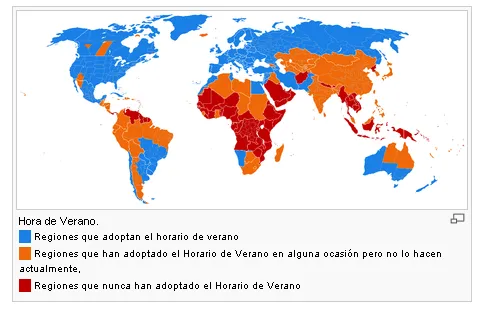
Nine provinces and the City of Buenos Aires will resume the old time zone starting at zero hour on Sunday. In this way, with the exception of San Luis, which on the contrary decided to set clocks back one hour starting Sunday (the people of San Luis had maintained the old time), the entire country will return to the -3 time zone.
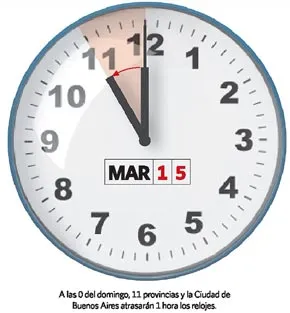
Regarding the time change, some considerations about Time.
1-Modern daylight saving time was first proposed by Benjamin Franklin and later, in 1907, by William Willett. Franklin proposed waking people up earlier on the brighter spring mornings so they could work during the day and thus save candles.
It was first widely used in 1916, during the First World War, to save coal. Despite controversies, many countries have been using it ever since. The details differ depending on the country and are modified from time to time.
2-Green days. The U.S. Department of Energy estimates that electricity demand drops 0.5% during daylight saving time, saving the equivalent of almost 3 million barrels of oil.
3-According to the results presented by the Federal Planning Ministry, the plan allowed a daily savings of between 150 and 175 MW, with a consumption peak shifting from 21 to 23, thus reaching the peak in a less abrupt manner.
4-Regarding the provinces, it is estimated that the program allowed an average savings in each district of between 1.7 and 2%.
5-The second is the unit of time in the International System of Units, the CGS System of Units and the Technical System of Units. One minute equals 60 seconds and one hour equals 3600 seconds. Until 1967 it was defined as the 86,400th part of the duration of the mean solar day between the years 1750 and 1890 and, from that date, its measurement is based on atomic time.
6-In Spanish texts, unofficial abbreviations for the second are frequently found, such as seg or sg. Note that the correct symbol (according to the International System of Units) is "s". Also, a space should be left between the number and the symbol and a period should not be added after the symbol.
7- Units smaller than a second
The decisecond is the unit of time equal to one tenth of a second. It is abbreviated ds. 1 ds = 0.1 s = 1x10⁻¹ s
Common stopwatches measure deciseconds.
The centisecond is the unit of time equal to one hundredth of a second. It is abbreviated cs. (1x10⁻² s). Common stopwatches can measure elapsed centiseconds.
The millisecond is the thousandth fraction of a second (0.001s). 1 ms = 0.001 second = 1 millisecond.
The microsecond is the millionth part of a second. One microsecond = 0.000001 s or 10-6 s.
The nanosecond is the billionth part of a second, 10-9.
The picosecond is the trillionth part of a second, and is abbreviated ps. 1 ps = 1x10-12 s
The femtosecond is the thousand trillionth part of a second. This fraction of time was the smallest measured until 2004. It is abbreviated fs. 1 fs = 1x10-15 s
The attosecond (from atto) is the quadrillionth part of a second and is abbreviated as. 1 as = 10-18 s
8-Chron is a unit of time equal to one million years. It is used in geology to determine ages.
9-The mass of the Moon is sufficiently large and the Moon is sufficiently close to raise tides on Earth: the Earth's masses, particularly the water in the oceans, bulge at the two ends of an axis passing through the centers of the Earth and the Moon.
As a consequence, an extra gravitational attraction occurs in the direction perpendicular to the line joining the Earth and the Moon, which is accelerating the Moon in its orbit, and decelerating the Earth's rotation. As a result of these changes, the mean solar day, which nominally has 86,400 seconds, is becoming progressively longer (1.5 milliseconds per century) and is currently measurable with highly precise atomic clocks.
10-If the Earth has been slowing its rotation, it means it was faster before and the Moon was closer. If dinosaurs had had clocks, their days would have been almost 23 hours long.
11-A leap second or additional second is a one-second adjustment to keep time broadcast standards close to mean solar time. Leap seconds are necessary to keep standards synchronized with civil calendars, which are astronomically based.
The International Telecommunication Union has proposed adding one hour to the clock every 600 years and abolishing this leap time.
12-December 31, 2008 was the last time a second was added to Argentina's Official Time at 24 h UTC. But it wasn't the only time. In fact, it was the tenth second added.
13-About 2.6 billion times a day, or 30,000 times per second, the NIST Internet Time Service sets the time on computers and other devices such as those used to synchronize telecommunications systems.
14-Universal time in Unix, a UNIX timestamp is the number of seconds from 00:00:00 UTC on January 1, 1970 (UNIX Epoch) to the moment the timestamp is created, it is also used in Linux and in Database systems
15-Sandford Fleming (January 7, 1827 – July 22, 1915), was a Canadian engineer and a prolific inventor, best known for creating the concept of Universal Time (Universal Time or UT) and the 24-hour time system corresponding to the 24 time zones.
16-The international date line is an imaginary terrestrial surface line drawn over the Pacific Ocean and coinciding with the 180° meridian, although for the convenience of some countries whose territory it crosses, the legal or local time and date may be that of the other hemisphere.
Crossing it means changing the date, exactly one day.
17-The Planck time is a unit of time considered the smallest time interval that can be measured.
Time interval resulting from the appropriate combination of the three fundamental constants h (Planck's constant), c (speed of light) and G (universal gravitational constant), therefore it is considered the natural unit of time: tP = (h G/c5)1/2 ~ 10-43 s, that is: 0.0000000000000000000000000000000000000000001 seconds.
18-An atomic clock is a clock whose operation is based on the frequency of an atomic vibration.
In 1949 the first atomic clock based on the resonance frequency of the ammonia molecule was put into operation, but it was no more accurate than a quartz oscillator clock. In the 1950s the first cesium beam clock appeared. Rubidium and mercury are also used today.
19-There are "Atomic wristwatches", which any of us could have. For example the Casio Oceanus OCWM800TBA-1ª.
The parts of this multi-band watch are accurate because they are activated upon receiving time calibration from radio signals from the United States, the United Kingdom, Germany and Japan. It also uses solar energy to power its small battery. You would have to shell out about u$s 900.
20-In the posts of this blog the "Estimated reading time" is indicated. If you hover the mouse, the estimated number of words the article contains will appear. The Estimated reading time adopted is 250 words per minute.
Sources and related links
- 20 Things You Didn't Know About... Time by LeeAundra Temescu
- The Earth-Moon system in Historias de la Ciencia
About the images
The watch image is from Clarín
The time zone image is from Wikipedia