Two identical NASA spacecraft are preparing to enter a point in space that could answer questions about how the Moon was born. This is the STEREO mission that is approaching two Lagrange points and will search for debris from a possible planet that could have impacted ours and thus formed the Moon.
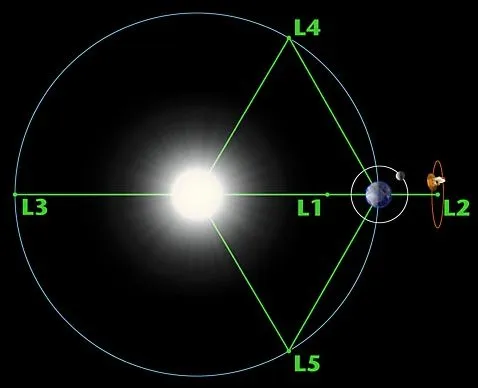
The duo of spacecraft, called STEREO, are approaching the Lagrange points. At these points, the gravity of the Sun and Earth combine to form "gravitational wells" where asteroids and stellar dust tend to gather. The mathematician Joseph-Louis Lagrange noted that there were five of these zones in the Sun-Earth system. The twin spacecraft are about to pass through two of them, called L4 and L5.
These regions, which are not just points (it's a mathematical term) but large zones of space, are also known as equilibrium or libration points. They are invisible zones of balanced, or librating, gravitational forces, within any two-body system (like Earth and the Moon), they rotate as the system rotates about its common center of mass. Five points are recognized with the following acronyms: L1, L2, L3, L4, and L5. L1 is located on the inner side of the second body; L2 on the outer side of the same body, and L3 is found on the far outer side of the primary body. L4 and L5, called Trojan points, lie on the orbit of the secondary body and around the primary, sixty degrees ahead of and behind the second body respectively.
During their journey, the spacecraft will use a wide-field telescope to search for asteroids orbiting the region. Scientists will be able to identify if a point of light is an asteroid because it will change its position against the background stars as it moves in its orbit.
"These points could host small asteroids, which could be debris from a Mars-sized planet that formed billions of years ago," said Michael Kaiser, a scientist at the Goddard Space Flight Center.
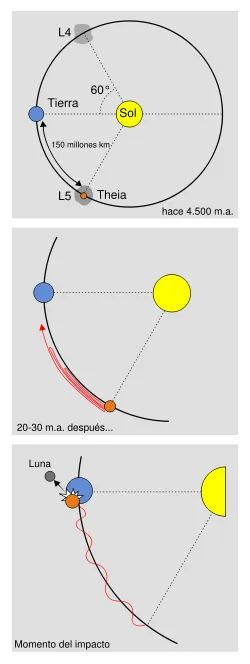
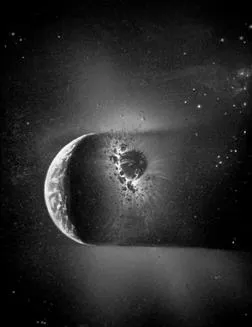
"According to Edward Belbruno and Richard Gott of Princeton University, about 4.5 billion years ago, when the planets were growing, a hypothetical world, named Theia, could have come out of L4 or L5 due to the increasing gravity of other developing planets, like Venus, sending it on a collision course with Earth. The resulting impact ejected the outer layers of Theia and Earth, which eventually merged under their own gravity to form the Moon," explained the scientist.
This concept is a modification of the giant impact theory about the lunar origin. The theory explains the Moon's rare properties, such as its relatively small iron core. At the time of the impact, Theia and Earth would have been large enough to be molten, allowing heavy elements like iron to sink to the center to form their cores. The impact would have stripped away the outer layers of both worlds, containing mainly light elements, such as silicon. The Moon would have eventually formed from this material.
"If we discover that the asteroids have the same composition as Earth and the Moon, it will support Belbruno and Gott's version of the giant impact theory. The asteroids themselves could be debris from the formation of the solar system. Furthermore, the L4/L5 regions could be home to asteroids that could collide with Earth in the future," explained Kaiser.
Analysis of lunar rocks brought to Earth by the Apollo missions reveals that they have the same isotopes (heavier versions of an element) as terrestrial rocks. Scientists believe the Sun and the worlds of our solar system formed from a cloud of gas and dust that collapsed under its own gravity. The composition of this primordial cloud changed with temperature. Since temperature decreases with distance from the Sun, whatever created the Moon must have formed in the same orbital location as Earth to have the same isotopic composition.
Although L4 and L5 are only points mathematically, their region of influence is huge—about 80 million kilometers along the direction of Earth's orbit, and about 16 million kilometers along the direction of the Sun. It will take STEREO several months to pass through them, with STEREO A making its closest approach to L4 in September and STEREO B approaching L5 in October.
The main mission of the STEREO mission is to provide three-dimensional images of space weather by observing the Sun from two points, where the spacecraft are located. The images and data are then combined for study and analysis. Space weather produces disturbances in Earth's magnetic fields that can affect power lines and cause large blackouts. It can also affect communications and navigation systems.
Sources and related links
- NASA twin spacecraft may reveal secret of Moon's origin
- Science@NASA: STEREO Hunts for Remains of an Ancient Planet near Earth
- STEREO site at NASA
- Lagrange points by WMAP (in English) and by Astroseti (in Spanish)
About the images
Illustration of the Moon and the great impact seen from the south pole: Wikipedia
Lagrange points of the Earth-Sun system. The STEREO probes will pass through L4 and L5. Solar observatories often "park" at L1, while deep space observatories prefer L2. Credit: NASA