Will physicists be able to predict solar storms with the same precision and efficiency that meteorologists predict hurricanes?
In a similar way that satellites allow forecasters to see the interior and development of a hurricane from its origin until it reaches the shore, NASA's STEREO spacecraft are capturing images of solar storms and making real-time measurements of their magnetic fields from the moment they leave the Sun until the moment their waves reach Earth's coasts.
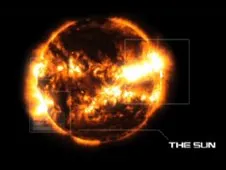
Eruptions from the Sun's outer atmosphere, or Corona, can wreak havoc on terrestrial technology. Solar hurricanes, known as coronal mass ejections (CME), spew billions of tons of plasma into space at thousands of kilometers per hour and carry some of the Sun's magnetic field with them.
These solar storm clouds create shock waves and a great disturbance in the solar system. The wave can accelerate some of the particles in space to high energies, a form of "solar cosmic rays" that can endanger spacecraft and astronauts. The CME material, which arrives days later, can alter our planet's magnetic field, the magnetosphere, and the upper atmosphere.
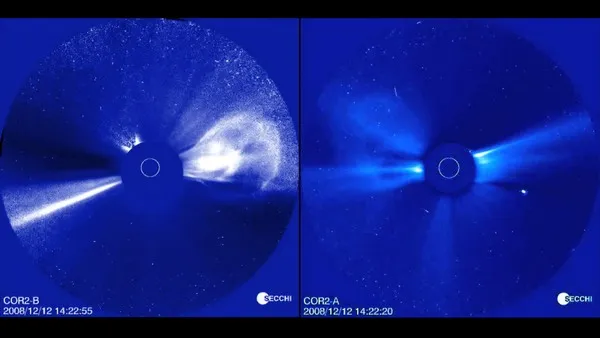
Observations from STEREO, a NASA mission composed of two twin spacecraft, have allowed scientists to precisely measure for the first time the speed, trajectory, and three-dimensional shape of solar storms.
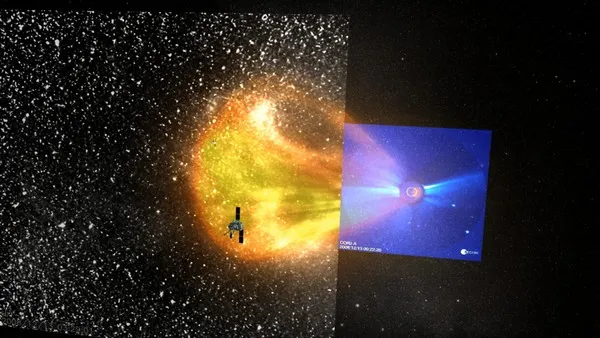
The spacecraft are observatories that perform simultaneous measurements from different points of view, one ahead and one behind our planet. When CMEs reach Earth's orbit, sensors on the satellites perform in-situ measurements of the solar storm cloud.
The combination is providing solar physicists with the most complete understanding to date of the inner workings of these storms. It also represents a great step towards predicting when and how the impact will be felt on our pale blue dot. The separation angle between the satellites allows researchers to track a CME in three dimensions, something they have done many times in recent years, having learned to use this new space weather tool.
"Now we can see a CME from when it leaves the Sun's surface until it reaches Earth, and we can reconstruct the event in 3D directly from the images," said Angelos Vourlidas, a solar physicist at the Naval Research Laboratory in Washington.
Until now, CMEs could be observed near the Sun but subsequent measurements had to wait until the cloud arrived at Earth, three to seven days later. Thus, energy companies and satellite operators have more time available to prepare for these dangerous events.
Angelos Vourlidas, Project Scientist, SECCHI instrument Naval Research Laboratory
As with hurricanes, whose destructive force depends on their direction, size, and speed, the severity of the effects of CMEs depends on their size and speed, as well as whether they will reach Earth's orbit directly or obliquely.
CMEs alter the space dominated by Earth's magnetic field. These alterations to the magnetosphere can generate the bright colors and dancing lights known as auroras.
Better understanding solar storms becomes important as they interfere with communication systems, between satellites, ground stations, airplane pilots, and astronauts. The radio noise from a storm can also affect cellular telephone communication service. The disturbances in the ionosphere caused by CMEs can distort the accuracy of global positioning systems (GPS), and in extreme cases, induce stray electrical currents in power cables and transformers.
In the NASA press release, cited below, higher resolution images and animations can be obtained.
Sources and related links
- NASA’s STEREO Spacecraft Reveals the Anatomy of Solar Storms
About the images
Credit: NASA's Goddard Spaceflight Center
Visualization of a coronal mass ejection on December 12-13, 2008 seen simultaneously by the two STEREO spacecraft. The images on the right were taken by STEREO-A, and those on the left by STEREO-B. The images were taken by STEREO's COR2 telescopes.
Angelos Vourlidas, Project Scientist, SECCHI instrument Naval Research Laboratory
Conceptual illustration and data visualization showing the STEREO-A spacecraft observing the CME of December 12-13, 2008.
Credit: Walt Feimer, NASA