It is the name of a scientific-educational initiative, which operates year-round at the Museo Participativo de Ciencias of the Centro Cultural Recoleta.

Assembling electrical circuits, seeing oneself reflected as a giant or a pygmy, projecting colored shadows, learning each participant's hearing range, communicating wirelessly over a distance, levitating like a real magician, and playing with optical fibers and laser beams are some of the activities that can be done.
Rooms
Visual perception
In this room you will find phenomena such as optical illusions related to color and movement, impossible figures, contradictory images, and many more surprises!
Mechanics
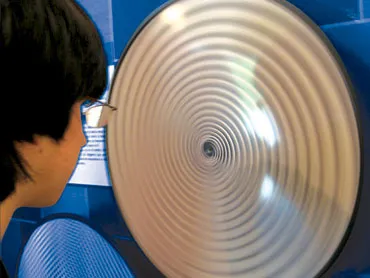
A set of exhibits deals with the main laws and principles that govern the mechanical world.
Some exhibits agree with the observer's common sense and others challenge it, awakening the visitor's curiosity.
Tech
A space where you can understand and learn about different technologies.
You will be able to see: how a radar detects planes and storms; learn how satellites work; what a GPS is; touch a virtual keyboard, understand how a remote control works.
And many more things that will surprise you.
Forces of nature
Winds, water, storms, and other natural phenomena, which affect the climate and our lives, are the theme that inspires the Forces of Nature room.
And there was light
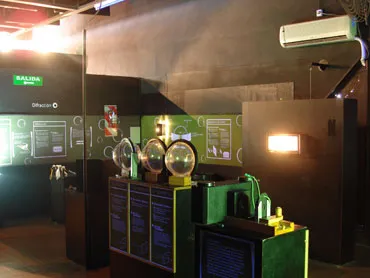
This room introduces us to the complex world of light, optical instruments, and the sense of sight.
A set of interactive and interrelated exhibits leads the visitor through the principles that govern the universe of light.
Don't go with the flow
Electricity is present at every moment of our lives, from lighting to communications.
But: What is it and what laws govern its universe?
Don't kill me, mathematics
Hated by many and loved by few, mathematics has provided solutions without looking at who, since prehistoric times.
This room invites you to get to know them from another angle, with concrete applications in everyday life.
And more
Art; cooking; music, waves and sound...
Auditorium
In the Auditorium-Demonstrations Room, during visiting hours, attractive demonstrations are presented:
- Static Generator that makes your hair stand on end.
- Watch the Bug! with the spider Juli, the frog Ale and the crickets, we will recognize differences and similarities between us, arachnids, amphibians and insects.
- Demonstrations with Liquid Gases.
- Chemistry Demonstrations.
On the Museum's website, in the "Auditorium" section, there are videos about the rooms.
About the Museo Participativo de Ciencias
The Museo Participativo de Ciencias is an institution dedicated to the popularization of science in a playful and participatory way.
The Museum has a significant number of interactive exhibits, which stimulate the visitor's curiosity, offering them the freedom to play and the desire to learn more. It is an active proposal for the public of all ages.
The Museum opened its doors in 1988; to date it has been visited by more than 2,000,000 people.
It has also been a model and origin for similar initiatives in the country such as the Parque de las Ciencias in Mendoza and the southernmost interactive museum in the world in Río Gallegos; and in neighboring countries through UNESCO.
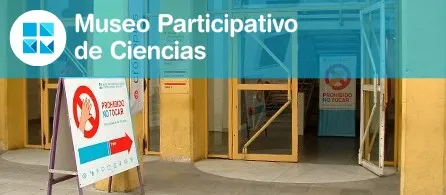
It operates within the Centro Cultural Recoleta, Junín 1930, 1st and 2nd floors.
It is run by the Fundación Museo Participativo de Ciencias, a non-profit organization.
Tel/Fax: 4807-3260 / 4806-3456 email: [email protected]
Aimed at the general public, the exhibition can be visited Monday to Friday from 12:30 to 19:30 h; and on Saturdays, Sundays, and holidays, from 15:30 to 19:30 h.
The bus lines that pass near the Museum are: 10,17,37,38,41,59,60,61,62,64,67,92, 93,101,102,110 and 130
Admission costs $12.-
Sources and related links
- Museo Participativo de Ciencias
- Educ.ar: "Prohibido No Tocar" during the winter holidays
About the images
- Images from the Museo Participativo de Ciencias