Next week, the general assembly of the IAU will meet again, in Rio de Janeiro, for the first time since Pluto's "demotion" to the dwarf planet category. Are there any chances of restoring its "status"?
According to the head of the International Astronomical Union (IAU), Karel van der Hucht, the resolution from the previous meeting, in Prague, is not expected to be challenged, but Pluto fans continue to unite, in resistance.
It is not the first time that, since the planet category was redefined and the dwarf planet category was established, in 2006, Pluto's defenders bring the debate to the fore at some astronomers' meeting. We reported on it last year in "The Pluto debate reignites", where we reviewed the issue. And this, despite the IAU decided that planets similar to Pluto would now be called "Plutoids".
If any possibility exists for the object to be reinstated to its previous category, it will surely come from new discoveries, rather than continuing with the current debate. Mark Skyes, from the Planetary Science Institute in Arizona, believes that discoveries inside and outside our solar system, in the coming years, will make the new resolution unsustainable. "We are in the middle of a conceptual revolution. We are shaking off the last vestiges of the mythological view of planets as special objects in the sky, and the idea that there must be a small number of them because they are special."
Skyes believes that the current missions en route to Pluto and to Ceres will reveal these dwarf planets as active and intricate worlds. Meanwhile, astronomers might find distant objects as large as Earth that the IAU would not define as planets.
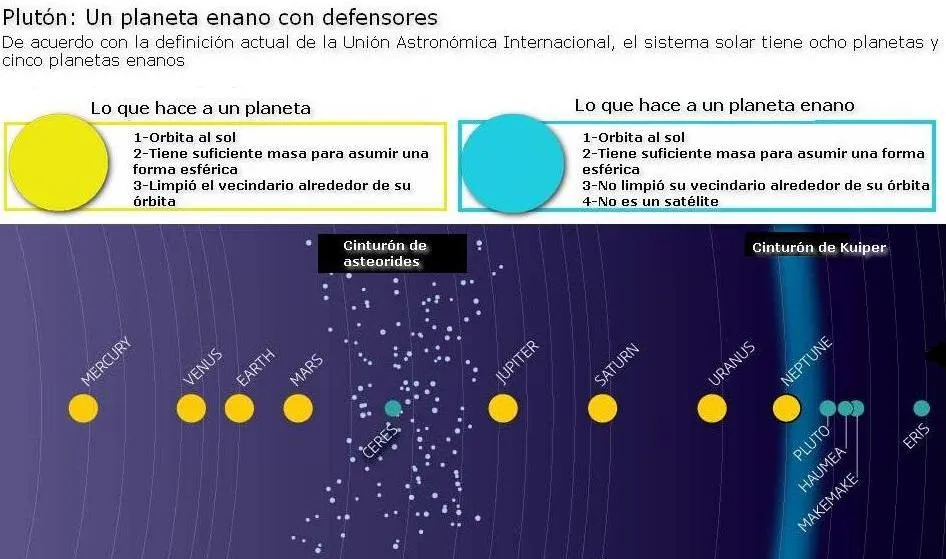
The scientist is among those who prefer an inclusive and simple definition of planet status: if an object is large enough for its own gravity to shape it into a spherical form, it should be a planet. That would not only bring Pluto back to its former class of object, but would immediately elevate the status of a large number of other bodies.
The IAU originally proposed something similar, but in Prague (the 26th General Assembly), a faction objected, pointing out that Pluto was just a piece of debris, one of the many icy objects beyond Neptune in the so-called Kuiper Belt. The objection came on the grounds that if a simple definition were chosen, many of those objects would reach the planet level and they persuaded the Assembly to add a condition: that the planet must clear its neighborhood around its orbit. Thus, only eight objects in the solar system could compose that category, demoting Pluto. Otherwise, the number of planets in the solar system would have risen to at least 12, considering the known objects. But it was argued that many more objects should be included in a simple category, as they were discovered.
Alan Stern, from the Southwest Institute in Colorado, is probably not very objective, as he leads NASA's mission to Pluto "New Horizons". However, what he explains must be considered: "No definition that allows a planet in one location but not another is unworkable. Take Earth. Move it to Pluto's orbit, and it will be instantly disqualified as a planet."
While Earth's gravity is strong enough to have cleared debris from its relatively small neighborhood, two factors would cause it to fail to do so if it were in Pluto's place: the outer solar system is vast and everything moves much slower out there. According to Skyes, 4.5 billion years would not have been enough for a small and slow Earth to sweep its surroundings.
In 2015 the New Horizons spacecraft will reach Pluto. It is expected, then, to reveal a complex landscape and an active atmosphere. Later, the "Dawn" mission will arrive at Ceres, the same year. The infrared light spectrum of Ceres suggests that parts of its surface are covered in clay, which could be a sign of geological activity. On Earth, clay is created when hot water flows through rocks. (It could also be an astronomical setting for Nadal to play!).
Likewise, the list of exoplanets grows ever faster. Along with the new knowledge of the bodies that make up our outer solar system, we could have new data on worlds that may seem much more than "simple asteroids".
Could that change astronomers' attitude? Certainly, there is a psychological-cultural component, to call it something. Perhaps, finding some kind of life on an object that cannot be called a planet, given the current definition, could change things. The idea that remains is that planets are special because we think life is more likely to arise there, more than on other bodies in a planetary system. But we don't have many examples to compare.
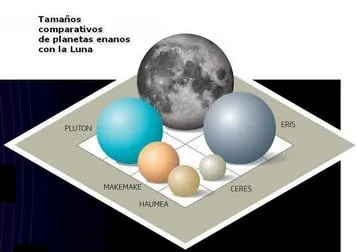
The definition based exclusively on the "roundness" of objects is, of course, also debatable. One would have to define to what extent a body can be called "spherical" and when not. There will surely be controversies there, when we notice objects very close to the definition, but not enough.
On the other hand, if that were the only condition, shouldn't the Moon be considered a planet too?
It is not the only controversial definition in astronomy. A while ago we commented here on some researchers who do not like the use of the Astronomical Unit (See: "They propose to redefine the Astronomical Unit"). And the controversial definition of brown dwarf is well known, objects that are halfway between stars and planets.
The truth is, there is discontent with the new definition and, perhaps, with new discoveries, the concept of planet should evolve. What does not seem logical is that definitions are modified every three years. And there should also be no discrimination. I mean, ultimately, the "fans" of Pluto feel that their favorite rock was "demoted" just because it is now "dwarf". Not only is there nothing wrong with being a dwarf (I say this from my one meter sixty height!), but it does not have, it should not have, a human analogy, a "personification". If that were the case, let's opt for a more "neutral" nomenclature: Type I Planets, Type II, etc., without particular labels that might hurt the sensitivity of sensitive astronomers and poets.
Binary planets
We know that a binary star is a stellar system composed of two stars that orbit each other around a common center of mass.
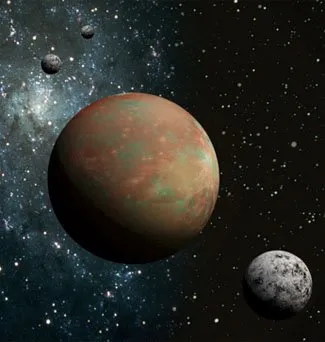
The term "binary planet" is used to describe a pair of worlds similar in mass. Each orbits the other around a point of gravitational equilibrium that is between them, the common center of mass. When one object has much more mass and the objects are far apart, the center of mass is close to the larger body. This is the case of Earth and the Sun. In the case of Pluto and Charon, separated by 17 Pluto radii, the ratio of their masses is 8:1, so the center of mass is outside Pluto. Most satellites in our solar system are too small, compared to the planet they orbit, to place the equilibrium point far from the center of the primary body in the system. But the mass ratio of Pluto to Charon is very small compared to other planet-satellite systems, which is about 10,000:1. Although Pluto-Charon is the only binary planetary system in the solar system, there are binary asteroids and binary Kuiper Belt objects.
Sources and related links
- New Scientist: Is Pluto a planet after all?, by Stephen Battersby
- XXVII General Assembly of the IAU
- The largest dwarf planet is Eris
- Makemake: a new plutoid
- Dwarf planets will be Plutoids
About the images
- Pluto:Planet or not:Planets and dwarf planets in the solar system
Credit: NewScientist - Comparison of dwarf planets and the Moon
Credit:NewScientist - Illustration of Pluto and Charon
Credit: NASA/JPL