And at last it arrived. And it is wonderful. A summary of the purchase, procedures, and assembly of a Galileo Telescope.
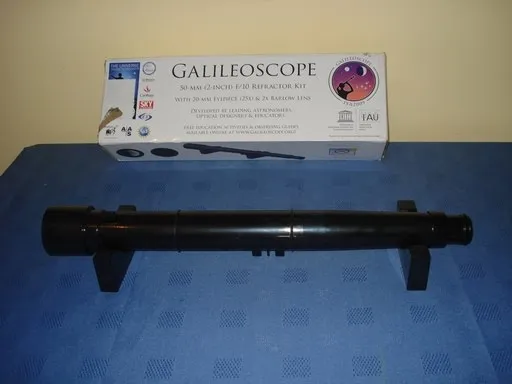
The Galileoscope is a low-cost, good-quality telescope developed for the International Year of Astronomy 2009 by a team of astronomers, optical engineers, and educators. It is a design similar, but modern, to the one built by Galileo Galilei 400 years ago. This 50-mm refractor offers magnifications of 17x and 25x (50x with Barlow) depending on the configuration. Galileo's design produces a "correct", upright image, but with a very small field of view. The other option, with the main eyepiece, is "Keplerian" and yields an inverted image. With the 2x Barlow lens, the total magnification doubles to 50x but you will observe a smaller portion of the sky in its field of view.
I had known about the novelty for a while, but it was a blog entry that made me decide to buy one. Phil Plait, the astronomer creator of Bad Astronomy, published a post urging us to get a Galileoscope on May 28. That day I bought mine and knew it would take a couple of months. But it was almost four. The notice from Correo Argentino, which arrived this week, indicated that they had already left a notification for me at the beginning of August. I never received it. This was the second notice and I had to pick it up before the 19th of this month.
As is logical for merchandise coming from abroad -except for books- there is an import procedure ahead, which is why the Postal Service cannot deliver the material until the procedure is completed.
I gathered courage and ran to the international office, in the Retiro neighborhood of the Capital Federal of Buenos Aires. After a loooong wait, they call my number and I go to an office where I see boxes rolling on a conveyor belt. The terror that the lenses might have broken took hold of me. However, those boxes were not my device, which was waiting for me on a small table. I point it out, they ask me what it is and how much I paid for it.
At that moment they inform me that the merchandise pays 50% of its cost and shipping as import duty. But they also tell me that each person can import merchandise up to $25 per year without paying that fee.
The AFIP website states:
Shipments whose values are up to $25 will be exempt from import taxes. This exemption is per person and once per calendar year.
Between $25 and $999:
These shipments will pay a single tax of 50% on the excess.
That is, if the Galileoscope, whose value was (when I bought it) $15 and its shipping double, totaling $45, the $25 is deducted, resulting in $20, on which half is charged as a fee, $10, at the exchange rate of that day.
This tax is paid at the Banco Nación window right there, a few meters away, after which the merchandise is delivered. Before leaving, you have to pay a $4 fee to the Postal Service for the procedure and -finally- I left with my telescope for home.
Currently, the value of the Galileoscope is $20 and shipping to Argentina is $36. On the site, the value can be calculated before finishing the purchase process. We add the product to a "cart" and then proceed to "Check out", all this without having registered or entered any personal data. Only on the next screen will they ask for our data. There, before filling in our details, we can choose our country and city in the section ("Delivery information") and, further down, we will have a button to calculate shipping ("Calculate shipping cost").
Payment methods are via PayPal or credit cards.
At home
I planned to assemble it tonight or tomorrow, but since I had problems with the internet connection this morning, I took advantage of the time to look at each part and start assembling it. I assembled and disassembled it several times and a summary of the process I recorded (and edited) in the video already hosted on YouTube, which accompanies this note.
The box contains all the parts and is divided into two levels. In the lower part are the two halves of the tube and in the upper part the rest. The lenses were very well protected and the contents include a synthetic manual, in English.
I recommend, however, that for those who have the same good fortune, consult the two guides available on the Galileoscope site, in pdf. One of the files is in Spanish (PDF 398 KB) and the other only contains images (PDF 3.8 MB), so it is universal.
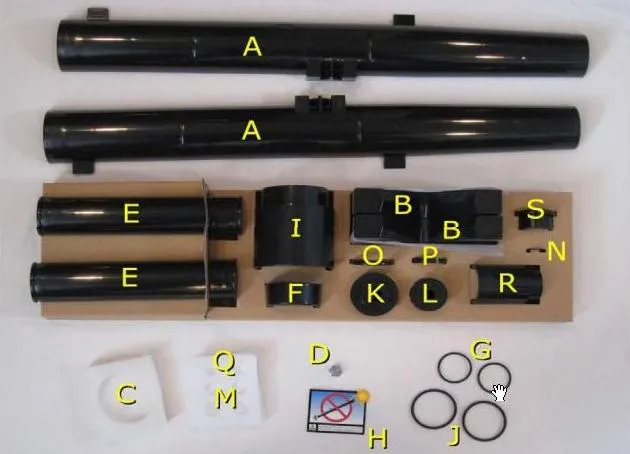
The box contains:
List of parts (in assembly order)
A halves of the main telescope tube (2)
B bases/feet (V-blocks) (2)
C 50-mm glass lenses
D tripod nut 1/4-20
E halves of the focus tube (2)
F main tube ring
G small rubber rings (2)
H Sun warning sticker
I large cap to protect the lens from sun/dew
J large rubber rings (2)
L halves of the auxiliary eyepiece tube (2)
M small main eyepiece lenses (4)
K halves of the main eyepiece tube (2)
N thin and small eyepiece stop
R tube for Barlow lenses
S auxiliary cap for eyepieces
O large eyepiece ring
P small eyepiece rings (2)
Q small auxiliary eyepiece lenses (2)
Galileoscope http://www.youtube.com/watch?v=zBD32enwJkg
Tripod and star diagonal
A tripod is not included and I will have to buy one urgently because the slightest vibration is notably detrimental. And it does not have enough focus to allow the use of a star diagonal, a common accessory that goes between the telescope and the eyepiece and allows you to avoid having to crane your neck when observing celestial objects at great heights.
That is why it is recommended to observe sitting in a chair with the telescope on an extendable tripod.
But that will be for tomorrow, if possible, or at most next week. For now it rests on a shelf, until I can test it at night, if the weather permits.
With the tripod, on which I will surely also be able to use the digital camera, perhaps I will make a new video, better than the one made now.
Sources and related links
- Galileoscope
About the images
- Image of MY Galileoscope. Credit: Gerardo Blanco
- Image of the parts of the Galileoscope. Credit: Galileoscope