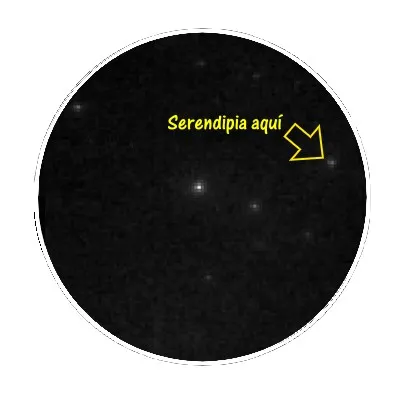
On February 4, NASA transmitted the fabulous four from Liverpool toward the star Polaris. That day was the 40th anniversary of the recording of the song "Across the Universe" and also the space agency's 50th birthday. But how far will the echoes of the song have reached?

Why comment on a news item seven months late?, you might ask. It's because Ian O'Neill, from Space Disco, thought that when talking about space, time, and interplanetary and intergalactic distances, 200 days is almost nothing. Even 200 years is little for the ionized tail of a comet; 200 thousand years is a fleeting moment when we talk about stellar evolution, universal expansion, and the vastness of space.
And so he wondered how far the Beatles' signal will have gotten. 218 days (18,835,200 seconds) is nothing on a cosmic time scale, especially with Polaris as a target 431 light-years from Earth (it would take the musicians' signal 431 years to get there, since radio waves travel at the speed of light), but will the signal have reached any planet?
Actually, "Across the Universe" didn't visit any planet in the solar system nor did it get close to any other star.
How can that be? The Moon is only 1.255 light-seconds away (light takes 1.255 seconds to travel from Earth to the Moon); even Pluto is seven light-hours away. But the signal sent via the Deep Space Network (DSN) wasn't sent along the plane of the ecliptic (where the planets orbit the Sun), but to the north of it. Thus, the signal never passed by any planet in our Solar System.
Well, but did the signal get anywhere?
"Across the Universe" was transmitted to Polaris 218 days ago. Traveling at the speed of light, it covered the distance of 0.59 light-years or 3.5 x 10¹² miles or 3.5 trillion miles. That's a bit more than 5 trillion kilometers.
We can calculate it like this:
The signal traveled for 218 days. We convert it to seconds (because the speed of light is km/s):218*60*60*24=18,835,200
What we did was multiply each day by the number of seconds it contains. One day has 24 hours of 60 minutes each of 60 seconds each.
The speed of light is 300,000 km/s (rounding), meaning that in one second light travels 300,000 km. If our signal traveled for 18,835,200 seconds, we multiply that figure by 300,000 and get 5,650,560,000,000 km traveled in 218 days (5.6 x 10¹²).
Another way to get the same result is to think like this:
The signal is a wave moving at the speed of light. And it left 218 days ago, so it traveled 218 light-days.
Now let's forget about light-days for a moment. Let's just think about days. If someone traveled for 218 days, how can we express it in years? Obviously it's less than a year. We do it like this 365/218=0.5973 years.
The same applies in this case, the signal traveled 0.59 light-years. Let's not lose sight that we are calculating distance, not time. Now we want to know how many kilometers those 0.59 light-years are. How many km is 1 light-year?
Well, in one year light travels 300,000*60*60*24*365 (seconds, minutes, hours, days)=9,460,800,000,000 km.
But the signal didn't travel a light-year, since we saw earlier it only did 0.59 light-years.
We multiply the light-years traveled by the km in 1 light-year and thus arrive at the same result:
9,460,800,000,000 * 0.5973=5,650,560,000,000.
A signal, at the speed of light, travels in 218 days, 0.5973 light-years, that is, about 5 trillion kilometers.
In cosmic distances it's like going from the front door to the garden fence.
The nearest star (beyond the Sun), Proxima Centauri is more than 4 light-years away, so the Beatles' song has only traveled one-eighth of the distance to the nearest star to home (although the signal isn't going in that direction).
But it will be able to reach Polaris in...431 years!!
However, as Ian points out, in the coming months, the song will be able to be heard in the Oort Cloud. This is a hypothetical volume of space around the Solar System, at approximately 1 light-year distance. The icy objects there will "dance" then to the sound of "Jai Guru De Va Om", but nothing's gonna change my world...
The Beatles - Across The Universe http://www.youtube.com/watch?v=YCKANiM9tUM
Lyrics of "Across the Universe"
Words are flowing out like endless rain into a paper cup
They slither while they pass
They slip away across the universe
Pools of sorrow, waves of joy are drifting through my open mind
Possessing and caressing me
Jai Guru De Va Om
Nothing's gonna change my world
Nothing's gonna change my world
Images of broken light which dance before me like a million eyes
That call me on and on across the universe
Thoughts meander like a restless wind inside a letter box
They tumble blindly as they make their way across the universe
Jai Guru De Va Om
Nothing's gonna change my world
Nothing's gonna change my world
Sounds of laughter, shades of earth are ringing through my open views
Inciting and inviting me
Limitless undying love which shines around me like a million suns
It calls me on and on across the universe
Jai Guru De Va Om
Nothing's gonna change my world
Nothing's gonna change my world
The Beatles
Source: musica.com
Sources and related links
- Space Disco: Oort Cloud To Echo With The Sound Of Beatles, by Ian O'Neill
- Note: 218 days passed from 2/4/09 to yesterday 9/10/09. The speed of light was taken as 300,000 km/s for the calculation because greater precision is not warranted for the desired purpose.
About the images
- Image Ian O'Neil