Knowledge of physical phenomena helps us not only to better understand nature, but also to amaze friends at parties.

On the occasion of the I Carnival of Physics, given that my knowledge is limited and self-taught, I started diving among the books that populate my library in search of a topic I could cover.
And there I found an old copy of "Otras pruebas y juegos científicos", by George Barr. It is a work translated from the original English and published by Kapeluz in 1971.
I remember the book fondly because I tried to carry out several of the experiments, with varying results.
One of them I had to repeat many, many times in front of the long faces of my teenage audience. And I was not successful... at that moment. It was necessary to try again on more occasions to get an optimal result. It is about "defying gravity" with the vacuum cleaner.
From personal experience, it is extremely advisable not to leave our mothers' vacuum cleaner running for a long time because the result can be fatal, as well as not to block the air outlet.
The idea is this:
We have the "body" of the vacuum cleaner, the machine, from which a hose comes out. We will connect an extension tube to the end of the hose. If it's two tubes or one long one, better. The tube must be vertical, for which we can tie it to a post, beam, or simply a chair. To make the air outlet uniform, we can place a funnel at the end of the tube (we'll have to use adhesive tape so it doesn't come off).
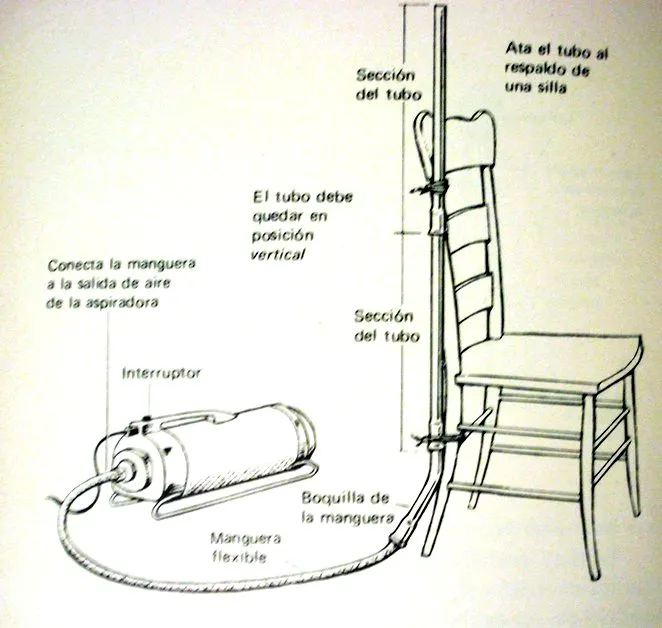
Then we inflate a medium or large balloon, which must be well sealed.
We can do the same thing with a hair dryer and a light ball.
Everything ready for our "scientific magic act":
We turn on the vacuum cleaner and place the balloon in the center of the air stream, above the end of the vertical tube. A priori, it might seem logical that the balloon "flies", that it goes up. But, contrary to intuition, the balloon should remain suspended in the air stream.
Wait. We know why the balloon "flies", right?
As I noted before, several tests will have to be done until the necessary adjustment is achieved. Something that works against the exercise is having walls too close or a ceiling too low as they will reflect the air stream. If there are "external" air currents to our experiment (open windows, doors, etc.) it may also fail.
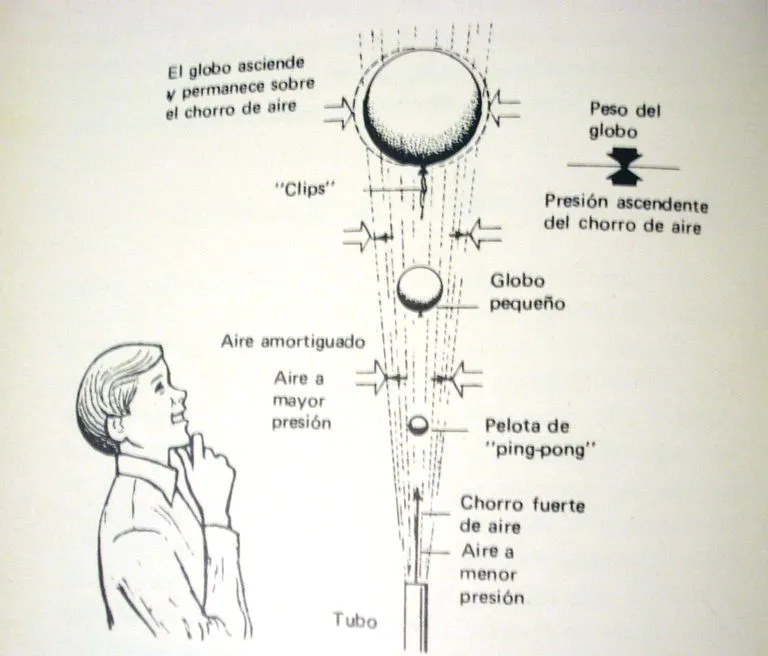
To the amazement of friends, the balloon will remain suspended, although it may move to the sides. With a little weight on the balloon we will achieve greater stability. We can attach some metal clips or other light objects to the balloon's nozzle.
And why does the balloon stay like that?
It is a demonstration of Bernoulli's Principle that physicists use to explain the behavior of fluids. "When the speed of a fluid increases, its pressure decreases."
Thus, the air coming out of the tube forcefully has less pressure than the "still" air surrounding it. When a random movement moves the balloon away from the air jet, the greater pressure of the outside air pushes it back towards the area of lower pressure, that is, the air coming out of the tube.
It is also possible to untie the tube, hold it firmly with your hands so that it is perfectly vertical, and perform the experiment while walking, which generates more drama, right? Of course, here there are more things that can go wrong, but with persistence it can be achieved.
And we could also add another balloon, smaller, to make it more eye-catching.
We can apply this same principle to achieve other effects. For example, have the tube close to us and reach up to our navel (more or less). We put a ping-pong ball and put our hands to the sides as if we were making it levitate. At that moment, a friend could take a photo of us, for example. Or a video, although you would hear the vacuum cleaner!
If we are not content with performing this "show", we can do another one, even better. We can try to explain what is happening.
It is about what Daniel Bernoulli found regarding fluids (a liquid or a gas). He experimentally verified that the pressure of the fluid decreases as the speed of the fluid increases, and vice versa. In other words, in a moving fluid, the sum of the pressure and the velocity at any given point remains constant.
If p is the pressure and v the velocity, then p + v =k, where k is a constant. For k to remain constant if p increases, then v must decrease, and vice versa.
Of course, the formulation is a bit more complex, but below I indicate some more links so that those interested can delve deeper into the topic and learn about some of the applications of the Principle in everyday life.
Sources and related links
- Other Tests and Scientific Games
G. Barr, Ed. Kapeluz, 1971, Buenos Aires - Sailing: from work to fun
- FisicaNet: Fluid Dynamics
About the images
- Images from "Otras pruebas...". Credit: Ed. Kapeluz