Sociologist Pablo Kreimer invites us to travel the paths of science, but along internal trails. The researcher researched, despite his precise lexicon and his radiant lab coat, is also a human being.
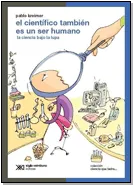
Book details
The scientist is also a human being
Science under the magnifying glass
Pablo Kreimer
Ed. Siglo XXI
Collection Ciencia que ladra…
144 pages | 19 x 14
ISBN 978-987-629-084-5 June 2009
Imagine a subject sitting in a chair with a spotlight on his eyes.
As if Pablo Kreimer, sociologist from UBA, were interrogating a scientist about his CV and he replied: "The story is very simple. You observe, then..." and there the song would be interrupted by a waterfall of questions:
What do you observe? And why do you observe that and not something else? What importance does that have?
The doctorate in science, technology and society from CNAM and author of the work in question, guides us through the labyrinth of science with his magnifying glass and a subtle sense of humor. His language is close and pleasant, as if he were a cousin who returned from a long trip and tells us about his adventures.
These adventures will allow us to travel through different geographies: laboratories in France or England. But also different times, since the journey is also historical.
This "intruder," who meddles in the facilities to inquire about scientific work, addresses in the first chapter of his book the functions of science. Ultimately, what is it and what is its purpose?
To answer, we will take a fast train through the biography of modern science that will have three stops (or stages): institutionalization, professionalization, and industrialization.
The role of the State and the relationship with the results of science are addressed, to finally account for its social role.
Talking mice?
In the second chapter, Kreimer snoops around laboratories to study scientists as if they were mice. He does this supported by the experiences of other sociologists like Bruno Latour and Karin Knorr-Cetina. At the beginning of the 1980s, a series of sociological studies on scientific work were carried out simultaneously. "Laboratory Life," by Bruno Latour and Steve Woolgar, stands out, considered one of the most influential works in the field.
The sociologists poked around in the laboratories as if those redoubts housed strange tribes that lived locked in their huts. How are scientific facts constructed from the laboratories? Where do statements come from and how do they develop?
Latour pointed out that a scientific fact is a weak statement, easily refutable, which will be attempted to be reinforced through "proofs." And the goal will be to strengthen the statement to be able to convince others of its validity, through inscriptions (the records of the experiments: photos, traces, etc.).
In contrast, for Knorr-Cetina the process of knowledge rests fundamentally on human relationships. Thus, everything scientists do is important and not just the experiments: applying for a grant, buying equipment, etc.
Kreimer recounts his own experiences in different laboratories and addresses the problem of method.
Can the observer be a conditioning factor? Can they be impartial? Is it necessary to know something about the topic beforehand: the jargon, the methods?
The difficult arenas

In the third part, the author proposes we investigate the ways scientists organize themselves, outside the laboratory. Researchers gather in communities that possess certain rules. But they also compete in the scientific field, to gain greater authority. And a third way to analyze the organization is the one suggested by Knorr-Cetina: trans-epistemic arenas, that is, spaces that are beyond knowledge itself. Because indeed a researcher will relate in different ways with diverse groups or individuals. And they will do so not only in the research itself of a topic, but to achieve the necessary resources. Ultimately, the sociologist prefers to understand scientific organization as dynamic and changing, unlike the static, harmonious, and tidy structures that seem less realistic.
Pei per (viú)
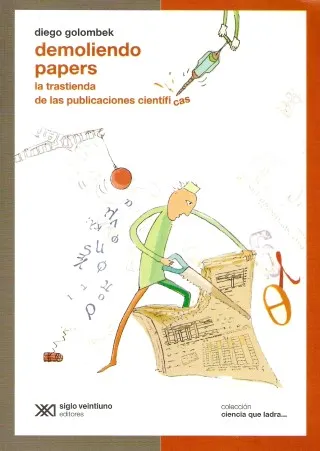
The next chapter (Publish and punish) delves into the production of science articles, using previously published concepts (1) such as in the introduction to "Demoliendo papers", by Diego Golombek, which we recently commented on here.
The science from here
Science is not the same everywhere, which is why the concepts of science "in" the periphery and peripheral science are introduced. In the first case we would be looking at excellent development in countries limited by their resources. Something like The South Also Exists.
In the second, science is conceived as limited in generating innovative knowledge. Or The South is the North.
Reality, however, is often different, mixing everything up a bit. Kreimer prefers to speak of scientific traditions as identifications of a country's scientific idiosyncrasy.

Beware of the "CANA"
According to the researcher from Quilmes, Applicable Knowledge Not Applied (CANA) characterizes, above all, developing countries. That is, applied research that is not applied, a "potential" study that is left wanting to be, like in a sad tango.
According to the sociologist, two-thirds of the research in our country is "applicable" and he provides three damning examples of "failed projects." It is also true that it's easy to read Monday's newspaper. However, that research "comes to nothing" is usually not true. This is where the author categorizes the "disciplinary regime," legitimized by its contribution of knowledge and in contrast to a "transversal regime," which leaves the laboratory for society with a criterion of effective utility.
The great powers can aspire to both things with abundant resources of all kinds and carry out basic and applied research. In developing countries, should the outlook be similar or aim for science that produces a better quality of life in society? Kreimer presents the state of affairs as a subordinated integration (of local teams into international ones) (concerning research lines).
Perhaps this is the knot that must first be untied in the social debate. There is a whole chain of links that depend on the analysis of what science we should/want to do. From there, specific education is promoted, human resources and specific training are poured in, equipment is acquired and facilities are built. If there is no connection between what we want to do and what we actually do, we will end up, every now and then (or every 2x4) Going Downhill.
Conclusion
I believe Kreimer's text is an excellent initial approach to the world of science, its method, and, fundamentally, its role. The topics are not exhausted in the book's 144 pages, but rather aim to be a good basis for further inquiry into the zigzagging paths of science and the people who build it.
The figure of the observer/analyst can seem, at the same time, comfortable (for the social researcher) and uncomfortable (for the researcher being studied).
Can you imagine someone attentively noting down everything we do in order to understand our activity? That's what sociologists do, in this case, with scientists. And it is also what the latter do with stars or plants.
Now I would like to know who conducts the same study with the sociologists themselves, to find out if they are also human beings.

About the author
In addition to the above, Pablo Kreimer, born in Buenos Aires, is a researcher at Conicet, full professor at the Universidad Nacional de Quilmes, where he currently directs the Institute of Studies on Science and Technology, and the Master's in Science, Technology and Society. He is also the editor of REDES. Revista de Estudios Sociales de la Ciencia.
Sources and related links
- (1): Kreimer, Pablo (1998): Publish and Punish. The Paper as a Problem and the Dynamics of Scientific Fields
Redes : revista de estudios sociales de la ciencia
No. 12 - Vol. 5, pp. 51-73
PDF at IEC - Kreimer, Pablo (1999):The Role of Scientific Journals in Structuring a Field
In: Ana María Cetto, Octavio Alonso (eds.): "Las publicaciones científicas en América Latina". Mexico, Fondo de Cultura Económica - BBC: La ciencia, de la escuela al laboratorio
by Lorena Nessi in the Special:"Cómo se hace un científico" - Kreimer, Pablo (2005): "On the Birth, Development and Demolition of Papers". In: Golombek (ed.), Demoliendo papers. La trastienda de las publicaciones científicas. Buenos Aires, Siglo XXI. ISBN: 987-1220-08-1
- Kreimer, Pablo. Review of "La fabricación del conocimiento. Un ensayo sobre el carácter constructivista y contextual de la ciencia" by Karin Knorr Cetina: Redes [online] 2005, vol. 11 no. 022 [cited 2009-11-19]. ISSN 0328-3186
About the images
- Cover of "El científico...". Credit: Ed. Siglo XXI
- Marguet, the uncertain cat. Credit: La evolución de las especies