The Gemini Project is an international agreement in which the Argentine Republic has participated since its inception and whose commitment extends until the year 2011 inclusive. Here we review its recent history and the latest news.

The Project
The project's objective is to build, install, commission, and operate two (2) telescopes with an 8.1-meter diameter, one located in the northern hemisphere (Mauna Kea, Hawaii) and the other in the southern hemisphere (Cerro Pachón, Chilean Norte Chico). To achieve this purpose, an international consortium has been formed, consisting of the United States, the United Kingdom, Canada, Argentina, Brazil, Australia, and Chile.
The design of both telescopes, the instrumentation, and their installation site have been conceived with the aim of achieving images of the Universe of the highest quality. In particular, having a telescope in each hemisphere allows astronomers to observe almost the entire celestial sphere.
Argentine astronomers can request observing time on any of the available instruments. Thus, many researchers submit different observing projects semester after semester, demonstrating the interest of the community and the need for this technologically advanced tool to compete at the same level with researchers from abroad. The Argentine Republic has 2.5% of the total time available for science on each telescope.
The Telescopes
Both telescopes are identical, of the reflector and active type. They have a primary mirror 8 meters in diameter, consisting of a thin meniscus that can, as explained later, be deformed to obtain images of the best quality conceived to date. Image quality is one of the essential requirements of the design. For this reason, it was decided to have only a Cassegrain focus for the telescopes. The focal ratio of the primary mirror, that is, the quotient between its focal length and its diameter, is 1.8, and it has a central hole of 1.2 m. The secondary mirror has a diameter of just over 1m. The resulting focal ratio at the Cassegrain focal plane will be f/16. The focal plane will be approximately 4 meters behind the primary mirror. Figure 1 shows the northern telescope inside its dome.
How the Gemini South Telescope Works
http://www.youtube.com/watch?v=wKAWvbWKi30
More: Visit to the Gemini South Observatory
More videos at Gemini Observatory
History
The Argentine Gemini Committee was formed by a decision of the then National Secretariat of Science and Technology dating from 1992. That Argentine Gemini Committee, which had an advisory role to the Secretary of Science and Technology, had a coordinator who was Dr. Jorge Sahade. That Committee had representatives from all the country's astronomical institutions and the Argentine Astronomical Association.
One of the initial concerns of the Committee was always the lack of institutionalization of Gemini: the lack of a resolution from a national entity that would assume the commitment to be the executing agency of the Gemini Program and that would endorse the Argentine representatives in their local and foreign tasks.
In May 2001, Dr. Sahade resigned from the Argentine Gemini Committee, and the then Secretary for Technology, Science and Productive Innovation of the Nation, Dr. Adriana Puiggrós, and Dr. Roberto Oscar Aquilano accepted it and appointed Dr. Jorge Sahade as Consultant for Special Affairs of the Secretariat through Resolution 147 of October 25, 2001, and accepted a proposal from the Argentine Gemini Committee to institutionalize it within CONICET. To this end, the corresponding procedures were carried out and it was institutionalized through Resolution 1156 of July 13, 2001, where, in addition to finally institutionalizing the Gemini project, the persons proposed to represent Argentina were provisionally appointed: Dr. Hugo Levato as representative to the Board, Dr. Nidia Morrell as Project Manager, and Dr. Guillermo Bosch as Project Scientist.
Subsequently, the next problem to solve was the debt owed to the organization, so, despite the economic difficulties the country was going through, Aquilano made a trip to the United States and met with leaders of the National Science Foundation, and upon his return, by mandate of the Secretary of State, initiated the corresponding procedures with the then authorities of the National Ministry of Economy, managing to settle the debt in December 2001 and prevent Argentina from being excluded from the project according to the organization's then-current rules.
Until 2007, each year the country maintained debts with the Project, but that year, on October 3, 2007, the program was transferred to SECYT (Resolution 2440/07) and it was decided to create the Gemini Program, which was established on October 17, 2007, by Resolution 656/07. Then the Argentine Gemini Committee (CGA) was created within the Gemini Program in November 2007. During the second half of 2007 and the first half of 2008, Argentina was suspended for non-payment, as had occurred between 2003 and 2004.
Once the new authorities assumed, Dr. Hugo Levato prepared a report for the Undersecretary of Evaluation of MINCYT. In that report, from August 2008, Levato indicates that MINCYT agreed to continue with the Program and approved the payment of 1,000,000 dollars for that current year.
Ultimately, the primary and urgent objective, which was to save Argentina from being excluded from the consortium, pay as quickly as possible, and restore use by Argentine researchers, had been achieved. An additional detail is that during 2008, and for the first time, Argentina began to pay its contribution to the instrumentation of ASPEN.
The "Aspen" Process
In June 2003, astronomers met in the city of Aspen, Colorado, to attend an instrumentation workshop that resulted in a planning process for the scientific objectives, future instruments, and the estimated cost.

Resolution 787/08 of 12/23/08 establishes that, in consideration of resolution 2440 of 10/3/07, the Gemini Project was transferred from CONICET to the Secretariat of Science and resolves the creation of the Argentine Gemini Office.
Resolution 095/09 of March 11 of this year, in consideration of the previous resolution, resolved to appoint the members of the User Advisory Council, to be renewed every two years and to perform their duties "ad honorem".
Current Situation
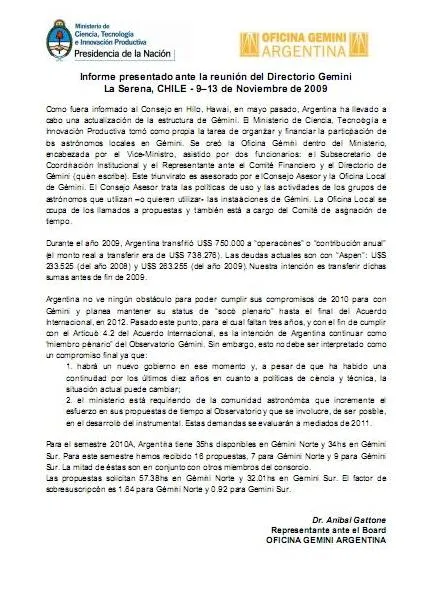
Dr. Anibal Gattone, Representative to the Board, presented a report at the Gemini Board meeting in La Serena, Chile, in November of this year, in which he states:
-That Argentina has carried out an update of the Gemini structure. The Ministry of Science took on the task of organizing and financing the participation of local astronomers in Gemini. The Gemini Office was created within the Ministry, headed by the Vice-Minister, assisted by two officials: the Undersecretary of Institutional Coordination and the Representative to the Committee. This triumvirate is advised by the Advisory Council and the Local Gemini Office. The Advisory Council deals with usage policies and the activities of groups of astronomers who use –or want to use– the Gemini facilities. The Local Office handles calls for proposals and is also in charge of the Time Allocation Committee.
-That during 2009, Argentina transferred US$ 750,000 to "operations" or "annual contribution" (the actual amount to transfer was US$ 738,276). The current debts are with "Aspen":
US$ 233,525 (from 2008) and US$ 263,255 (from 2009). Our intention is to transfer these sums before the end of 2009.
-And that Argentina sees no obstacle to being able to fulfill its 2010 commitments to Gemini and plans to maintain its status as a "full partner" until the end of the International Agreement, in 2012. Beyond this point, it is Argentina's intention to continue as a "full member" of the Gemini Observatory.
OGA Report September 2009
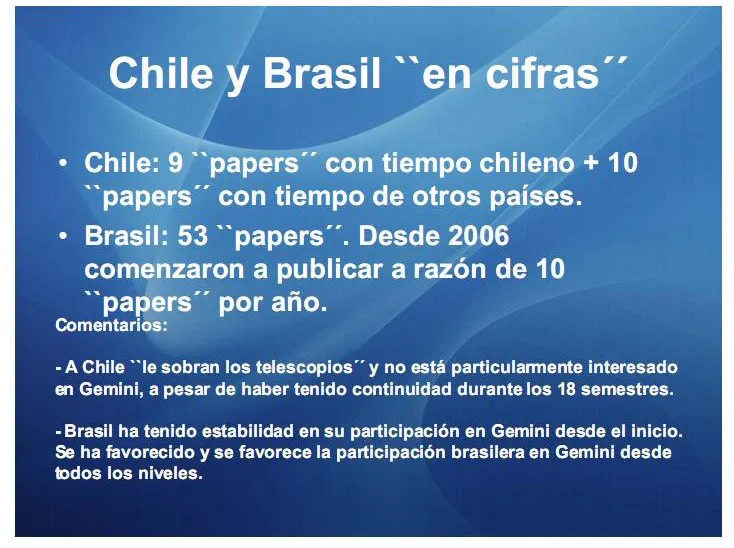
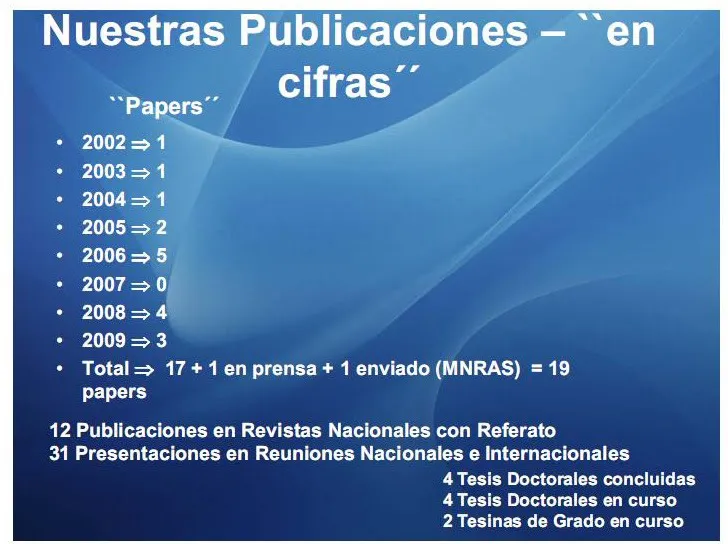
This report details several aspects such as time requested on Gemini North and South, number of papers, comparison with Chile and Brazil, and other indicators. It can be summarized that:
1- Out of the 18 semesters of activity of the Gemini Telescopes, Argentina has been out for 5 semesters (2003A, 2003B, 2004A, 2007B, 2008A), which represents approximately 30% of the useful telescope time. This has the additional consequence of discouraging users who wonder if the effort of submitting proposals is worth it.
2- The first three semesters (2001B, 2002A, 2002B) produced scarce useful data.
In total, 8 out of 18 semesters implies that almost 45% of useful time has been lost.
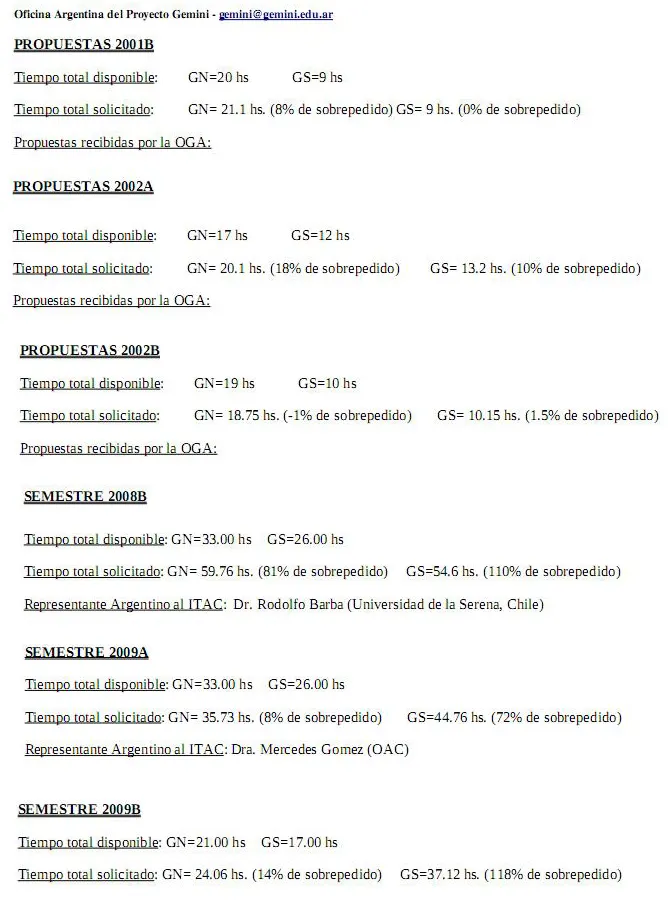
Argentina and its neighbors
Scientific production
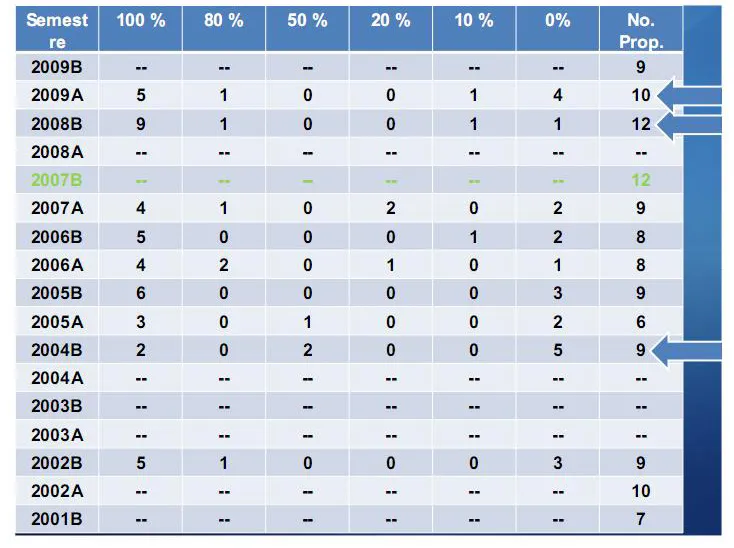
What's next
Workshop on Gemini:
May 2010 – La Plata, probably sponsored by the Asociación Argentina de Astronomía.
Workshop on the use of Gemini instrumental facilities.
How to prepare observation proposals.
Structure of the Project in Argentina.
Members
Executive Secretariat: Undersecretariat of Institutional Coordination - MINCyT Coordination: Dr. Mercedes GOMEZ Technical Secretariat: Dr. Favio FAIFER Dr. Claudio QUIROGA Representative to the Board: Dr. Anibal GATTONE Representative to the Scientific Committee: Dr. Diego Rodolfo GARCIA LAMBAS
Advisory Council
- Dr. Sergio Aldo CELLONE - FACULTAD DE CIENCIAS ASTRONOMICAS Y GEOFISICAS - UNIVERSIDAD NACIONAL DE LA PLATA - IALP
- Dr. Patricia TISSERA - INSTITUTO DE ASTRONOMIA Y FISICA DEL ESPACIO - IAFE
- Dr. Ricardo GIL - HUTTON - COMPLEJO ASTRONOMICO EL LEONCITO - CASLEO
- Dr. María Victoria ALONSO - OBSERVATORIO ASTRONOMICO DE LA UNIVERSIDAD NACIONAL DE CORDOBA
References
- Report to the AAA of June 23, 2008 by Dr. Roberto Oscar Aquilano, Former member of the Gemini Committee
- Report by Hugo Levato on the evolution of Argentine participation in the Gemini Observatory over the last two years (August 2008)
- Gemini Argentina Report 2001 - 2009
Sources and related links
- Oficina Gemini Argentina
- Asociación Argentina de Astronomía
About the images
- Images from the cited reports obtained from the AAA and Gemini pages.