NASA's WISE exploration mission is scheduled for launch on December 11, with the goal of studying asteroids, the coldest and faintest stars, and the most luminous galaxies.
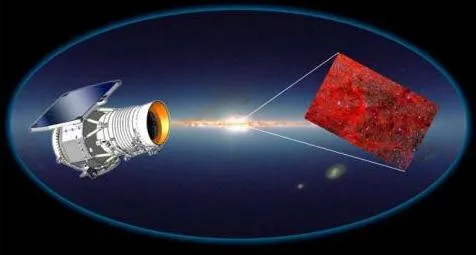
WISE carries a sensitive infrared telescope and will orbit Earth at 525 km. Since our planet also moves around the Sun, after six months the mission will have observed the entire sky.
A special infrared camera will take an image every 11 seconds. Each image will cover an area three times larger than that of the full Moon. After six months WISE will have taken one and a half million images of the entire sky. Each image will have one megapixel for each of the four wavelengths ranging from 5 to 35 times longer than the waves the human eye can perceive. The data will be downloaded via radio transmissions four times a day to computers here on Earth. There they will be combined to form a large atlas of the celestial sphere and a list of detected objects.
The targets
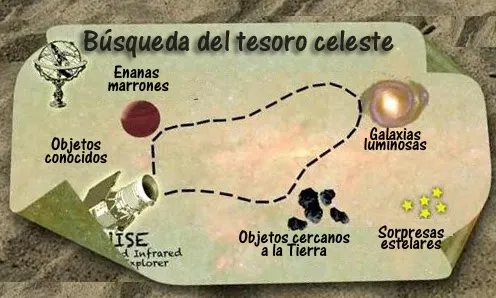
Unlike other current infrared missions, such as Spitzer and Herschel, WISE will observe the entire sky. Its main targets will be, from the closest to the farthest:
- Asteroids and comets: it is expected to find a great many objects near Earth and in the asteroid belt.
- Brown dwarfs: These are gas objects the size of Jupiter, but they do not have enough mass to function as stars. They are cold and faint objects, very difficult to see in visible light. The mission is expected to detect about a thousand objects and if a brown dwarf were hiding closer to Earth than the nearest star (Proxima Centauri), WISE would find it.
- The most distant objects in the telescope's view will be the ultraluminous infrared galaxies (ULIRGs) that shine with the light of millions of suns.
- It will also be able to observe: new stars, debris disks around young stars, a detailed look at the structure of our galaxy, galaxy clusters in the distant universe, and more.
The mission will spend the first month as a checkout period, after which the first cycle of mapping the entire sky will begin, lasting six months. Then, a second partial cycle will be performed, ending at the third month, so this second cycle will observe half the sky. And it will not be able to continue because the spacecraft's hydrogen will run out after nine months.
The data will be released in two stages: a preliminary one at 6 months after the end of the survey, that is, at 16 months after launch; and a more scheduled dataset for 17 months after the end of the survey (27 months from launch).
The spacecraft
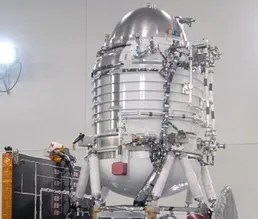
The spacecraft is like a large polar bear, but wider. It measures 2.85 m high, 2 m wide, 1.73 deep and weighs 661 kg.
The instruments include a 40-centimeter diameter telescope and four infrared detectors with one million pixels each, kept cold inside a tank filled with hydrogen. Some think it's like a giant thermos, while others see it as a giant R2-D2 robot.
The launch
If the weather doesn't interfere, WISE is scheduled to launch on December 11 between 6 and 6:30 PST, that is, between 11 and 11:30 in Argentina (15:00 for Spain/9:00 for Colombia) and it can be followed on NASA TV.
Sources and related links
- NASA: Wide-field Infrared Survey Explorer
- WISE Berkeley
- To build a 3D model of WISE
About the images
- Credit: NASA/JPL-Caltech/UCB