The most powerful X-ray observatory was launched into space ten years ago. Since then, its observations have revolutionized the way we see the hottest and most extreme regions of the universe.
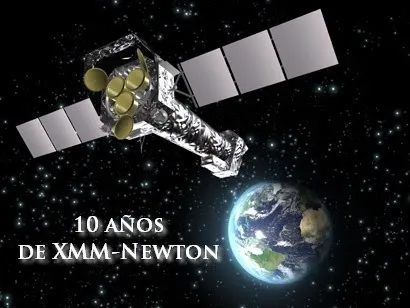
What does XMM-Newton mean?
XMM is an acronym, in English, for X-ray Multi-Mirror, that is multiespejo de rayos-X and its name celebrates the English genius of Sir Isaac Newton.
The satellite was launched on an Ariane 504 on December 10, 1999 from Kourou. The spacecraft is 10 meters long and carries three X-ray telescopes, each of which is composed of 58 thin gold mirrors. The instruments it possesses are the EPIC camera and the RGS spectrometer fed by the three parallel telescopes plus an optical/UV telescope (the Optical Monitor).
X-rays are a form of light that is emitted at very high energies and are naturally produced in extreme environments such as strong gravitational fields or very high-speed collisions. Despite their penetrating power, X-rays are absorbed by the Earth's atmosphere, so, to study cosmic sources of rays it is necessary to launch a telescope into space.
Ten years, ten great achievements
Among the advances produced by the satellite we can mention
1-Crucial observations that impacted every aspect of astronomy
2-Tracing the largest structures in space: galaxy clusters
3-Investigating the regions closest to stellar black holes in our galaxy and the supermassive black hole at the center of galaxies
4-Showing how supermassive black holes grow
5-Measuring the activity of powerful magnetic fields
6-Discovering that Mars has a larger atmosphere than previously thought
7-Having played a role in the study of elusive dark matter
8-Observing X-rays emitted from around Earth and other planets like Jupiter and Saturn
9-Having made the largest catalog of X-ray sources, more than a quarter of a million entries
10-Tracing the production and dispersal of supernova chemical elements
Sources and related links
- XMM-Newton celebrates decade of discovery
- XMM-Newton revolutionizes the way we view the universe
About the images
- Credit: ESA