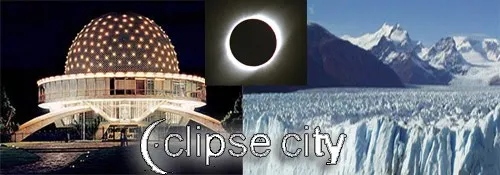
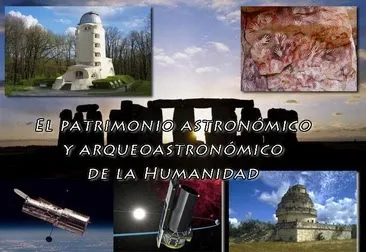
A small guide to astronomical tourism in Argentina.
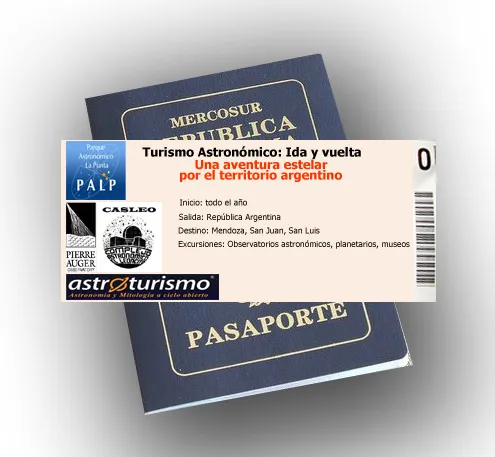
Due to my absolute sedentary lifestyle, the idea of thematic tourism had not occurred to me until I saw the documentary The Story of Maths by Professor Marcus du Sautoy.
(If you haven't seen this series, I recommend it emphatically. You can watch the episodes on YouTube and it is being broadcast again on Canal Encuentro).
From there I began to read about astronomical tourism. The ideal would be to tour the most important astronomical sites of humanity, across all continents, although the amount of money needed would also be astronomical!
It is more feasible, instead, to tour nearby astronomical zones with several points of interest. In Argentina there are several suitable regions. Here I compile available information about some provinces, but it is surely just the tip of the iceberg.
Those readers who have made trips linked to astronomy and wish to contribute their experiences will be welcome.
I do not have data on tourism agencies with specific packages on the subject, but admission to observatories, museums and planetariums is usually very accessible and even free. Thus, we can put together a trip to some area with several points of interest, in the same way we plan a common vacation and, in addition to the various excursions the areas may offer, approach the local telescopes.
What may be necessary, if the planned trip has a special interest in astronomy, is to consider the time of year, both to seek good weather conditions and to ensure that planetariums or observatories are open and conducting guided tours.
Mendoza: among rays, witches and wines
In Malargüe, 422 km from the capital of the Province of Mendoza, is located one of the most important cosmic ray observatories in the world, the Pierre Auger Observatory. But the place also has other points of interest, not only astronomical, let's say scientific, linked to archaeology, paleontology, volcanism.
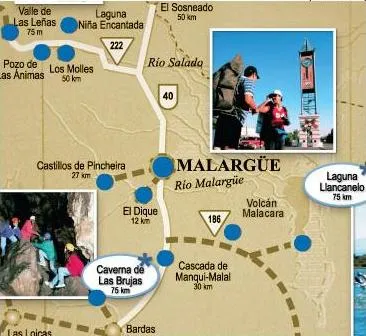
With the incorporation of the Malargüe Planetarium as a new attraction of the scientific tourism product, the tourist offer of the Department is increased and ranked, which in addition to serving tourism becomes a fundamental pillar of the education and culture of the Department.
Another unavoidable site is the Caverna de las Brujas, on Cerro Moncol at 1831 meters above sea level, which proposes an unforgettable journey into geology with the indescribable beauty of stalactite and stalagmite formations.
Furthermore, Mendoza is wine with its Fiesta de la Vendimia.
The Copernicus Institute
The Copernicus Institute, in Rama Caída, participates in the design, scientific and educational direction, as well as in the development and execution of the activities of the "Amauta Pacha Educational Theme Park and Astronomical Observatory Complex", located in the Cañón del Atuel, on the way to the Valle Grande dam, in the department of San Rafael, province of Mendoza, Argentina, operated by Saint Joseph.
Furthermore, the Hotel & Resort Valle Grande (department of San Rafael, province of Mendoza, Argentina) inaugurated, on March 9, 2002, an astronomical observatory which it named B-612, in homage to Antoine de Saint Exupery, who was inspired by the south of Mendoza to write his famous work Wind, Sand and Stars.
More information
Scientific tourism in Malargüe
Information about Malargüe
Karen Travel
Choique Turismo
Copernicus Institute: Amauta Pacha Theme Park and Observatory
The protected skies of San Juan
The province of San Juan is a privileged area of our country for astronomical observation. Legislators have done some homework in this regard, by enacting protection laws, such as the San Juan Provincial Decree Law 4525/79 which created the Astronomical Reserve and the Sky Protection Law 5,771/1 of 1987. And there is a bill in parliamentary process to extend that protection.
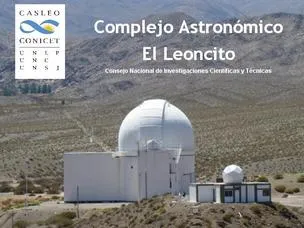
In San Juan we have the El Leoncito Astronomical Complex (CASLEO) which was formally created in May 1983 as a National Service Center for the Astronomical Community.
It was created under the National Council for Scientific and Technical Research (CONICET) with the participation of the National Secretariat of Science and Technology and the National Universities of La Plata, Córdoba and San Juan. Its base instrument is a 215 cm diameter reflecting telescope contributed by the National University of La Plata and named "Jorge Sahade" in honor of the precursor of the initial idea that gave rise to CASLEO.
CASLEO is located in the place called "El Leoncito", in the Calingasta Department of the Province of San Juan, about 40 km from the town of Barreal and facing a geological structure called "Barreal Blanco". It is characterized by great darkness of its night sky, more than 250 cloudless nights per year, almost without wind, and an atmosphere that is generally clear and free of pollution. The water vapor content is also low.
Night Visit to the El Leoncito Astronomical Complex
The service consists of receiving visitors at El Leoncito on the fixed day assigned by turn.
That night the visitor will have a 20 cm Meade telescope and a technician who will assist them to carry out a program previously designed by CASLEO staff, which will allow them to observe some interesting objects that are above the horizon that night. They can observe with the eye and also with an electronic detector where they will save the images and take them away on a floppy disk.
Accommodation with private bathroom, food and a snack on the observation night are provided for that day and night from arrival until they get up the next day.
Carlos Cesco Observatory
The "Félix Aguilar" Astronomical Observatory (OAFA), is a research institute under the Faculty of Exact, Physical and Natural Sciences of the National University of San Juan.
By agreement, it is in charge of the "Dr. Carlos U. Cesco" Astronomical Observatory located in the Calingasta Department, town of Barreal at 2,348 meters above sea level.
Night visits to the OAFA headquarters are held on Mondays, Tuesdays, Thursdays and Fridays at 20:30 h. Request an appointment in advance.
Hugo Mira Visitor Center
The Hugo Mira Visitor Center of the Dr. Carlos U. Cesco Astronomical Station - under the National University of San Juan, offers a different alternative in terms of Scientific Tourism, in the Astronomical field.
The visit consists of a tour of the Interpretation Room of the Center. The guide in charge will comment, in easy-to-understand language, on the different sections that make up the exhibition room, which include: Astronomical News, External Galaxies, Milky Way and Solar System.
Subsequently, the visitor will be invited to enter the dome. Then the tourist will be invited to move to the shelter of the Automatic Meridian Circle, the only instrument of its kind in the country.
More information: Observatorio "Félix Aguilar"
Guíadecabanias.com: Observatorios Astronómicos
TravelSanJuan.com: Circuito del Río
LiveArgentina: Parques Nacionales San Juan
San Luis has top-notch tourism
The Parque Astronómico La Punta (PALP) aims to help teach and learn fundamental concepts of observational astronomy and through it improve knowledge in the natural sciences.
PALP has two planetariums, one fixed and one mobile, an astronomical observatory and the Solar de las Miradas, which is an area where didactic devices were installed for learning basic concepts of observational astronomy.
But, in addition, San Luis has other natural attractions such as the salt desert, Potrero de los Funes, Merlo, El Trapiche, etc.
If we visit some of these places, we must not miss the Mega Sistema Solar. It is a theme park that extends throughout the province of San Luis with the largest representation made to date of our Solar System.
It must be said that in recent years, San Luis has seen the development of sciences boosted through the Universidad de La Punta and with initiatives such as San Luis Coellum and those indicated above, it has positioned itself better than ever for the study and enjoyment of astronomy.
More information:
WelcomeArgentina: Turismo en San Luis
ArgentinaTurismo: San Luis Capital
Gobernación de San Luis: Centros turísticos
Turismo San Luis: Parques de San Luis
Astroturismo
Astroturismo: Astronomy and mythology in the open air, they present a wide variety for the astronomical tourist, such as trips on Buquebús aboard the Eladia Isabel, the Hotel Cañón Talampaya to tour "Las Mil y una estrellas del cielo riojano", astrotourism courses and events, themed birthdays, etc.

Up to this point we have developed some of the astronomical tourist attractions of Argentina, particularly in the Cuyo region which boasts the best conditions for astronomical observation. But other areas of the country allow for tourism and astronomy. Those interested in promoting tourist activities linked to astronomy anywhere in the country, do not hesitate to get in touch with us.
STARLIGHT Certification
Astronomical tourism has evolved so much that a project to certify quality was recently launched. The Starlight Tourism Certification System was created with the aim of promoting, worldwide, the improvement of the quality of tourist experiences and the protection of night skies in Starlight Destinations, visitable places that possess excellent qualities for the contemplation of starry skies and the practice of tourist activities based on that resource. The Starlight Certification seeks to guarantee the ability to enjoy the sight of the stars and to know the associated scientific, cultural, natural and landscape values. The Starlight Certification allows, for the first time, to unite science and tourism, basing on astronomy and the vision of the firmament a new form of intelligent tourism that provides innovative criteria for the responsible development of the activity. At the foundation of the standard's development is the recognition of science as a tourist product and, at the same time, of science as a working methodology in tourism.
More information at: Starlight
Like other activities, tourism can become a powerful instrument to develop a new alliance in favor of the quality of the night sky. Responsible tourism can and must integrate the night sky landscape as a resource to be safeguarded and valued in each destination. The generation of new tourist products based on the observation of the firmament and nighttime phenomena opens up unforeseen possibilities for cooperation between tourism actors, local communities and scientific institutions.
Extract from the Declaration on the Defence of the Night Sky and the Right to Starlight (UNESCO, UNWTO, IAU, IAC; UNEP-CMS, EC, CBD, CoE, MAB Programme and Ramsar Convention).
Sources and related links
- Astronomical tourism practices
- Clarín: A walk through distant galaxies
- Astronomical tourism in Chile
- Astronomical Tourism and Natural Resource Sky
- Astronomical tourism and the International Year of Astronomy 2009
By Prof. Héctor S. Lépez, Teacher Researcher at UNSJ in
Boletín Electrónico Intercambios - September 2008 - Year 7 - Number 44 - Conserving the sky resource through tourism and astronomy
By Gabriela Torre & Yanina Buchiniz, FATU- UNCo-Agreement with UNSJ in Boletín Electrónico Intercambios - September 2008 - Year 7 - Number 44 - Astronomical Tourism in San Luis
- Astronomy in Tucumán
About the images
- Map of Malargüe: http://www.malargue.gov.ar/
Image of CASLEO. Credit: CASLEO
Logo of PALP. Credit: PALP
Logo of Astroturismo. Credit: Astroturismo.com.ar
Image of Starlight Certification. Credit: Starlight2007.net