The open-source launch of an online platform for researchers, HUBzero, which already has several sites dedicated to various disciplines, is announced, for sharing information, educational resources, running simulations and more. Science on the web 2.0.

The platform will be launched as free software for the first time at the HUBbub 2010 workshop in April. HUBzero has been described as a cloud, a content management system and as a Facebook for scientists. In a way, all of that is true, although it is also something more.
It all started with a web infrastructure called PUNCH, developed in 1995 by Purdue University. Scientists could use PUNCH to create a web form that, when completed and submitted, could run batch jobs.
At the time that was revolutionary. But in 2002 it was time to update. So they began working on nanoHUB.org. They wanted to take that PUNCH infrastructure and apply it to the realm of nanotechnology. 'What we were looking for when I joined the project [in 2004] was to reinvent the infrastructure to be more web 2.0,' said Michael McLennan, director of HUBZero.
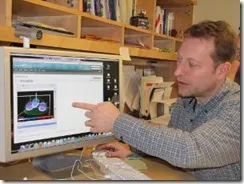
nanoHUB has built-in visualization and graphics capabilities and is connected to larger grids like TeraGrid and Open Science Grid. It was also designed to allow researchers to collaborate with each other by sharing tools, seminars and queries.
Today, nanoHUB has over 100,000 users worldwide. It is used for online meetings, sharing educational resources and tools, running simulations and more.
From that success, HUBzero was born in 2007 to be a generic platform. Since then it has been used to deploy other hubs focused on different areas of science.
Currently, these sites are maintained at a cost. But when it is launched as open source, anyone will be able to try to deploy their own hub.
Behind HUBzero lies virtualization technology that protects users and computing resources from individual user codes. In addition, it incorporates the Rappture toolkit, with which a graphical user interface can be automatically generated.
HUBzero indicates that a hub is a website created with many familiar open-source packages, like a Linux system on Apache, PHP, Joomla and MySQL. This creates an environment in which researchers, educators and students can access tools and share information.
An example?
AQME Advancing Quantum Mechanics for Engineers is a set of tools (toolbox) that when used in concert offer resources for teaching and learning quantum mechanics on nanoHUB. Among the individual resources assembled in AQME are videos, like the one from the popular Dr. Quantum.
Other scientific-social networks
Vivo, from Cornell University; ScienceFeed, microblog for the scientific community; ResearchGATE, which claims to have semantic search (web 3.0); SciLink, very 'Facebook-like'; Academia.edu, to find out who researches what; and although not exactly a social network, Lumifi might qualify: it presents itself as a destination for people whose work, hobby or academic interest requires a lot of reading, research and collaboration.
Sources and related links
- Networking in VIVO, by Virginia Gewin
- Lluís Codina. Science 2.0: Social Networks and Online Applications for Academics [online]. "Hipertext.net", no. 7, 2009. <http://www.hipertext.net/web/pag295.htm> [Consulted: 01/28/110]. ISSN 1695-5498
- ISGTW: Doing science on the hub, by Miriam Boon
About the images
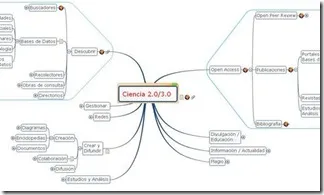
- Codina, Lluís. Science 2.0: Directory and diagram (mind map). Access:http://tinyurl.com/ciencia20
- Michael McLennan demonstrates a visualization tool on nanoHUB. Image: Miriam Boon