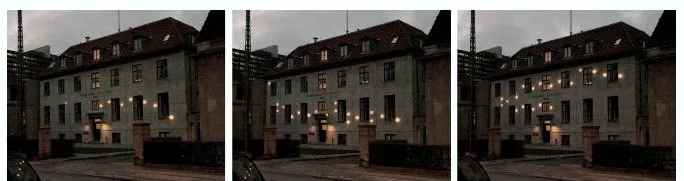
The facade with flashing lights of the Niels Bohr Institute in Copenhagen is not just decorative. They are showing the traces of subatomic particles from an LHC experiment. It's the "colliderscope".
The ATLAS experiment of the Large Hadron Collider consists of protons, traveling almost at the speed of light, which collide and release enormous concentrations of energy that give rise to new particles. The particles generated in this way travel through a detector called TRT (Transition Radiation Tracker) that records the passage of the charged particles as they pass.
That is what the 96 LEDs on the facade of the Bohr Institute reflect, which were named Colliderscope. It is an invention by artists Christian Skeel and Morten Skriver who worked with physicists Clive Ellegaard and Troels C. Petersen.
The lights are produced when a computer program translates the data from the TRT into lights, encoding the information about the particles' energies as differences in the brightness, duration, and frequency of the diodes.
"The work could be seen as a kind of visual translation of the music that sounded at the beginning of the universe," suggests the Colliderscope website, since the experiment at CERN reproduces conditions similar to those that prevailed in the universe shortly after the Big Bang.
The TRT detector consists of 500,000 "little tubes" that give a signal when a charged particle passes. If there are many signals in a row, it means a particle passed and, based on the position, it can be determined where it came from.
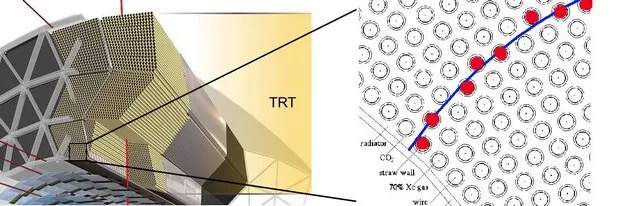
The particles move in a magnetic field which, due to their charge, curves the path of the particles. Those with higher energy curve only a little, while those with lower energy curve more and, depending on their charge, the curve will be to one side or the other.
This way the energy, charge, and origin of the particles can be determined and what happened in the collision can be reconstructed. Furthermore, the TRT can recognize electrons. A potential electron is shown as a bright light that remains on the building's facade for several seconds. Since there are no electrons in the colliding protons, the presence of one implies that something interesting happened that should be examined in depth.
Other interesting traces are those that do not come directly from the proton collisions, represented by less time, so it seems that the lights "move slowly forward", as if they were caterpillars.
The Niels Bohr Institute participated in the design, testing, calibration, and optimization of the TRT detector. Together with the other detectors in the ATLAS experiment, it is hoped they will be capable of finding the famous Higgs boson.
The data that is translated into lights on the facade is not in real time, but it is displayed as quickly as possible.
Video: The Colliderscope in action
http://www.youtube.com/watch?v=jjpyDxuXwH8
I think, by all lights, the facade design is brilliant and I hope the scientists get enlightened and make the expected discoveries. Let's hope the findings -and the Institute's facade- don't shine by their absence...
Sources and related links
- Colliderscope
About the images
- Credit: Niels Bohr Institute.