Next Saturday, February 13, the exoplanet XO-3b will transit its star. Although the phenomenon itself is not spectacular, while it orbits its star in less than 4 days, the planet will be accompanied by an extraordinary event on Earth: a professional telescope will observe the transit and broadcast it live on the web.
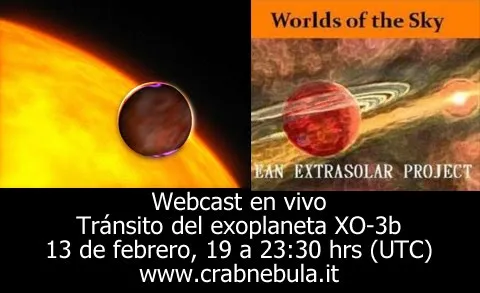
The project is called "Mundos del cielo" ("Worlds of the Sky" in English; "Terre del Cielo" in Italian) after the famous book "Les Terres du ciel" by Camille Flammarion. The event is organized by the Italian observatories of Brera and Palermo in cooperation with several associations of amateur astronomers.
The event will be broadcast live from the site www.crabnebula.it on February 13 (from 19:00 to 23:30 UTC) which will allow us to observe, from all over the world, the evolution of the light curve of the star XO-3 as the planet passes in front of it, monitored by the Ruths Telescope of the Brera Observatory in Merate. The real-time data will be accompanied by comments from astronomers, in English, Italian and Chinese.
The organizers aim to involve students, enthusiasts and teachers in this outreach project and wish for amateurs all over the globe to monitor the event with their own equipment.
The transit of an exoplanet is one of the main techniques used by astronomers to detect planets orbiting other stars different from our Sun, by detecting variations in the star's brightness.
Video: Terre del Cielo
http://www.youtube.com/watch?v=59Wu_zk3W0E
The exoplanet XO-3b is very peculiar. It is a very massive one, almost 12 times more massive than Jupiter (which could be considered almost a brown dwarf) and orbits very close to its star also known as GSC 03727-01064, in the constellation Camelopardalis, the giraffe. The event will last about 170 minutes.
The exoplanet was discovered by the XO Project team. They made the discovery public at the meeting of the American Astronomical Society in Honolulu in 2007. Christopher Johns-Krull, an astronomer at Rice University and presenter of the team's results, said: "This is a really extravagant planet" and explained that its rarity lies in the fact that "It is the largest and most massive planet found so far [in 2007] in such a close orbit, and given the proximity of the orbit to the star, we were surprised that the orbit was not circular but significantly elliptical."
In case the weather does not cooperate, the event will be postponed until February 18 for the observation of the transit of XO-2b. This other exoplanet was already the subject, on March 11 of last year, of a similar event. The activity planned for next week is a continuation of that episode.
A blind man who looks at the sky without understanding it is a traveler who passes through the world without seeing it; he is a deaf man in the middle of a concert.
Camille Flammarion
Sources and related links
- Crabnebula: Project 2009-2010 Worlds of the sky
- The XO Project: Searching for Transiting Extrasolar Planet Candidates
P. R. McCullough, J. E. Stys, J. A. Valenti, S. W. Fleming, K. A. Janes, J. N. Heasley
2005. The Astronomical Society of the Pacific.
DOI: 10.1086/432024 - XO-3b: A Massive Planet in an Eccentric Orbit Transiting an F5V Star
Christopher M. Johns-Krull, Peter R. McCullough, Christopher J. Burke, et al.
arXiv:0712.4283v3 - Rice: XO-3b: Supersized planet or oasis in the 'brown dwarf desert'?
About the images
- Worlds of the sky logo. Credit: www.crabnebula.it
- Illustration of XO-3b. Credit: www.media.rice.edu