The papers from IAU Symposium 264 on solar and stellar variability and its impact on Earth and the planets have been published.
During August of last year, the XVII General Assembly of the International Astronomical Union was held in Brazil.
We mentioned here that researchers from Argentina would participate in the XVII Assembly, on various topics.
As in related articles, the aim of this post is to disseminate the work of Argentine astronomers. Where possible, links were provided to their pages or their curriculum vitae, so we can learn a bit more about each of them.
(Only the institution to which the Argentine researchers belong is indicated).
About the symposium
The Sun is a star that has variations, cycles of different activity that can affect our planet. Understanding that variability is essential. During the last decade, observations have been made at multiple wavelengths, which tremendously increased the amount of new information about the physical processes of the Sun and stars of the same type. Furthermore, the detection of planetary systems around other stars has driven studies to understand the mechanisms of planet formation.
The goal of the three-day IAU symposium 264 was to discuss the most important results from those observations. And the work from those presentations later becomes printed and electronic articles that document in detail the most recent research addressed at that symposium. These annals or proceedings are called "Proceedings", that is, a collection of scientific articles published in the context of an academic conference.
Here I detail the articles in which Argentine astronomers participated:
- Proceedings IAU Symposium No. 264 Solar and Stellar Variability: Impact on Earth and Planets
Eds. Alexandre Andrei, Alexander Kosovichev and Jean-Pierre Rozelot
Cambridge University Press, ISBN 978-0-521-76499-5 - New improvements of HASTA for the analysis of chomospheric solar events
L. Leuzzi (OAFA), C. Francile (OAFA), M. L. Luoni (IAFE), M. Rovira (IAFE) and J. I. Castro (OAFA),pp 93-95
DOI: 10.1017/S1743921309992468
From 1998 to 2006 the HAlpha Solar Telescope of Argentina (HASTA) provided images of the sun to the scientific community with the technological resources available at that time. Since 2007, improvements such as a new ccd camera, automatic focusing system, etc. have been incorporated. These changes were also reflected in the software with a new routine. Currently, the Félix Aguilar Observatory (OAFA) of the University of San Juan has permanent observer staff that now allows for continuous monitoring. It is expected that this will enable more detailed analysis of solar activity. - Study of helicity properties of peculiar active regions
M. C. López Fuentes (IAFE), C. H. Mandrini (IAFE) and P. Démoulin
pp 102-104
DOI: 10.1017/S1743921309992493
Study of the magnetic helicity of complex active regions:
Complex solar active regions (ARs), such as so-called delta islands and other bipolar regions highly inclined relative to the solar equator, are commonly associated with the emergence of deformed magnetic flux tubes. The study of these regions therefore provides valuable information about the origin and evolution of magnetic structures in the solar interior. On the other hand, they are of special interest because they are the ARs that present the highest levels of activity in the form of flares and coronal mass ejections. Using data from the Solar Heliospheric Observatory (SOHO) and the Transition Region and Coronal Explorer (TRACE), in combination with models of the coronal magnetic field, we study the helicity properties of a set of complex ARs. This allows us to infer which physical processes give rise to this type of structure. - The influence of spicules in the solar radius at multiple radio wavelengths
Caius L. Selhorst, Adriana Silva-Válio, Priscila A. Martins, Daiane B. Seriacopi, Pierre Kaufmann and Hugo Levato (ICATE), pp 285-287
DOI: 10.1017/S1743921309992808
This work analyzes observations made with the Itapetinga radio observatory in Brazil and with the Submillimeter-wave Telescope (SST or Solar Submillimeter Telescope, El Leoncito, San Juan, Argentina). - UV habitability and dM stars: an approach for evaluation of biological survival
Ximena C. Abrevaya (IAFE), Eduardo Cortón (UBA) and Pablo J. D. Mauas (IAFE),pp 443-445
DOI: 10.1017/S1743921309993073
This work focuses on analyzing the limits for the development of extraterrestrial life on M dwarf stars. These stars make up about 75% of the stars in the galaxy. For several years, it was ruled out that planets that might orbit these stars could harbor life as we know it. This paradigm is changing and they are now being reconsidered, although the amount of ultraviolet radiation during the flares of these stars could limit the development of life.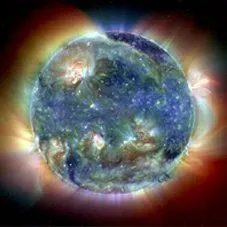
- Observation of non-Gaussianity and phase synchronization in intermittent magnetic field turbulence in the solar-terrestrial environment
Rodrigo A. Miranda, Abraham C.-L. Chian, Sergio Dasso (IAFE), Ezequiel Echer, Pablo R. Muñoz, Nalin B. Trivedi, Bruce T. Tsurutani and Michio Yamada, pp 363-368
DOI: 10.1017/S1743921309992936
Two techniques are applied to analyze measurements from images taken by SOHO MDI, ACE and Cluster and with magnetometers in Brazil, focused on two events from February 2002 and January 2005. - Lower and middle atmosphere and ozone layer responses to solar variation
Ana G. Elias (Universidad Nacional de Tucumán), pp 336-342
DOI: 10.1017/S1743921309992882
The Sun can influence Earth and its climate through variations in electromagnetic radiation and the solar wind. The effects of both mechanisms on the lower and middle atmosphere and on the ozone layer are discussed. - Magnetic energy release: flares and coronal mass ejections
Cristina H. Mandrini (IAFE), pp 257-266
DOI: 10.1017/S1743921309992717
Key observational signs of flares and CMEs on the Sun are described, their magnetic field topology, and it is discussed how the combined analysis of solar and interplanetary observations can be used to constrain the eruption generation mechanism.
Sources and related links
- Proceedings IAU Symposium No. 264
- IAU Symposium No. 264
About the images
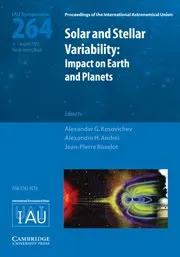
- Cover of the Proceedings. Credit: Cambridge Journals