Greenpeace accompanied the public presentation, at the Argentine National Senate, of the draft Law on Minimum Budgets for the Management of Waste Electrical and Electronic Equipment. The NGO and other civil society organizations collaborated, working for more than two years to reach a consensus text for the law.
Among the main points of the draft law is the establishment of Extended Producer Responsibility, a principle promoted by Greenpeace, which makes producers of these devices legally and financially responsible for them throughout their complete life cycle, from the initial production phase to their final management when their useful life ends. The text of the law also establishes the prohibition of toxic substances in the devices, which is in line with international legislation on the matter.
The Electronic Waste bill was jointly presented by its author, National Senator Daniel Filmus; the Executive Director of the National Institute of Industrial Technology (INTI), Dr. Leila Devia; the Campaigns Director of Greenpeace, Juan Carlos Villalonga; the Executive Director of the Equidad Foundation, Carolina Aniño; the vice president of the Fundación Ambiente y Sociedad, Roberto Felicetti; and the director of the operating company Silkers, Lic. Gustavo Protomastro, among others.
The speed of electronic waste
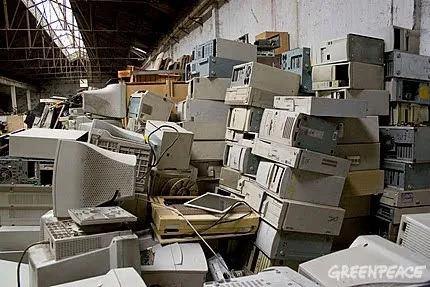
The "boom" in global consumption of electrical and electronic devices has created an explosion in the generation of electronic waste, which contains persistent toxic chemicals in the environment and heavy metals.
Every year, hundreds of thousands of old computers, televisions, batteries, mobile phones, etc., are dumped into open-air dumps, landfills, or are incinerated.
The speed at which this mountain of obsolete electronic products is growing will generate a crisis of enormous proportions unless the corporations in the electronics industry, which profit from manufacturing and selling these devices, assume their responsibility. It is possible to make clean, durable products that are upgradable, recyclable, and easy to manage at the end of their useful life and that do not end up as hazardous waste in dumps and landfills polluting the environment.
Green Electronics Ranking
14th edition - December 2009
Summary of the Report "The fourth Greenpeace Guide to Greener Electronics"
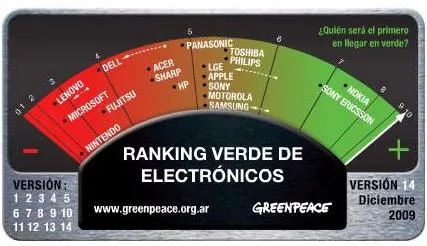
The green electronics ranking reports on the behavior of leading companies in computers, cell phones, televisions, and video game consoles, their global policies and practices for eliminating hazardous chemicals, the responsibility they assume for their products once they have been discarded by consumers, and climate change. The ranking is done according to publicly available information from the companies.
What's inside Electrical and Electronic Equipment (EEE)?
Electronic devices are a complex mixture of hundreds of materials; many contain heavy metals such as lead, mercury, cadmium, and beryllium and hazardous chemicals such as brominated flame retardants. PVC plastic is also a widely used compound. A cell phone, for example, contains between 500 and 1,000 different components.
The solution
Greenpeace believes that manufacturers of electrical and electronic equipment, who benefit from the sale of their products, must assume responsibility for their products until the end of their useful life. To prevent a crisis from the growth of electronic waste, manufacturers must design clean products with a longer lifespan that are safe and easy to recycle and that do not expose workers and the environment to hazardous chemicals.
What is Extended Producer Responsibility?
Extended producer responsibility (EPR) is carried out when producers take responsibility for the environmental impacts of their products throughout the entire life cycle of their product – production, use, and final disposal. Most current EPR programs focus on the end-of-life of the product, its take-back, where the producer becomes physically and/or financially responsible for the management of their product once the customer has discarded it.
Toxic telephony
Currently, there are 4.6 billion subscribers to mobile phone service in the world, and it is expected that by the end of this year they will reach 5 billion. More than 1 billion mobile phone devices are sold each year.
In the last two years, Argentina reached an alarming level of cell phone disposal: almost 10 million mobile phone devices were discarded per year, that is, almost 30% of the current stock of 32.5 million lines in service. In turn, disposal levels increased fourfold in the last five years. If we also consider the 16 million active but unused lines, it can be estimated that the disposal is greater.
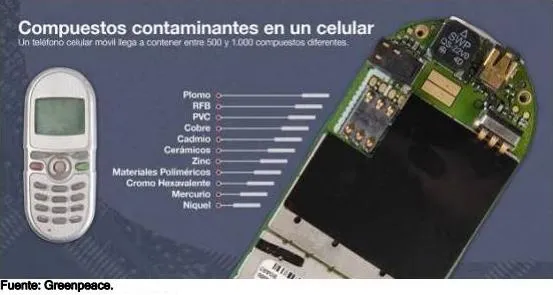
"Rounding figures, almost 30% of the weight of batteries is made up of toxic materials such as Mercury, Cadmium, Nickel, Manganese, Lithium, and Zinc," states Greenpeace in its report "The Toxic Side of Mobile Telephony." These pollutants are inadvertently and uncontrolledly concentrated in the country's landfills and dumps with very serious and poorly documented consequences, reported the NGO and pointed out that, in addition to polluting the environment, there are health dangers.
Sources and related links
Greenpeace: Electronic Waste
Greenpeace backed the Electronic Waste bill
Greenpeace Report: High "Toxic" Tech
About the images
Daniel Filmus and Juan Carlos Villalonga (Campaigns Director of Greenpeace) at the presentation. Credit: Greenpeace / Martín Katz
Green Electronics Ranking. Credit: Greenpeace