It seems this has been a difficult year in terms of earthquakes. Yesterday there was another quake in Taiwan. Are there more earthquakes this year than others and is it related to global warming? Well, it seems NOT.

Kurtis Williams is a researcher in the astronomy department at the University of Texas, Austin and is also a well-known blogger through Professor Astronomy, his web space.
In an entry written yesterday the 26th, he explains why he doesn't believe this year is special or that there is a connection between the number of earthquakes and global warming.
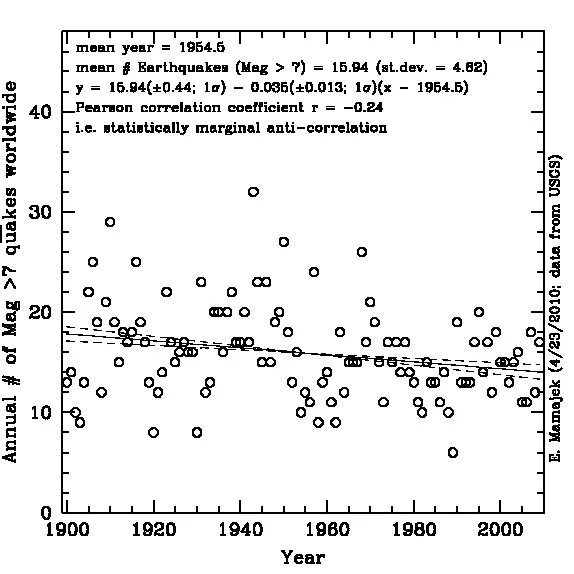
He recounts that a friend of his, Professor Eric Mamajec from the University of Rochester, searched the archives of the United States Geological Survey (USGS) and made some graphs that show there are no significant changes in the number of strong earthquakes (magnitude >7) between 1900 and the year 2000.
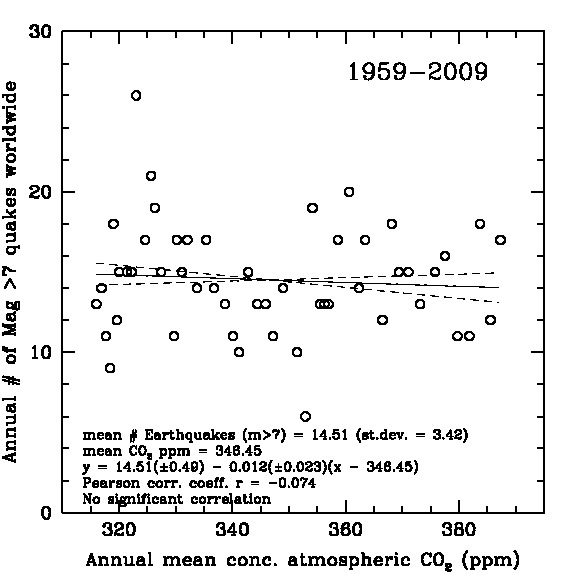
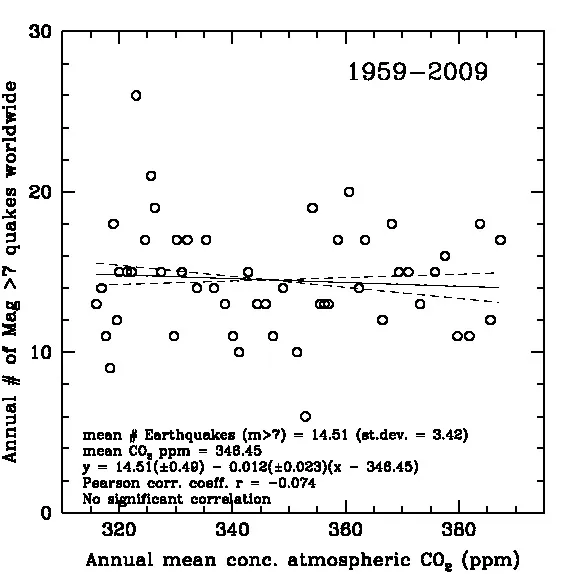
Even, in another graph, the number of strong earthquakes was correlated with the amount of carbon dioxide in the atmosphere (1959-2009).
Then, Williams went a step further and added the total energy released by moderate and strong earthquakes each year since 1990. At first glance there seems to be a trend, but according to the professor, if you remove just two earthquakes, the Chilean one this year and the Indonesian one from 2004, the trend disappears.
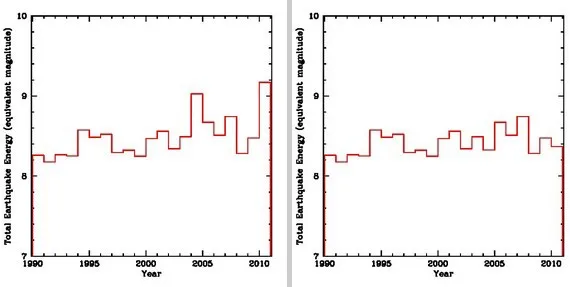
Those two earthquakes were important, but the faults where they are located produced earthquakes before and the graphs contain the aftershocks of those quakes. Williams also corrected the data for this year considering that only a third of the year has passed, otherwise that point would be lower. In summary, both the number and the energy of earthquakes have been essentially constant in the last 20 years.
However, as also happens with other events and all over the world, a catastrophic event generates attention and interest, from which similar events are highlighted more.
There is no shortage of extremists who blame this series of seismic movements on the immorality of women or the idiocy of the end of the world in 2012.
However, some people with some level of authority or credibility, like Alan Weissman, give their opinion on the matter by extrapolating certain data towards unfortunate conclusions.
Weissman wrote a column on CNN in which he blames global warming for the earthquakes and the Iceland volcano, implying that the melting of glaciers and the subsequent redistribution of mass on the planet's surface results in a release of seismic energy.
Geologists, Williams points out, know that the weight of material on the Earth's crust deforms the crust and the upper mantle of the Earth and that this leads to earthquakes. Hawaii is a good example where the massive volcanoes that accumulate rocks cause the big island to sink at a rate of a few inches per year.
The melting of glaciers is known to cause the crust to emerge, a phenomenon known, Williams notes, as post-glacial crustal rebound or glacial isostatic adjustment. This is supposed to occur slowly, but it has been suggested, Williams indicates in his post, that it could occur on shorter time scales, perhaps a thousand years in the case of Iceland's volcanoes. But global warming due to human activity has occurred on a much smaller scale, in the last hundred years. It is a bit premature to blame this year's earthquakes (whose energy release is normal as noted earlier) and the eruption of the Icelandic volcano on global warming.
In short, at least so far, "There is NO connection!".
This does not mean that it is possible to relate some earthquakes to others, in what are called "aftershocks" that occur in the same fault system.
Weissmann points out in his CNN article: "The Earth shudders in Haiti. Then Chile. Then western China. Mexicali-Calexico. The Solomon Islands. Spain. New Guinea. And those are just the six largest, over 6 magnitude on the Richter scale, and only in 2010. And it's only April." Faced with this, one might worry, although Williams's post, however, points in the opposite direction: there is nothing strange about this year, the number is no greater than previous years and there is no correlation that can be established between the different earthquakes that occurred in different parts of the world, except for those that are in the same fault system.
To not just stay with two opposing views, let's look at the numbers:
On the USGS facts and statistics page we find that based on observations since 1900, only 1 earthquake of magnitude 8 or greater occurs, on average per year. And that 15 earthquakes between 7 and 7.9 are generated, data updated with data from the centennial catalog (1900-1999).
And for magnitudes between 6 and 6.9, guess: 134.
For the range 5 to 5.9, guess: 1319.
Bet you can't guess this one, how many earthquakes on average per year for the magnitude range 4-4.9 (estimated value)?
13,000, thirteen thousand earthquakes, on average, per year. Have you ever read in the press about more than a hundred earthquakes? I don't think so. And not because they don't happen, but because they are not of interest, either because they happen far away from you or because they don't cause major damage (magnitude is a measure of their danger, but aspects like the infrastructure of the place, prevention systems, etc., play a predominant role).
On that same page we can see what these magnitudes mean in terms of ground displacement and energy change. For each point of magnitude, the displacement is 10 times greater and the energy released is 32 times larger.
For example, for a 7.2 magnitude earthquake, there is 10 times more ground movement than for a 6.2, but 32 times more energy is released.
Below, on the same page we have the number of earthquakes worldwide from 2000 to 2010, broken down by magnitude ranges.
For the magnitude range 7 to 7.9, last year there were 16 (did you read about the 16 in the press?). This year, 5 (I think I read about all of them in the press!).
For the previous range: 142 in 2009, 64 this year.
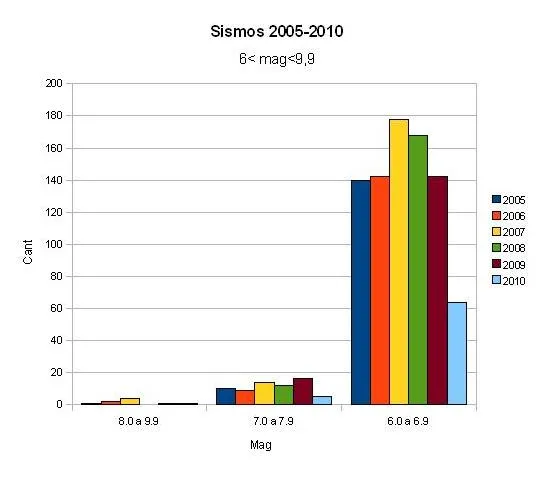
The centennial catalog is available for download in different formats (rtf, cat, xls, pdf).
So more than panicking, I think we should inform ourselves. It's not that the press shouldn't report. On the contrary, it should. But aiming to be objective. If last year one or two earthquakes were reported and so far this year six or seven are already being publicized, it can generate concern. Unnecessary, if it is explained properly.
A good source to start informing ourselves could be the page of the Instituto Nacional de Prevención Sísmica de Argentina, in San Juan (INPRES). There we can see by consulting recent data, for example, that in our country, so far in April, 8 earthquakes occurred.
Sources and related links
Earthquakes, volcanoes, global warming, and bad science
About the images
Graph images: Kurtis Williams, Eric Mamajek, USGS.
Last graph: USGS.
Earthquake illustration. Palo Alto Medical Foundation.