A work in which two Argentine astronomers participated earned the cover of the prestigious journal Astronomy & Astrophysics in the September volume, upon publishing the detection of light echoes from irregular variable stars.
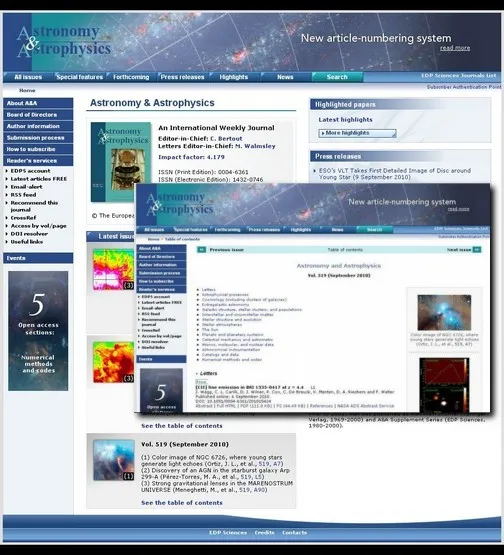
Although the research was published in the September issue of the famous scientific publication, we had not had the opportunity to comment on it here.
The objective of the astronomers' work was to present new results based on observations made over three months of NGC 6726 using the remote telescope at Cerro Burek.
Light echoes were detected around two young irregular variable stars. These echoes can be produced when the light pulse from an astronomical source is scattered by dust. If the direction in which it is scattered is towards Earth and the pulse is sufficiently intense, an echo can be observed from here. The conditions required for the observation of these light echoes make them rare phenomena, valuable not only as a phenomenological curiosity, but they can also provide data on the three-dimensional and chemical structure of interstellar environments around variable sources.
What the astronomers present are faint echoes from two young variable stars, a Herbig Ae/Be star called R CrA and a T Tauri star S CrA. The name comes from their location in the constellation Corona Australis.
As part of the southern hemisphere sky survey carried out by the Complejo Astronómico El Leoncito (CASLEO) in Argentina, a field containing the reflection nebula NGC 6726 was observed twice, with a month between observations.
The research included: J. L. Ortiz (Instituto de Astrofísica de Andalucía, IAA), B. E. K. Sugerman (Baltimore), I. de la Cueva (Astroimagen), P. Santos-Sanz (IAA-Observatoire de Paris), R. Duffard (IAA), R. Gil-Hutton (CASLEO-CONICET), M. Melita (IAFE-CONICET) and N. Morales (IAA). In bold I highlight the Argentine astronomers.
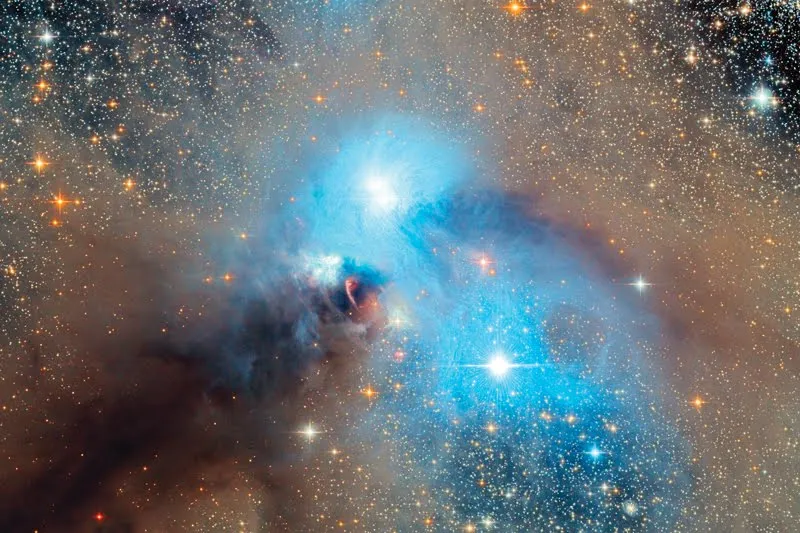
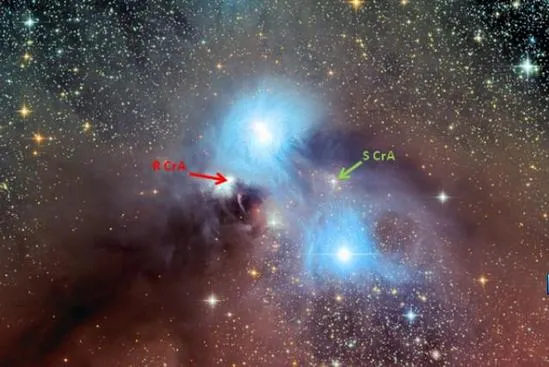
"Light echoes show a cosmos more dynamic than usual -points out José Luis Ortiz, researcher at the Instituto de Astrofísica de Andalucía (IAA-CSIC) responsible for the research to Plataforma Sinc-. In the optical range we are used to seeing wonderful images of certain parts of the universe, but they normally maintain a fixed morphology. However, what we see in the movie we have composed is a changing nebula with zones that apparently expand."
R CrA is located 500 light-years from Earth and on this star a rapid variability in brightness had already been detected in 1989 (see Graham & Phillips)
However, the phenomenon had never been recorded in the case of S CrA, a T Tauri star.
Below I link an entry in the blog Capturando el universo by I. Cueva, one of the Spanish researchers, with additional information about the study and the image shown here.
Video: Light echoes around two very young stars
http://www.youtube.com/watch?v=S3pdegmwidI
About the Argentine astronomers
Mario Daniel Melita is a Licenciado en Ciencias Físicas from the Universidad Nacional de Buenos Aires and holds a doctorate in Astronomy from the University of York, England, and was "famous" back in 2002 for work done together with Adrián Brunini about a new planet in the solar system.
See: Argentine scientists provide clues about a tenth planet
BBC: Does the tenth planet exist?
Ricardo Gil-Hutton obtained his Doctorate in astronomy from the Universidad Nacional de La Plata and his Licenciatura from the Universidad de San Juan. In 2007, the IAU Committee for Small Body Nomenclature named an asteroid in his honor: 4878 Gilhutton (1968 OF).
Sources and related links
- Observation of light echoes around very young Stars
Ortiz, J. L.; Sugerman, B. E. K.; de La Cueva, I.; Santos-Sanz, P.; Duffard, R.; Gil-Hutton, R.; Melita, M.; Morales, N.
Astronomy and Astrophysics, Volume 519, id.A7.
DOI: 10.1051/0004-6361/201014438
arXiv:1007.2556v2 - Light echoes observed around very young stars
- I.Cueva: Three months in the life of the stars s and r corona australis
About the images
- Images from J. L. Ortiz et al A&A 2010,
- Screenshot of Astronomy & Astrophysics.