About a new study by two Argentine astrophysicists regarding cosmological parameters from the Planck Satellite.
I recently alluded to the work of H. J. de Vega and Norma G. Sánchez in New Argentine articles (October 2010).
There I cited the article Forecast for the Planck precision on the tensor to scalar ratio and other cosmological parameters published in Astrophysical Journal (volume 724, number 1).
When I write those notes I don't always stop to summarize each work. I do download the papers (when possible) and try to read them, although in some cases it is really complex. But the intention is, at least, to know who the professionals doing research in astronomy are, what institutions they belong to, and what topics they develop.
It had been a while since I talked about cosmology here. That's why, although the topic is difficult to address, I would like to try to explain what this work is about and what its importance is.
Let's say, first of all, that cosmology (physical, not philosophical or religious, sometimes called cosmogony) is a branch of astrophysics that emerged from 1915, with the General Theory of Relativity and gained notable momentum from hypotheses (Steady State Model, Big Bang, Primordial Nucleosynthesis) and, in particular, from the discovery of the cosmic microwave background radiation.
The standard cosmological model or conventional one is a set of ideas that have support in many observations, but which also has its "gaps" and its detractors.
The Big Bang hypothesis, by itself, as originally postulated, not only did not answer the questions about the origin of the cosmos, but complicated them even more. A proposed solution was the idea of cosmic inflation (not verified), but many questions still remain.
The vital discovery in this matter seems to be the famous CMB (acronym in English for cosmic microwave background).
For the study of this radiation that seems to bathe everything and be too homogeneous (isotropic), the COBE probe and the WMAP satellite were first launched.
Then, in May 2009, an even more sensitive satellite was launched, Planck, to measure the anisotropies of the CMB with greater precision.
What the two researchers from the Paris Observatory do is evaluate the precision of cosmological parameters expected from Planck's data and they use two relevant models:
The Lambda-CDM Model and the Lambda-CDMrT variant. The first refers to a cold dark matter model, that is, matter that does not move at high temperatures, like the proposed WIMPs. It is often said that it is the simplest, most elegant model and that it fits observational data.
Λ (lambda) indicates the cosmological constant as part of a dark energy term that allows knowing the current value of the acceleration of the expansion of the Universe.
Parameters of the Standard Cosmological Model
General Relativity allows a set of solutions. This is because it is necessary to use parameters that can only be obtained experimentally, by measuring them.
There are six parameters, from which other derived ones can be calculated. The values of these parameters will result in the universe being one shape or another.
That is why measuring them is of vital importance to support or refute the current model. Hence the relevance of this work.
THE TWO PRIMORDIAL NUMBERS
Researchers Héctor José de Vega and Norma Sánchez make a forecast of the Planck satellite's precision on some cosmological parameters.
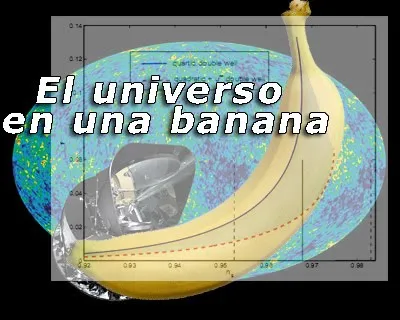
In this context, the origin of the universe (13,700 million years ago) depended on two crucial and measurable numbers today: they are the parameters called r and ns (the initial numbers), where r (Tensor-to-scalar Ratio) describes the amount of the initial waves that gave rise to space and time (primordial gravitational waves) and ns (Scalar spectral index) characterizes the clumps (or "seeds") that gave origin to matter and later formed galaxies, planets, and today's universe. All the values of these two numbers r and ns are encapsulated in a "banana"-shaped region.
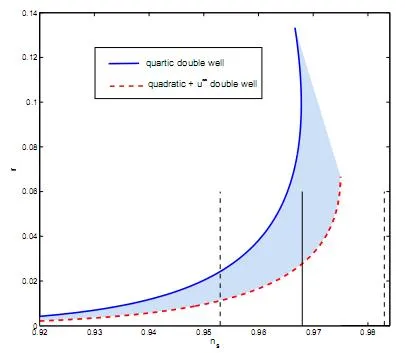
Sánchez and de Vega, together with Italian scientists from the Planck satellite team (from the European Space Agency and the Italian Space Agency) forecast that the value of the number r that the satellite will be able to find will be between 0.028 and 0.116 with the most probable value 0.04, and that for the number ns the value will be 0.9608.
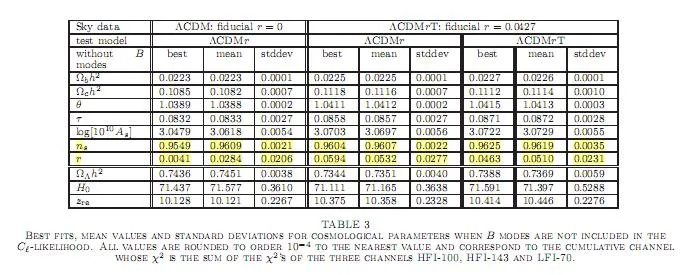
If the Planck satellite finds these numbers, it will truly be a very important verification in the history of the Universe.
And as Sánchez and de Vega explain simply: "These two numbers open the doors to the origin of the Universe".
We talked about these researchers before, in:
"Argentines after the mass of dark matter",
"Two Argentines closer to the origin of the cosmos",
"Two Argentines limit the inflation of the Universe".
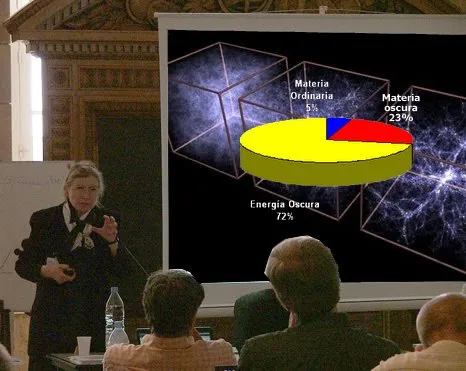
Professor Dr. Sánchez is the director of the "Daniel Chalonge" school and museum at the Paris Observatory. Dr. Sánchez was proposed with a GEN bill as an illustrious citizen of the Province of Buenos Aires.
The fact of thinking of the universe as "born from a banana" is clearly just an analogy from the previous graph. An analogy that in this case does not have a popularizing or clarifying value, as it does in other cases.
But I took it because a few days ago our friend Alejandro Tropea was illustrating us about Newton's banana and Uchronia. Again, in a different context, the banana, due to its curvature, alluding to the universe.
In The Laughter of Science, Alejandro not only steals a smile from me, but also allows us to know terms or facts that perhaps we didn't know. I always recommend it.
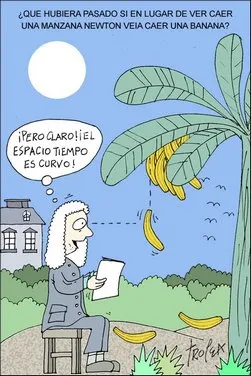
And, in a way, astrophysicists seem to try to "peel" that cosmic banana, although perhaps it will end up being an onion of infinite fractal layers...
Sources and related links
- Forecast for the Planck precision on the tensor to scalar ratio and other cosmological parameters
C. Burigana, C. Destri, H. J. de Vega, A. Gruppuso, N. Mandolesi, P. Natoli, N. G. Sanchez
ApJ, Volume 724, Number 1
DOI: 10.1088/0004-637X/724/1/588
arXiv:1003.6108v2
About the images
- Initial image: CMB (credit: NASA) with the graph from Burigana et al.
- Graph and table from Burigana et al, ApJ, 2010.
- Newton's banana, Credit: Alejandro Tropea