Next week a conference on "The astronomical system of Aristotle" will be held at the AAAA, while at IAFE a talk on "The physics of astrophysics" will be given.
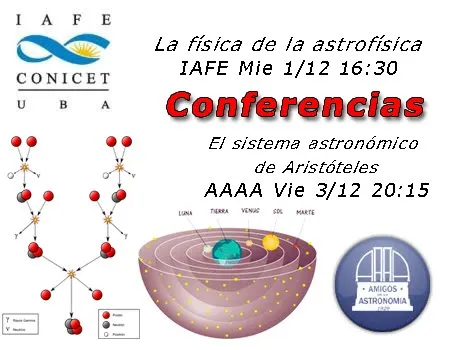
From IAFE they invite you to the last Public Talk of 2010, which as usual does not require prior registration.
“The Physics of Astrophysics”
Dr. Daniel Gómez, CONICET Researcher and UBA Professor
Wednesday, December 1st, 2010, at 16:30 h
IAFE Building Auditorium - Ciudad Universitaria
Astrophysics is the branch of Astronomy that studies the Physics of the Universe. Astrophysics is a relatively recent discipline, but Astronomy is as old as writing. However, in its origin, Astronomy was completely separate from Physics. In Aristotle's time, Astronomy was the study of celestial objects, inaccessible and perfect, while Physics was the study of terrestrial phenomena, concrete and imperfect.
Since then, Physics has advanced considerably, allowing a detailed knowledge of the laws of Mechanics, Electromagnetism, Thermodynamics, and atomic and nuclear structure, among others. In the talk we will see examples of astrophysical problems, which show how from fundamental laws of Physics it is possible to know the properties of astronomical objects that are inaccessible to us.
Conference at AAAA
From the Asociación Argentina Amigos de la Astronomía they invite you to the conference "The astronomical system of Aristotle", given by Lic. Gerardo Botteri (UTN) and Prof. Mgter. Roberto Casazza (UBA - UNR).
It will be held on Friday, December 3, 2010, at 20:15 h, at its headquarters (Av. Patricias Argentinas 550).
The astronomical system of Aristotle
Lic. Gerardo Botteri (UTN)
Prof. Mgter. Roberto Casazza (UBA - UNR)
Friday, December 3 - 20:15 h.
The astronomical system of Aristotle, composed of 55 concentric spheres, is based on the astronomical systems of Eudoxus (26 spheres) and Callippus (33 spheres), astronomers of the 4th century BC. All these systems seek to account for the apparent motions of the sky –which they achieve in some cases with great precision, as will be illustrated through various comparative calculations–. The operation of such systems assumes the fixing of the axes of the inner spheres at a certain angle relative to the axes of the outer ones, while all spheres rotate on their respective axes with regular speed, although in different directions. Only some of these spheres, the innermost of each planetary group of spheres, carry the planets fixed on their surface.
The Greek geometer-philosophers managed through such models to explain (and calculate) the wandering motions of the planets. However, while the systems of Eudoxus and Callippus are eminently geometric, offering a kinematic consideration of the problem of celestial motions, Aristotle attempts a remarkable sui generis mechanical integration, which forces him to increase the number of spheres of his predecessors by inserting anti-rotating spheres to cancel the superposition of certain motions present, in his judgment, in the systems of Eudoxus and Callippus.
The presentation will succinctly present the systems of these three thinkers, and will devote special attention to some aspects of Aristotelian physics and metaphysics relevant to understanding the doctrine of the First Unmoved Mover, which Aristotle characterizes as pure act, considering it divine, eternal, unalterable and immaterial. This First Unmoved Mover moves as an object of love the first heaven (the sphere of the fixed stars) eternally, thus its perfect actuality being the ultimate cause of all supralunar and sublunar motions.
Sources and related links
- Instituto de Astronomía y Física del Espacio, IAFE, (CONICET-UBA)
- Conferences at AAAA
About the images
- Logos of IAFE and AAAA.
- Images of classical astronomy and solar fusion. Credits: letraherido and Wikipedia.